Category: Ramadan

  • Al-Siyaam70 Matters Related to FastingBook by Sheikh Muhammed Salih Al-Munajjid

    1. Introduction
    2. definition of Siyaam (fasting)
    3. Ruling on fasting
    4. The virtues of fasting
    5. The benefits of fasting
    6. Etiquette and Sunnah of fasting
    7. What should be done during this great month
    8. Some of the ahkaam (rulings) on fasting
    9. How the onset of Ramadaan is determined
    10. Who is obliged to fast?
    11. Travellers
    12. The sick
    13. The elderly
    14. Niyyah (intention) in fasting
    15. When to start and stop fasting
    16. Things that break the fast
    17. Rulings on fasting for women


    Introduction

    Praise be to Allaah, we praise Him and seek His help and forgiveness. We seek refuge with Allaah from the evil of our own selves and from our evil deeds. Whomsoever Allaah guides cannot be misled, and whomsoever He leaves astray cannot be guided. I bear witness that there is no god except Allaah alone, with no partner or associate, and I bear witness that Muhammad is His slave and Messenger.

    Allaah has blessed His slaves with certain seasons of goodness, in which hasanaat (rewards for good deeds) are multiplied, sayi’aat (bad deeds) are forgiven, people’s status is raised, the hearts of the believers turn to their Master, those who purify themselves attain success and those who corrupt themselves fail. Allaah has created His slaves to worship Him, as He says (interpretation of the meaning): “And I (Allaah) created not the jinns and humans except that they should worship Me (Alone).” [al-Dhaariyaat 51:56]

    One of the greatest acts of worship is fasting, which Allaah has made obligatory on His slaves, as He says (interpretation of the meaning):“… Observing al-sawm (the fasting) is prescribed for you as it was prescribed for those before you, that you may become al-muttaqoon (the pious).” [al-Baqarah 2:183]

    Allaah encourages His slaves to fast:“… And that you fast, it is better for you, if only you know.” [al-Baqarah 2:184 – interpretation of the meaning]

    He guides them to give thanks to Him for having made fasting obligatory on them:“… that you should magnify Allaah for having guided you so that you may be grateful to Him.” [al-Baqarah 2:185 – interpretation of the meaning]

    He has made fasting dear to them, and has made it easy so that people do not find it too hard to give up their habits and what they are used to. Allaah says (interpretation of the meaning):“… for a fixed number of days…” [al-Baqarah 2:184]

    He has mercy on them and keeps them away from difficulties and harm, as He says (interpretation of the meaning:“… but if any of you is ill or on a journey, the same number (should be made up) from other days…” [al-Baqarah 2:184]

    No wonder then, that in this month the hearts of the believers turn to their Most Merciful Lord, fearing their Lord above them, and hoping to attain His reward and the great victory (Paradise).

    As the status of this act of worship is so high, it is essential to learn the ahkaam (rulings) that have to do with the month of fasting so that the Muslim will know what is obligatory, in order to do it, what is haraam, in order to avoid it, and what is permissible, so that he need not subject himself to hardship by depriving himself of it.

    This book is a summary of the rulings, etiquette and Sunnah of fasting. May Allaah make it of benefit to myself and my Muslim brothers. Praise be to Allaah, Lord of the Worlds.


    Definition of Siyaam (fasting)

    (1) Siyaam in Arabic means abstaining; in Islam it means abstaining from things that break the fast, from dawn until sunset, having first made the intention (niyyah) to fast.

    Ruling on fasting

    (2) The ummah is agreed that fasting the month of Ramadaan is obligatory, the evidence for which is in the Qur’aan and Sunnah. Allaah says (interpretation of the meaning):“O you who believe! Observing al-sawn (the fasting) is prescribed for you as it was prescribed for those before you, that you may become al-muttaqoon (the pious).” [al-Baqarah 2:183]

    The Prophet (peace and blessings of Allaah be upon him) said: “Islam is built on five [pillars]…” among which he mentioned fasting in Ramadaan. (Reported by al-Bukhaari, al-Fath, 1/49). Whoever breaks the fast during Ramadaan without a legitimate excuse has committed a serious major sin, The Prophet (peace and blessings of Allaah be upon him) said, describing a dream that he had seen: “… until I was at the mountain, where I heard loud voices. I asked, ‘What are these voices?’ They said, ‘This is the howling of the people of Hellfire.’ Then I was taken [to another place], and I saw people hanging from their hamstrings, with the corners of their mouths torn and dripping with blood. I said, ‘Who are these?’ They said, ‘The people who broke their fast before it was the proper time to do so,’ i.e., before the time of iftaar.” (Saheeh al-Targheeb, 1/420).

    Al-Haafiz al-Dhahabi (may Allaah have mercy on him) said, “Among the believers it is well-established that whoever does not fast in Ramadaan without a valid excuse is worse than an adulterer or drunkard; they doubt whether he is even a Muslim at all, and they regard him as a heretic and profligate.” Shaykh al-Islam [Ibn Taymiyah] (may Allaah have mercy on him) said: “If a person does not fast in Ramadaan knowing that it is haraam but making it halaal for himself to do so, kill him; and if he does it because he is immoral [but believes it is haraam], then punish him for not fasting.” (Majmoo’ al-Fataawa, 25/265).


    The virtues of fasting

    (3) The virtues of fasting are great indeed, and one of the things reported in the saheeh ahaadeeth is that Allaah has chosen fasting for Himself, and He will reward it and multiply the reward without measure, as He says [in the hadeeth qudsi]: “Except for fasting which is only for My sake, and I will reward him for it.” (al-Bukhaari, al-Fath, no. 1904; Saheeh al-Targheeb, 1/407). Fasting has no equal (al-Nisaa’i, 4/165; Saheeh al-Targheeb, 1/413), and the du’aa’ of the fasting person will not be refused (reported by al-Bayhaqi, 3/345; al-Silsilat al-Saheeh, 1797). The fasting person has two moments of joy: one when he breaks his fast and one when he meets his Lord and rejoices over his fasting (reported by Muslim, 2/807). Fasting will intercede for a person on the Day of Judgement, and will say, “O Lord, I prevented him from his food and physical desires during the day, so let me intercede for him.” (Reported by Ahmad, 2/174. Al-Haythami classed its isnaad as hasan in al-Majma’, 3/181. See also Saheeh al-Targheeb, 1/411). The smell that comes from the mouth of a fasting person is better with Allaah than the scent of musk. (Muslim, 2/807). Fasting is a protection and a strong fortress that keeps a person safe from the Fire. (Reported by Ahmad, 2/402; Saheeh al-Targheeb, 1/411; Saheeh al-Jaami’, 3880). Whoever fasts one day for the sake of Allaah, Allaah will remove his face seventy years’ distance from the Fire. (Reported by Muslim, 2/808). Whoever fasts one day seeking the pleasure of Allaah, if that is the last day of his life, he will enter Paradise. (Reported by Ahmad, 5/391; Saheeh al-Targheeb, 1/412). In Paradise there is a gate called al-Rayyaan, through those who fast will enter, and no one will enter it except them; when they have entered it will be locked, and no-one else will enter through it.” (al-Bukhaari, Fath, no. 1797).

    Ramadaan is a pillar of Islam; the Qur’aan was revealed in this month, and in it there is a night that is better than a thousand months. “When Ramadaan begins, the gates of Paradise are opened and the gates of Hell are closed, and the devils are put in chains.” (Reported by al-Bukhaari, al-Fath, no. 3277). Fasting Ramadaan is equivalent to fasting ten months (See Musnad Ahmad, 5/280; Saheeh al-Targheeb, 1/421). “Whoever fasts Ramadaan out of faith and with the hope of reward, all his previous sins will be forgiven.” (Reported by al-Bukhaari, Fath, no. 37). At the breaking of every fast, Allaah will choose people to free from Hellfire. (Reported by Ahmad, 5/256; Saheeh al-Targheeb, 1/419).


    The benefits of fasting

    (4) There is much wisdom and many benefits in fasting, which have to do with the taqwa mentioned by Allaah in the aayah (interpretation of the meaning):“… that you may become al-muttaqoon (the pious).” [al-Baqarah 2:183]

    The interpretation of this is that if a person refrains from halaal things hoping to earn the pleasure of Allaah and out of fear of His punishment, it will be easier for him to refrain from doing haraam things.

    If a person’s stomach is hungry, this will keep many of his other faculties from feeling hunger or desires; but if his stomach is satisfied, his tongue, eye, hand and private parts will start to feel hungry. Fasting leads to the defeat of Shaytaan; it controls desires and protects one’s faculties.

    When the fasting person feels the pangs of hunger, he experiences how the poor feel, so he has compassion towards them and gives them something to ward off their hunger. Hearing about them is not the same as sharing their suffering, just as a rider does not understand the hardship of walking unless he gets down and walks.

    Fasting trains the will to avoid desires and keep away from sin; it helps a person to overcome his own nature and to wean himself away from his habits. It also trains a person to get used to being organized and punctual, which will solve the problem that many people have of being disorganized, if only they realized.

    Fasting is also a demonstration of the unity of the Muslims, as the ummah fasts and breaks its fast at the same time.

    Fasting also provides a great opportunity for those who are calling others to Allaah. In this month many people come to the mosque who are coming for the first time, or who have not been to the mosque for a long time, and their hearts are open, so we must make the most of this opportunity by preaching in a gentle manner, teaching appropriate lessons and speaking beneficial words, whilst co-operating in righteousness and good deeds. The dai’yah should not be so preoccupied with others that he forgets his own soul and becomes like a wick that lights the way for others while it is itself consumed.


    Etiquette and Sunnah of fasting

    Some aspects are obligatory (waajib) and others are recommended (mustahabb).

    We should make sure that we eat and drink something at suhoor, and that we delay it until just before the adhaan of Fajr. The Prophet (peace and blessings of Allaah be upon him) said: “Have suhoor, for in suhoor there is blessing (barakah).” (Reported by al-Bukhaari, Fath, 4/139). “Suhoor is blessed food, and it involves being different from the people of the Book. What a good suhoor for the believer is dates.” (Reported by Abu Dawood, no. 2345; Saheeh al-Targheeb, 1/448).

    Not delaying iftaar, because the Prophet (peace and blessings of Allaah be upon him) said: “The people will be fine so long as they do not delay iftaar.” (Reported by al-Bukhaari, Fath, 4/198).

    Breaking one’s fast in the manner described in the hadeeth narrated by Anas (may Allaah be pleased with him): “The Prophet (peace and blessings of Allaah be upon him) used to break his fast with fresh dates before praying; if fresh dates were not available, he would eat (dried) dates; if dried dates were not available, he would have a few sips of water.” (Reported by al-Tirmidhi, 3/79 and others. He said it is a ghareeb hasan hadeeth. Classed as saheeh in al-Irwa’, no. 922).

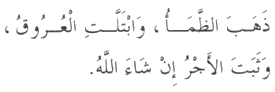
    After iftaar, reciting the words reported in the hadeeth narrated by Ibn ‘Umar (may Allaah be pleased with them both), according to which the Prophet (peace and blessings of Allaah be upon him), when he broke his fast, would say: “Dhahaba al-zama’, wa’btallat al-‘urooq, wa thabat al-ajru in sha Allaah (Thirst is gone, veins are flowing again, and the reward is certain, in sha Allaah).” (Reported by Abu Dawood, 2/765; its isnaad was classed as hasan by al-Daaraqutni, 2/185).

    Keeping away from sin, because the Prophet (peace and blessings of Allaah be upon him) said: “When any of you is fasting, let him not commit sin…” (Reported by al-Bukhaari, al-Fath, no. 1904). The Prophet (peace and blessings of Allaah be upon him) said: “Whoever does not stop speaking falsehood and acting in accordance with it, Allaah has no need of him giving up his food and drink.” (Al-Bukhaari, al-Fath, no. 1903). The person who is fasting should avoid all kinds of haraam actions, such as backbiting, obscenity and lies, otherwise his reward may all be lost. The Prophet (peace and blessings of Allaah be upon him) said: “It may be that a fasting person gets nothing from his fast except hunger.” (Reported by Ibn Maajah, 1/539; Saheeh al-Targheeb, 1/453).

    Among the things that can destroy one’s hasanaat (good deeds) and bring sayi’aat (bad deeds) is allowing oneself to be distracted by quiz-shows, soap operas, movies and sports matches, idle gatherings, hanging about in the streets with evil people and time-wasters, driving around for no purpose, and crowding the streets and sidewalks, so that the months of tahajjud, dhikr and worship, for many people, becomes the month of sleeping in the day so as to avoid feeling hungry, thus missing their prayers and the opportunity to pray them in congregation, then spending their nights in entertainment and indulging their desires. Some people even greet the month with feelings of annoyance, thinking only of the pleasures they will miss out on. In Ramadaan, some people travel to kaafir lands to enjoy a holiday! Even the mosques are not free from such evils as the appearance of women wearing makeup and perfume, and even the Sacred House of Allaah is not free of these ills. Some people make the month a season for begging, even though they are not in need. Some of them entertain themselves with dangerous fireworks and the like, and some of them waste their time in the markets, wandering around the shops, or sewing and following fashions. Some of them put new products and new styles in their stores during the last ten days of the month, to keep people away from earning rewards and hasanaat.

    Not allowing oneself to be provoked, because the Prophet (peace and blessings of Allaah be upon him) said: “If someone fights him or insults him, he should say, ‘I am fasting, I am fasting.’” (Reported by al-Bukhaari and others. Al-Fath, no. 1894) One reason for this is to remind himself, and another reason is to remind his adversary. But anyone who looks at the conduct of many of those who fast will see something quite different. It is essential to exercise self-control and be calm, but we see the opposite among crazy drivers who speed up when they hear the adhaan for Maghrib.

    (*) Not eating too much, because the Prophet (peace and blessings of Allaah be upon him) said: “The son of Adam fills no worse vessel than his stomach.” (Reported by al-Tirmidhi, no. 2380; he said, this is a hasan saheeh hadeeth). The wise person wants to eat to live, not live to eat. The best type of food is that which is there to be used, not that which is there to be served. But people indulge in making all kinds of food (during Ramadaan) and treating food preparation as a virtual art form, so that housewives and servants spend all their time on making food, and this keeps them away from worship, and people spend far more on food during Ramadaan than they do ordinarily. Thus the month becomes the month of indigestion, fatness and gastric illness, where people eat like gluttons and drink like thirsty camels, and when they get up to pray Taraaweeh, they do so reluctantly, and some of them leave after the first two rak’ahs.

    (*) Being generous by sharing knowledge, giving money, using one’s position of authority or physical strength to help others, and having a good attitude. Al-Bukhaari and Muslim reported that Ibn ‘Abbaas (may Allaah be pleased with him) said: “The Messenger of Allaah (peace and blessings of Allaah be upon him) was the most generous of people [in doing good], and he was most generous of all in Ramadaan when Jibreel met with him, and he used to meet him every night in Ramadaan and teach him the Qur’aan. The Messenger of Allaah (peace and blessings of Allaah be upon him) was more generous in doing good than a blowing wind.” (Reported by al-Bukhaari, al-Fath, no. 6). How can people exchange generosity for stinginess and action for laziness, to the extent that they do not do their work properly and do not treat one another properly, and they use fasting as an excuse for all this.

    Combining fasting with feeding the poor is one of the means of reaching Paradise, as the Prophet (peace and blessings of Allaah be upon him) said: “In Paradise there are rooms whose outside can be seen from the inside and the inside can be seen from the outside. Allaah has prepared them for those who feed the poor, who are gentle in speech, who fast regularly and who pray at night when people are asleep.” (Reported by Ahmad 5/343; Ibn Khuzaymah, no. 2137. Al-Albaani said in his footnote, its isnaad is hasan because of other corroborating reports). The Prophet (peace and blessings of Allaah be upon him) said: “Whoever gives food to a fasting person with which to break his fast, will have a reward equal to his, without it detracting in the slightest from the reward of the fasting person.” (Reported by al-Tirmidhi, 3/171; Saheeh al-Targheeb, 1/451). Shaykh al-Islam [Ibn Taymiyah] (may Allaah have mercy on him) said: “What is meant is that he should feed him until he is satisfied.” (Al-Ikhtiyaaraat al-Fiqhiyyah, p. 109).

    A number of the Salaf (may Allaah have mercy on them) preferred the poor over themselves when feeding them at the time of iftaar. Among these were ‘Abd-Allaah ibn ‘Umar, Maalik ibn Deenaar, Ahmad ibn Hanbal and others. ‘Abd-Allaah ibn ‘Umar would not break his fast unless there were orphans and poor people with him.


    What should be done during this great month

    (*) Preparing oneself and one’s environment for worship, hastening to repent and turn back to Allaah, rejoicing at the onset of the month, fasting properly, having the right frame of mind and fearing Allaah when praying Taraaweeh, not feeling tired during the middle ten days of the month, seeking Laylat al-Qadr, reading the entire Qur’aan time after time, trying to weep and trying to understand what you are reading. ‘Umrah during Ramadaan is equivalent to Hajj, and charity given during this virtuous time is multiplied, and I’tikaaf (retreat in the mosque for worship) is confirmed (as part of the Sunnah).

    (*) There is nothing wrong with congratulating one another at the beginning of the month. The Prophet (peace and blessings of Allaah be upon him) used to tell his Companions the good news of the onset of Ramadaan, and urge them to make the most of it. Abu Hurayrah (may Allaah be pleased with him) said: “The Messenger of Allaah (peace and blessings of Allaah be upon him) said, ‘There has come to you Ramadaan, a blessed month. Allaah has made it obligatory on you to fast (this month). During it the gates of Paradise are opened and the gates of Hell are locked, and the devils are chained up. In it there is a night that is better than a thousand months, and whoever is deprived of its goodness is deprived indeed.’” (Reported by al-Nisaa’i, 4/129; Saheeh al-Targheeb, 1/490)


    Some of the ahkaam (rulings) on fasting

    (6) There is the kind of fasting that must be done on consecutive days, like fasting in Ramadaan, or fasting to expiate for killing someone by mistake, divorcing one’s wife by zihaar [a jaahili form of divorce in which a man says to his wife, “You are to me as the back of my mother” – Translator], or having intercourse during the day in Ramadaan. Also, one who makes a vow to fast consecutive days must fulfil it.

    There is also the other kind of fasting which does not have to be done on consecutive days, such as making up days missed in Ramadaan, fasting ten days if one does not have a sacrifice, fasting for kafaarat yameen (according to the majority), fasting to compensate for violating the conditions of ihraam (according to the most correct opinion), and fasting in fulfilment of a vow in cases where one did not have the intention of fasting consecutive days.

    (7) Voluntary fasts make up for any shortfall in obligatory fasts. Examples of voluntary fasts include ‘Aashooraa, ‘Arafaah, Ayyaam al-Beed [the 13th, 14th and 15th of the hijri months – Translator], Mondays and Thursdays, six days of Shawwaal, and fasting more during Muharram and Sha’baan.

    (8) It is not permitted to single out a Friday for fasting (al-Bukhaari, Fath al-Baari, no. 1985), or to fast on a Saturday, unless it is an obligatory fast (reported and classed as hasan by al-Tirmidhi, 3/111) – what is meant is singling it out without a reason. It is not permitted to fast for an entire lifetime, or to fast for two days or more without a break, i.e., to fast two or three days without a break in between.

    It is haraam to fast on the two Eid days, or on the Ayyaam al-Tashreeq, which are the 11th, 12th and 13th of Dhoo’l-Hijjah, because these are the days of eating and drinking and remembering Allaah, but it is permissible for the one who does not have a sacrifice to fast them (Ayyaam al-Tashreeq) in Mina.


    How the onset of Ramadaan is determined

    (9) The onset of Ramadaan is confirmed by the sighting of the new moon, or by the completion of thirty days of Sha’baan. Whoever sees the crescent of the new moon or hears about it from a trustworthy source is obliged to fast.

    Using calculations to determine the onset of Ramadaan is bid’ah, because the hadeeth of the Prophet (peace and blessings of Allaah be upon him) clearly states: “Fast when you see it (the new moon) and break your fast when you see it.” If an adult, sane, trustworthy, reliable Muslim who has good eyesight says that he has seen the crescent with his own eyes, then we should take his word for it and act accordingly (i.e., start fasting).


    Who is obliged to fast?

    (10) Fasting is an obligation on every adult, sane, settled [i.e., not travelling] Muslim who is able to fast and has nothing such as hayd [menstruation] or nifaas [post-natal bleeding] to prevent him or her from doing so.

    A person is deemed to have reached adulthood when any one of the following three things occur: emission of semen, whether in a wet dream or otherwise; growth of coarse pubic hair around the private parts; attainment of fifteen years of age. In the case of females, there is a fourth, namely menstruation; when a girl reaches menarche (starts her periods), she is obliged to fast even if she has not yet reached the age of ten.

    (11) Children should be instructed to fast at the age of seven, if they are able to, and some scholars said that a child may be smacked at the age of ten if he does not fast, just as in the case of salaah. (See al-Mughni, 3/90). The child will be rewarded for fasting, and the parents will be rewarded for bringing him up properly and guiding him to do good. Al-Rubay’ bint Mu’awwidh (may Allaah be pleased with her) said, speaking about Ramadaan when it was made obligatory: “We used to make our children fast, and we would make them a toy made out of wool. If any one of them started to cry for food, we would give them that toy to play with until it was time to break the fast.” (al-Bukhaari, Fath, no. 1960). Some people do not think it is important to tell their children to fast; indeed, a child may be enthusiastic about fasting and may be capable of doing it, but his father or mother may tell him not to fast, out of so-called “pity” for him. They do not realize that true pity and compassion consist of making him get used to fasting. Allaah says (interpretation of the meaning): “O you who believe! Ward off from yourselves and your families a Fire (hell) whose fuel is men and stones, over which are (appointed) angels stern (and) severe, who disobey not, (from executing) the Commands they receive from Allaah, but do that which they are commanded.” [al-Tahreem 66:6]. Extra attention must be paid to the matter of a girl’s fasting when she has just reached maturity, because she may fast when she has her period, out of shyness, and then not make up the fast later.

    (12) If a kaafir becomes Muslim, or a child reaches puberty, or an insane person comes to his senses during the day, they should refrain from eating for the rest of the day, because they are now among those who are obliged to fast, but they do not have to make up for the days of Ramadaan that they have missed, because at that time they were not among those who are obliged to fast.

    (13) The insane are not responsible for their deeds (their deeds are not being recorded), but if a person is insane at times and sane at other times, he must fast during his periods of sanity, and is excused during his periods of insanity. If he becomes insane during the day, this does not invalidate his fast, just as is the case if someone becomes unconscious because of illness or some other reason, because he had the intention of fasting when he was sane. (Majaalis Shahr Ramadaan by Ibn ‘Uthaymeen, p.28). A similar case is the ruling governing epileptics.

    (14) If someone dies during Ramadaan, there is no “debt” on him or his heirs with regard to the remaining days of the month.

    (15) If someone does not know that it is fard (obligatory) to fast Ramadaan, or that it is haraam to eat or have sexual intercourse during the day in this month, then according to the majority of scholars, this excuse is acceptable, as is also the case for a new convert to Islam, a Muslim living in Daar al-Harb (non-Muslim lands) and a Muslim who grew up among the kuffaar. But a person who grew up among the Muslims and was able to ask questions and find out, has no excuse.


    Travellers

    (16) For a traveller to be allowed to break his fast, certain conditions must be met. His journey should be lengthy, or else be known as travelling (although there is a well-known difference of opinion among the scholars on this matter), and should go beyond the city and its suburbs. (The majority of scholars say that he should not break his fast before he passes the city limits. They say that a journey has not really begun until a person passes the city limits, and a person who is still in the city is “settled” and “present”. Allaah says (interpretation of the meaning): “… So whoever of you sights (the crescent on the first night of) the month (of Ramadaan, i.e., is present at his home), he must observes sawm (fasts) that month…” [al-Baqarah 2:185]. He is not counted as a traveller until he has left the city; if he is still within the city, he is regarded as one who is settled, so he is not permitted to shorten his prayers). His journey should also not be a journey for sinful purposes (according to the majority of scholars), or for the purpose of trying to get out of having to fast.

    (17) The traveller is allowed to break his fast, according to the consensus of the ummah, whether he is able to continue fasting or not, and whether is it difficult for him to fast or not. Even if his journey is easy and he has someone to serve him, he is still permitted to break his fast and shorten his prayers. (Majmoo’ al-Fataawaa, 25/210).

    (18) Whoever is determined to travel in Ramadaan should not have the intention of breaking his fast until he is actually travelling, because something may happen to prevent him from setting out on his journey. (Tafseer al-Qurtubi, 2/278).

    The traveller should not break his fast until he has passed beyond the inhabited houses of his town; once he has passed the city limits, he may break his fast. Similarly, if he is flying, once the plane has taken off and has gone beyond the city limits, he may break his fast. If the airport is outside his city, he can break his fast there, but if the airport is within his city or attached to it, he should not break his fast in the airport because he is still inside his own city.

    (19) If the sun sets and he breaks his fast on the ground, then the plane takes off and he sees the sun, he does not have to stop eating, because he has already completed his day’s fasting, and there is no way to repeat an act of worship that is finished. If the plane takes off before sunset and he wants to complete that day’s fasting during the journey, he should not break his fast until the sun has set from wherever he is in the air. The pilot is not permitted to bring the plane down to an altitude from which the sun cannot be seen just for the purposes of breaking the fast, because this would just be a kind of trickery, but if he brings the plane down lower for a genuine reason, and the disk of the sun disappears as a result, then he may break his fast. (From the fataawa of Shaykh Ibn Baaz, issued verbally).

    (20) Whoever travels to a place and intends to stay there for more than four days must fast, according to the majority of scholars. So if a person travels to study abroad for a period of months or years, then according to the majority of scholars – including the four imaams – he is regarded as one who is “settled” there and so he has to fast and pray his prayers in full.

    If a traveller passes through a city other than his own, he does not have to fast, unless his stay there is longer than four days, in which case he must fast, because the rulings that apply to those who are settled apply also to him. (See Fataawa al-Da’wah by Ibn Baaz, 977).

    (21) Whoever begins fasting while he is “settled” then embarks on a journey during the day is allowed to break his fast, because Allaah has made setting out in general a legitimate excuse not to fast. Allaah says (interpretation of the meaning): “… and whoever is ill or on a journey, the same number [of days on which one did not observe sawm must be made up] from other days…” [al-Baqarah 2:185]

    (22) A person who habitually travels is permitted not to fast if he has a home to which he returns, such as a courier who travels to serve the interests of the Muslims (and also taxi drivers, pilots and airline employees, even if their travel is daily – but they have to make up the fasts later). The same applies to sailors who have a home on land; but if a sailor has his wife and all he needs with him on the ship, and is constantly travelling, then he is not allowed to break his fast or shorten his prayers. If nomadic Bedouins are travelling from their winter home to their summer home, or vice versa, they are allowed to break their fast and shorten their prayers, but once they have settled in either their summer home or their winter home, they should not break their fast or shorten their prayers, even if they are following their flocks.(See Majmoo’ Fataawa Ibn Taymiyah, 25/213).

    (23) If a traveller arrives during the day, there is a well-known dispute among the scholars as to whether he should stop eating and drinking. (Majmoo’ al-Fataawa, 25/212). But to be on the safe side, he should stop eating and drinking, out of respect for the month, but he has to make the day up later, whether or not he stops eating and drinking after his arrival.

    (24) If he starts Ramadaan in one city, then travels to another city where the people started fasting before him or after him, then he should follow the ruling governing the people to whom he has travelled, so he should only end Ramadaan when they end Ramadaan, even if it means that he is fasting for more than thirty days, because the Prophet (peace and blessings of Allaah be upon him) said: “Fast when everyone is fasting, and break your fast when everyone is breaking their fast.” If it means that his fast is less than twenty-nine days, he must make it up after Eid, because the hijri month cannot be less than twenty-nine days. (From Fataawa al-Shaykh ‘Abd al-‘Azeez ibn Baaz: Fataawa al-Siyaam, Daar al-Watan, pp. 15-16)


    The sick

    (25) In the event of any sickness that makes people feel unwell, a person is allowed not to fast. The basis for this is the aayah (interpretation of the meaning): “… and whoever is ill or on a journey, the same number [of days on which one did not observe sawm must be made up] from other days…” [al-Baqarah 2:185]. But if the ailment is minor, such as a cough or headache, then it is not a reason to break one’s fast.

    If there is medical proof, or a person knows from his usual experience, or he is certain, that fasting will make his illness worse or delay his recovery, he is permitted to break his fast; indeed, it is disliked (makrooh) for him to fast in such cases. If a person is seriously ill, he does not have to have the intention during the night to fast the following day, even if there is a possibility that he may be well in the morning, because what counts is the present moment.

    (26) If fasting will cause unconsciousness, he should break his fast and make the fast up later on. (al-Fataawa, 25/217). If a person falls unconscious during the day and recovers before Maghrib or after, his fast is still valid, so long as he was fasting in the morning; if he is unconscious from Fajr until Maghrib, then according to the majority of scholars his fast is not valid. According to the majority of scholars, it is obligatory for a person who falls unconscious to make up his fasts later on, no matter how long he was unconscious. (Al-Mughni ma’a al-Sharh al-Kabeer, 1/412, 3/32; al-Mawsoo’ah al-Fiqhiyyah al-Kuwaytiyyah, 5/268). Some scholars issued fatwaas to the effect that a person who falls unconscious or takes sleeping pills or receives a general anaesthetic for a genuine reason, and becomes unconscious for three days or less, must make up the fasts later on, because he is regarded as being like one who sleeps; if he is unconscious for more than three days, he does not have to make up the fasts, because he is regarded as being like one who is insane. (From the fataawa of Shaykh ‘Abd al-‘Azeez ibn Baaz, issued verbally).

    (27) If a person feels extreme hunger or thirst, and fears that he may die or that some of his faculties may be irreparably damaged, and has rational grounds for believing this to be so, he may break his fast and make up for it later on, because saving one’s life is obligatory. But it is not permissible to break one’s fast because of bearable hardship or because one feels tired or is afraid of some imagined illness. People who work in physically demanding jobs are not permitted to break their fast, and they must have the intention at night of fasting the following day. If they cannot stop working and they are afraid that some harm may befall them during the day, or they face some extreme hardship that causes them to break their fast, then they should eat only what is enough to help them bear the hardship, then they should refrain from eating until sunset, and they have to make the fast up later. Workers in physically demanding jobs, such as working with furnaces and smelting metals, should try to change their hours so that they work at night, or take their holidays during Ramadaan, or even take unpaid leave, but if this is not possible, then they should look for another job, where they can combine their religious and worldly duties. “And whoever fears Allaah and keeps his duty to Him, He will make a way for him to get out (from every difficulty). And He will provide him from (sources) he could never imagine.” [al-Talaaq 65:2-3 – interpretation of the meaning]. (Fataawa al-Lajnah al-Daa’imah, 10/233, 235)

    Students’ exams are no excuse for breaking one’s fast during Ramadaan, and it is not permissible to obey one’s parents in breaking the fast because of having exams, because there is no obedience to any created being if it involves disobedience to the Creator. (Fataawa al-Lajnah al-Daa’imah, 10/241).

    (28) The sick person who hopes to recover should wait until he gets better, then make up for the fasts he has missed; he is not allowed just to feed the poor. The person who is suffering from a chronic illness and has no hope of recovery and elderly people who are unable to fast should feed a poor person with half a saa’ of the staple food of his country for every day that he has missed. (Half a saa’ is roughly equivalent to one and a half kilograms of rice). It is permissible for him to do this all at once, on one day at the end of the month, or to feed one poor person every day. He has to do this by giving actual food, because of the wording of the aayah – he cannot do it by giving money to the poor (Fataawa al-Lajnah al-Daa’imah, 10/198). But he can give money to a trustworthy person or charitable organization to buy food and distribute it to the poor on his behalf.

    If a sick person does not fast in Ramadaan, waiting to recover so that he can make the days up later, then he finds out that his sickness is chronic, he has to feed a poor person for every day that he did not fast. (From the fataawa of Shaykh Ibn ‘Uthaymeen). If a person is waiting to recover from his illness and hopes to get better, but then dies, there is no “debt” owed by him or his heirs. If a person’s sickness is considered to be chronic, so he does not fast and feeds the poor instead, then advances in medical science mean that there is now a cure, which he uses and gets better, he does not have to make up the fasts he has missed, because he did what he had to do at the time. (Fataawa al-Lajnah al-Daa’imah, 10/195)

    (29) If a person is sick, then recovers, and is able to make up the missed fasts but does not do so before he dies, then money should be taken from his estate to feed a poor person for every day that he missed. If any of his relatives want to fast on his behalf, then this is OK, because it was reported in al-Saheehayn that the Messenger of Allaah (peace and blessings of Allaah be upon him) said: “Whoever dies owing some fasts, let his heir fast on his behalf.” (From Fataawa al-Lajnah al-Daa’imah, volume on Da’wah, 806).


    The elderly

    (30) The very elderly who have lost their strength and are getting weaker every day as death approaches, do not have to fast, and they are allowed not to fast so long as fasting would be too difficult for them. Ibn ‘Abbaas (may Allaah be pleased with him) used to say, concerning the aayah (interpretation of the meaning), “And as for those who can fast with difficulty (e.g., an old man, etc.), they have (a choice either to fast or) to feed a poor person (for every day)” [al-Baqarah 2:184]: “This has not been abrogated. It refers to the old man and the old woman who cannot fast, so they should feed a poor person for every day.” (Al-Bukhaari, Kitaab al-Tafseer, Baab Ayaaman Ma’doodaat…)

    Those who have become senile and confused do not have to fast or do anything else, and their family does not have to do anything on their behalf, because such people are no longer counted as responsible. If they are of sound mind sometimes and confused at other times, they have to fast when they are OK and they do not have to fast when they are confused. (See Majaalis Shahr Ramadaan by Ibn ‘Uthyameen, p. 28).

    (31) For those who are fighting an enemy or are being besieged by an enemy, if fasting would make them too weak to fight, they are allowed to break the fast, even if they are not travelling. If they need to break their fast before fighting, they can break their fast. The Prophet (peace and blessings of Allaah be upon him) said to his Companions once, before fighting: “In the morning you are going to meet your enemy and not fasting will make you stronger, so do not fast.” (Reported by Muslim, 1120, ‘Abd al-Baaqi edn. This is also the preferred opinion of Shaykh al-Islam Ibn Taymiyah. The scholars of Damascus also issued fatwas to the same effect when their city was attacked by the Tatars)

    (32) If a person’s reason for not fasting is obvious, such as illness, there is nothing wrong with him eating or drinking openly, but if the reason is hidden, such as menstruation, it is better to eat and drink in secret, so as not to attract accusations and the like.


    Niyyah (intention) in fasting

    (33) Niyyah (intention) is a required condition in fard (obligatory) fasts, and in other obligatory fasts such as making up missed fasts or fasts done as an act of expiation (kafaarah), because the Prophet (peace and blessings of Allaah be upon him) said: “There is no fast for the person who did not intend to fast from the night before.” (Reported by Abu Dawood, no. 2454. A number of the scholars, such as al-Bukhaari, al-Nisaa’i, al-Tirmidhi and others thought it was likely to be mawqoof. See Talkhees al-Hubayr, 2/188)

    The intention may be made at any point during the night, even if it is just a moment before Fajr. Niyyah means the resolution in the heart to do something; speaking it aloud is bid’ah (a reprehensible innovation), and anyone who knows that tomorrow is one of the days of Ramadaan and wants to fast has made the intention. (Majmoo’ Fataawa Shaykh al-Islam, 25/215). If a person intends to break his fast during the day but does not do so, then according to the most correct opinion, his fast is not adversely affected by this; he is like a person who wants to speak during the prayer but does not speak. Some of the scholars think that he is not fasting as soon as he stops intending to fast, so to be on the safe side, he should make up that fast later on. Apostasy, however, invalidates the intention; there is no dispute on this matter.

    The person who is fasting Ramadaan does not need to repeat the intention every night during Ramadaan; it is sufficient to have the intention at the beginning of the month. If the intention is interrupted by breaking the fast due to travel or sickness – for example – he has to renew the intention to fast when the reason for breaking the fast is no longer present.

    (34) Making the intention the night before is not a condition of general nafl (supererogatory) fasts, because of the hadeeth narrated by ‘Aa’ishah (may Allaah be pleased with her), who said: “The Messenger of Allaah (peace and blessings of Allaah be upon him) entered upon me one day and said, ‘Do you have anything [food]?’ We said, ‘No.’ He said, ‘In that case I am fasting.’” (Reported by Muslim, 2/809, ‘Abd al-Baaqi). But in the case of specific nafl fasts such as ‘Arafaah and ‘Aashooraa’, it is better to be on the safe side and make the intention the night before.

    (36) If a person embarks on an obligatory fast, such as making up for a day missed in Ramadaan, or fulfilling a vow, or fasting as an act of expiation (kafaarah), he must complete the fast, and he is not permitted to break it unless he has a valid excuse for doing so. In the case of a naafil fast, “the person who is observing a voluntary fast has the choice either to complete the fast or to break it” (reported by Ahmad, 6/342) – even if there is no reason to break it. The Prophet (peace and blessings of Allaah be upon him) got up fasting one morning, then he ate. (As reported in Saheeh Muslim, in the story of the al-hais (a type of food) that was given to him as a gift when he was in ‘Aa’ishah’s house; no. 1154, ‘Abd al-Baaqi). But will the person who breaks his fast for no reason be rewarded for the fasting that he has already done? Some of the scholars say that he will not be rewarded (al-Mawsoo’ah al-Fiqhiyyah, 28/13), so it is better for the person who is observing a voluntary fast to complete it, unless there is a valid, pressing reason for him to stop fasting.

    (36) If a person does not know that Ramadaan has started until after dawn, he has to stop eating and drinking for the rest of the day, and he has to make that day up later on, according to the majority of scholars, because the Prophet (peace and blessings of Allaah be upon him) said: “There is no fasting for the one who does not have the intention to fast from the night before.” (Reported by Abu Dawood, 2454).

    (37) If a prisoner or captive knows that Ramadaan has begun by sighting the moon himself or by being told by a trustworthy person, he has to fast. If he does not know when the month is beginning, he must try to work it out for himself (ijtihaad) and act according what he thinks is most likely. If he later finds out that his fasting coincided with Ramadaan, this is fine according to the majority of scholars, and if his fasting came after Ramadaan, this is fine according to the majority of fuqahaa’, but if his fasting came before Ramadaan, this is not acceptable, and he has to make up the fast. If part of his fasting coincided with Ramadaan and part of it did not, what coincided with it or came after it is fine, but what came before is not OK. If the matter never becomes clear to him, then his fasting is fine because he did the best he could, and Allaah burdens not a person beyond his scope. (Al-Mawsoo’ah al-Fiqhiyyah, 28/84).


    When to start and stop fasting

    (38) Once the entire disk of the sun has disappeared, the fasting person should break his fast, and not pay any attention to the red glow that remains on the horizon, because the Prophet (peace and blessings of Allaah be upon him) said: “Once night comes from there and the day disappears from there, and the sun has set, the fasting person should break his fast.” (Reported by al-Bukhaari, al-Fath, no. 1954; the issue is also mentioned in Majmoo’ al-Fataawa, 25/216).

    The Sunnah is to hasten in breaking the fast. The Prophet (peace and blessings of Allaah be upon him) would not pray Maghrib until he had broken his fast, if only with a sip of water. (Reported by al-Haakim, 1/432; al-Silsilat al-Saheehah, 2110). If a fasting person cannot find anything with which to break his fast, he should have the intention in his heart to break his fast, and he should not suck his finger, as some of the common people do. He should beware of breaking the fast before the correct time, because the Prophet (peace and blessings of Allaah be upon him) saw some people hanging from their hamstrings with blood pouring from the corners of their mouths, and when he asked about them, he was told that they were people who broke their fast before it was time to do so.” (The hadeeth is in Saheeh Ibn Khuzaymah, no. 1986, and in Saheeh al-Targheeb, 1/420). If a person is certain, or thinks it most likely, or is not sure whether he broke the fast before the proper time, he should make up the fast later on, because the basic principle is that the day is still there and has not ended. (Fataawa al-Lajnah al-Daa’imah, 10/287). He should beware of relying on the word of small children or untrustworthy sources, and he should also beware of the time differences between different cities and villages when he hears the adhaan on the radio and so on.

    (39) When the dawn comes – which is the white light coming across the horizon in the East – the fasting person must stop eating and drinking straightaway, whether he hears the adhaan or not. If he knows that the muezzin calls the adhaan at dawn, he has to stop eating and drinking as soon as he hears his adhaan, but if the muezzin calls the adhaan before Fajr, he does not have to stop eating and drinking when he hears it. If he does not know the muezzin’s usual practice, or there are differences among the muezzins, and he cannot determine the time of dawn for himself – as is usually the case in cities because of lighting and buildings – he should take the precaution of referring to a printed timetable, so long as he is sure that the calculations on which it is based are not incorrect.

    The idea of being on the safe side by stopping eating and drinking a certain time before Fajr, such as ten minutes before, is bid’ah. On some timetables you can see one heading for “imsaak” (stopping eating and drinking) and another for Fajr; this is something that is contrary to Islam.

    (40) The Muslims living in cities where there is a distinct alternation of night and day in every twenty-four hour period are obliged to fast, no matter how long the day is, so long as that distinction between night and day is there. In some places there is no such distinction between night and day; Muslims in these places should fast according to the times in the nearest city in which there is a distinct alternation of night and day.


    Things that break the fast

    (41) Apart from hayd (menstruation) and nifaas (post-natal bleeding), other things that can break the fast are only considered to do so if the following three conditions apply: if a person knows that it breaks the fast and is not ignorant; if he is aware of what he is doing and has not forgotten that he is fasting; if he does it of his own free will and is not forced to do it.

    Among the things that break the fast are actions that involves the expulsion of bodily fluids, such as intercourse, vomiting, menstruation and cupping, and actions that involve ingesting matter, such as eating and drinking. (Majmoo’ al-Fataawa, 25/148)

    (42) Among the things that break the fast are things that are classified as being like eating or drinking, such as taking medicines and pills by mouth, or injections of nourishing substances, or blood transfusions.

    Injections that are not given to replace food and drink but are used to administer medications such as penicillin and insulin, or tonics, or vaccinations, do not break the fast, regardless of whether they are intra-muscular or intravenous. (Fataawa Ibn Ibraaheem, 4/189). But to be on the safe side, all these injections should be given during the night.

    Kidney dialysis, whereby the blood is taken out, cleaned, and put back with some chemicals or nourishing substances such as sugars and salts added, is considered to break the fast. (Fataawa al-Lajnah al-Daa’imah, 10/190).

    According to the most correct view, suppositories, eye-drops, ear-drops, having a tooth extracted and treating wounds do not break the fast. (Majmoo’ Fataawa Shaykh al-Islam, 25/233, 25/245).

    Puffers used for asthma do not break the fast, because this is just compressed gas that goes to the lungs – it is not food, and it is needed at all times, in Ramadaan and at other times.

    Having a blood sample taken does not break the fast and is permissible because it is something that is needed. (Fataawa al-Da’wah: Ibn Baaz, no. 979).

    Medicines used by gargling do not break the fast so long as they are not swallowed. If a person has a tooth filled and feels the taste of it in his throat, this does not break his fast. (From the fataawa of Shaykh ‘Abd al-‘Azeez ibn Baaz, issued verbally).

    The following things do NOT break the fast:

    Having the ears syringed; nose drops and nasal sprays – so long as one avoids swallowing anything that reaches the throat.

    Tablets that are placed under the tongue to treat angina and other conditions – so long as one avoids swallowing anything that reaches the throat.

    Anything inserted into the vagina, such as pessaries, douches, scopes or fingers for the purpose of a medical examination.

    Insertion of a scope or intra-uterine device (IUD or “coil”) and the like into the uterus.

    Insertion into the urethra – for males or females – of a catheter, opaque dye for diagnostic imaging, medication or solutions for cleansing the bladder.

    Dental fillings, tooth extractions, cleaning of the teeth, use of siwaak or toothbrush – so long as one avoids swallowing anything that reaches the throat.

    Rinsing, gargling or applying topical mouth sprays – so long as one avoids swallowing anything that reaches the throat.

    Subcutaneous, intramuscular or intravenous injections – except for those used to provide nourishment.

    Oxygen.

    Anaesthetic gases – so long as the patient is not given nourishing solutions.

    Medications absorbed through the skin, such as creams and patches used to administer medicine and chemicals.

    Insertion of a catheter into veins for diagnostic imaging or treatment of blood vessels in the heart or other organs.

    Use of a laparoscope (instrument inserted through a small incision in the abdomen) to examine the abdominal cavity or to perform operations.

    Taking biopsies or samples from the liver or other organs – so long as this is not accompanied by the administration of solutions.

    Gastroscopy – so long as this is not accompanied by the administration of solutions or other substances.

    Introduction of any instrument or medication to the brain or spinal column.

    (43) Anyone who eats and drinks deliberately during the day in Ramadaan with no valid excuse has committed a grave major sin (kabeerah), and has to repent and make up for that fast later on. If he broke the fast with something haraam, such as drinking alcohol, this makes his sin even worse. Whatever the case, he has to repent sincerely and do more naafil deeds, fasting and other acts of worship, so as to avoid having any shortfall in his record of obligatory deeds, and so that Allaah might accept his repentance.

    (44) “If he forgets, and eats and drinks, then let him complete his fast, for Allaah has fed him and given him to drink.” (Reported by al-Bukhaari, Fath, no. 1933). According to another report, “He does not have to make the fast up later or offer expiation (kafaarah).”

    If a person sees someone else who is eating because he has forgotten that he is fasting, he should remind him, because of the general meaning of the aayah (interpretation of the meaning): “… Help one another in righteousness and piety…” [al-Maa’idah 5:2], and the hadeeth, “if I forget, remind me”; and because of the principle that this is an evil action (munkar) that must be changed. (Majlis Shahr Ramadaan, Ibn ‘Uthaymeen, p.70)

    (45) Those who need to break their fast in order to save someone whose life is in danger, may break their fast and should make it up later on. This applies in cases where someone is drowning, or when fires need to be put out.

    (46) If a person is obliged to fast, but he deliberately has intercourse during the day in Ramadaan, of his own free will, where the two “circumcised parts” (genitals) come together and the tip of the penis penetrates either the front or back passage, his fast is broken, whether or not he ejaculates, and he has to repent. He should still fast for the rest of the day, but he has to make up the fast later on, and offer expiation (kafaarah), because of the hadeeth narrated by Abu Hurayrah (may Allaah be pleased with him): “Whilst we were sitting with the Messenger of Allaah (peace and blessings of Allaah be upon him), a man came to him and said: ‘O Messenger of Allaah, I am doomed!’ He said, ‘What is the matter with you?’ He said, ‘I had intercourse with my wife whilst I was fasting.’ The Messenger of Allaah said, ‘Do you have a slave whom you could set free?’ He said, ‘No.’ He said, ‘Can you fast for two consecutive months?’ He said, ‘No.’ He said, ‘Do you have the wherewithal to feed sixty poor people?’ He said, ‘No’…” (Reported by al-Bukhaari, al-Fath, 4, no. 1936). The same ruling also applies in cases of zinaa (adultery or fornication), homosexuality and bestiality.

    [Translator’s Note: Having Intercourse from the back passage, adultery, homosexuality, and bestiality are major sins in Islam and are magnified if done during the day of Ramadhan.]

    If a person has intercourse during the day on more than one day during Ramadaan, he must offer expiation for each day, as well as repeating the fast for each day. Not knowing that kafaarah is obligatory is no excuse. (Fataawa al-Lajnah al-Daa’imah, 10/321).

    (47) If a man wants to have intercourse with his wife but he breaks his fast by eating first, his sin is more serious, because he has violated the sanctity of the month on two counts, by eating and by having intercourse. It is even more certain in this case that expiation is obligatory, and if he tries to get out of it, that only makes matters worse. He must repent sincerely. (See Majmoo’ al-Fataawa, 25/262).

    (48) Kissing, hugging, embracing, touching and repeatedly looking at one’s wife or concubine, if a man is able to control himself, is permissible, because it is reported in al-Saheehayn from ‘Aa’ishah (may Allaah be pleased with her) that the Prophet (peace and blessings of Allaah be upon him) used to kiss and embrace his wives whilst he was fasting, but he was the most in control of his desire. With regard to the hadeeth qudsi, “he keeps away from his wife for My sake”, this is referring to intercourse. But if a person get aroused quickly and is unable to control himself, then it is not permissible for him to kiss or embrace his wife, because that will lead to him breaking his fast, as he cannot be sure that he will be able to avoid ejaculating or having intercourse. Allaah says in a hadeeth qudsi: “and he leaves his desire for My sake.” The Islamic guideline is that anything that leads to haraam is also haraam.

    (49) If a person is engaged in the act of intercourse and dawn comes, he is obliged to withdraw, and his fast will be valid even if he ejaculates after withdrawal, but if he continues having intercourse until after dawn, he has broken his fast, and he must repent, make the fast up later, and offer expiation.

    (50) If morning comes and a person is in a state of janaabah (impurity following sexual intercourse), this does not affect his fasting. He or she is permitted to delay doing ghusl, whether it is for janaabah or following menstruation or post-natal bleeding, until after the sun has come up, but it is better to hasten to do ghusl so that one can pray.

    (51) If a person who is fasting sleeps and experiences a wet dream, this does not break his fast, according to scholarly consensus (ijmaa’), so he should complete his fast. Delaying doing ghusl does not break the fast, but he should hasten to do ghusl so that he can pray and so that the anegls will draw close to him.

    (52) If a person ejaculates during the day in Ramadaan because of something that he could have refrained from, such as touching or repeatedly looking at a woman, he must repent to Allaah and fast for the rest of the day, but he also has to make up that fast later on. If a person starts to masturbate but then stops, and does not ejaculate, then he has to repent but he does not have to make the fast up later on, because he did not ejaculate. The person who is fasting must keep away from everything that may provoke his desire, and he must repel any bad thoughts that come to him. However, according to the most correct opinion, if he emits prostatic fluid (madhiy), this does not break his fast.

    The emission of wadiy, a thick sticky substance that comes out after urination, with no sense of physical pleasure, does not break the fast, and a person does not have to do ghusl, but he does have to do istinjaa’ (clean his private parts) and do wudoo’. (Fataawa al-Lajnah al-Daa’imah, 10/279)

    (53) “Whoever vomits unintentionally does not have to make up the fast later on, but whoever vomits on purpose does have to make up the fast.” (Saheeh hadeeth narrated by al-Tirmidhi, 3/89). A person who vomits deliberately, by sticking his finger down his throat or applying pressure to his stomach, or deliberately smelling a repulsive odour, or looking at something that could make him vomit, is obliged to make up the fast later on. If he feels that he is about to vomit, but then it subsides by itself, this does not break his fast, because it is not something that he can control, but if the vomit comes into his mouth and he swallows it back down, this does break the fast. If a person feels sick in his stomach, he does not have to suppress the urge to vomit, because this could cause him harm. (Majaalis Sharh Ramadaan, Ibn ‘Uthaymeen, 67).

    If a person unintentionally swallows something that is stuck between his teeth, or if it is so small that he could not tell it was there or spit it out, this is counted as being part of his saliva and it does not break his fast. But if it is big enough to spit out, he should spit it out. If he spits it out, this is OK, but if he swallows it, this breaks his fast. If it can be diluted in the mouth, in whole or in part, and it has an added taste or sweetness, it is haraam for him to chew it. If any of this substance reaches the throat, this breaks the fast. If a person spits out water after rinsing his mouth, his fast is not affected by any moisture or wetness that is left behind, because he cannot help it.

    If a person suffers from a nosebleed, his fast is still valid, because this is something that is beyond his control. (Fataawa al-Lajnah al-Daa’imah, 10/264).

    If he has gum ulcers or his gums bleed after using the siwaak (tooth stick), it is not permissible for him to swallow the blood; he has to spit it out. However, if some blood enters his throat by accident, and he did not mean for that to happen, there is no need to worry. Similarly, if vomit rises in his throat then goes back down to his stomach without him intending for this to happen, his fast is still valid. (Fataawa al-Lajnah al-Daa’imah, 10/254).

    With regard to mucus coming from the head (nose and sinuses) and phlegm coming from the chest by coughing and clearing the throat, if it is swallowed before it reaches the mouth, this does not break a person’s fast, because it is a problem which all people have; but if it is swallowed after it reaches the mouth, this does break the fast. However, if it is swallowed unintentionally, it does not break the fast.

    Inhaling water vapours, as may happen to people working in desalination plants, does not break the fast. (Fataawa al-Lajnah al-Daa’imah, 10/276).

    It is disliked (makrooh) to taste food unnecessarily, because this carries the risk that the fast may be broken. Examples of cases where it is necessary to taste food include a mother chewing food for an infant when she has no other way to feed him, tasting food to make sure that it is OK, and tasting something when making a purchase. It was reported that Ibn ‘Abbaas said: “There is nothing wrong with tasting vinegar or anything that one wishes to buy.” (Classed as hasan in Irwa’ al-Ghaleel, 4/86; See al-Fath, commentary on Baab Ightisaal al-Saa’imKitaab al-Siyaam).

    (54) Using siwaak is Sunnah for the one who is fasting at all times of the day, even if it is wet. If a person who is fasting uses a siwaak and detects some heat or other taste from it and swallows it, or if he takes the siwaak out of his mouth and sees saliva on it then puts it back in his mouth and swallows the saliva, this does not break his fast. (al-Fataawa al-Sa’diyyah, 245). He should avoid any substance that can be diluted, such as the green siwaak, or siwaak that has any extra flavour added to it, like lemon or mint. He should spit out any small pieces that come off the siwaak in his mouth; he should not swallow them deliberately, but if he swallows them accidentally, there is no harm done.

    (55) If a fasting person is injured or suffers a nosebleed, or gets water or petrol in his mouth by accident, this does not break his fast. If he gets dust, smoke or flies in his mouth by accident, this does not break his fast either. Things that one cannot avoid swallowing, like one’s own saliva, or dust from grinding flour, do not break the fast. If a person gathers a lot of saliva in his mouth then swallows it on purpose, this does not break the fast, according to the most correct opinion. (al-Mughni by Ibn Qudaamah, 3/106).

    If tears reach one’s throat, or if a person applies oil to his hair or moustache, or uses henna, and then detects the taste of it in his throat, this does not break his fast. Using henna, kohl or oil does not break the fast. (See Majmoo’ al-Fataawa, 25/233, 25/245). This also applies to creams used to moisturize and soften the skin.

    There is nothing wrong with smelling pleasant fragrances, using perfume or applying scented creams and the like. There is nothing wrong with a fasting person using bukhoor (incense), so long as he does not use it as snuff. (Fataawa al-Lajnah al-Daa’imah, 10/314).

    It is better not to use toothpaste during the day, and to leave it till night-time, because it is too strong. (Al-Majaalis, Ibn ‘Uthaymeen, p. 72).

    (56) To be on the safe side, it is better for the fasting person not to be treated with cupping (hijaamah). There is a strong difference of opinion on this matter. Ibn Taymiyah suggested that the one who has cupping done breaks his fast, but the one who does it does not break his fast.

    (57) Smoking breaks the fast, and it cannot be used as an excuse not to fast. How can a sin be taken as an excuse?!

    (58) Immersing oneself in water or wrapping oneself in wet clothes in order to cool down does not break the fast. There is nothing wrong with pouring water over one’s head to obtain relief from heat and thirst. Swimming is disliked, because it might make one break the fast (by swallowing water). If a person’s work involves diving and he can be sure that he will not get water in his mouth, there is nothing wrong with this.

    (59) If a person eats, drinks or has intercourse, thinking that it is still night, then he realizes that dawn has already broken, there is no harm done, because the aayah clearly states that it is permissible to do these things until one is sure that dawn has come. ‘Abd al-Razzaaq reported with a saheeh isnaad going back to Ibn ‘Abbaas (may Allaah be pleased with him) that he said: “Allaah has permitted you to eat and drink so long as there is any doubt in your mind.” (Fath al-Baari, 4/135; this is also the opinion of Shaykh al-Islam Ibn Taymiyyah, Majmoo’ al-Fataawa, 29/263).

    (60) If a person breaks his fast, thinking that the sun has already set when it has not, he must make up the fast later on (according to the majority of scholars), because the principle is that it is still day, and a fact that is certain cannot be rejected in favour of something doubtful. (Shaykh al-Islam Ibn Taymiyah thought that it was not necessary for a person in this situation to make up the fast).

    If dawn breaks and a person has food or drink in his mouth, the fuqaha’ are agreed that he should spit it out, and his fast is valid. This is like the ruling on one who eats or drinks because he forgets, then remembers he is fasting – if he hastens to spit out the food or drink in his mouth, his fast is still valid.


    Rulings on fasting for women

    (62) A woman who has reached the age of puberty, but is too shy to tell anyone, so she does not fast, has to repent and make up the days she has missed, as well as feeding a poor person for each day, as an act of expiation for delaying her fast, if the following Ramadaan comes and she has not yet made up those days. Her case is like that of a woman who fasts the days of her period out of shyness, and does not make them up later.

    If a woman does not know exactly how many days she has missed, she should fast until she is fairly certain that she has made up the days she had missed and not made up from previous Ramadaans, and offer the expiation for delaying for each day. She can do this at the same time as fasting or separately, depending on what she is able to do

    (63) A woman should not fast – except during Ramadaan – if her husband is present without his permission, but if he is travelling then it does not matter.

    (64) When a menstruating woman sees the white substance – which is discharged by the uterus when the period is finished – by which a woman knows that she has now become taahir (pure), she should have the intention to fast from the night before and should fast. If she does not have a time when she knows she is taahir, she should insert a piece of cotton or something similar, and if it comes out clean, she should fast, and if she starts to bleed again, she should stop fasting, whether the blood is a flow or just spotting, because it breaks the fast as long as it comes at the time of the period. (Fataawa al-Lajnah al-Daa’imah, 10/154).

    If the cessation of bleeding continues until Maghrib, and she has fasted with the intention from the night before, then her fast is valid. If a woman feels the movement of menstrual blood inside her, but is does not come out until after the sun has set, her fast is valid and she does not have to make the day up later.

    If a woman’s period or post-natal bleeding ceases during the night, and she makes the intention to fast, but dawn comes before she is able to do ghusl, according to all the scholars her fast is valid. (al-Fath, 4/148)

    (65) If a woman knows that her period will come tomorrow, she should still continue her intention and keep fasting; she should not break her fast until she actually sees the blood.

    (66) It is better for a menstruating woman to remain natural and accept what Allaah has decreed for her by not taking any medication to prevent her from bleeding. She should be content with what Allaah accepts from her of breaking her fast during her period and making those days up later. This is how the Mothers of the Believers and the women of the salaf were. (Fataawa al-Lajnah al-Daa’imah, 10/151). Moreover, there is medical evidence to prove that many of the things used to prevent bleeding are in fact harmful, and many women have suffered from irregular periods as a result of taking them. However, if a woman does that and takes something to stop the bleeding, then fasts, this is OK.

    (67) Istihaadah (non-menstrual vaginal bleeding) does not have any effect on the validity of the fast.

    (68) If a pregnant woman miscarries and the foetus is formed or has a discernible outline of any part of the body, such as a head or hand, then her blood is nifaas; if, however, she passes something that looks like a blood clot (‘alaq) or a chewed piece of meat that has no discernible human features, her bleeding is istihaadah and she has to fast, if she is able, otherwise she can break her fast and make it up later on. (Fataawa al-Lajnah al-Daa’imah, 10/224). Once she becomes clean after having an operation to clean the womb (D&C), she should fast. The scholars stated that the embryo is considered to start taking shape after 80 days of pregnancy.

    If a woman becomes clean from nifaas before forty days, she should fast and do ghusl so that she can pray. (al-Mughni ma’a al-Sharh al-Kabeer, 1/360). If the bleeding resumes within forty days after the birth, she should stop fasting, because this is still nifaas. If the bleeding continues after the fortieth day, she should make the intention to fast and do ghusl (according to the majority of scholars), and any bleeding beyond the fortieth day is considered to be istihaadah (non-menstrual bleeding) – unless it coincides with the usual time of her period, in which case it is hayd (menstrual blood).

    If a breastfeeding woman fasts during the day and sees a spot of blood during the night, although she was clean during the day, her fast is still valid. (Fataawa al-Lajnah al-Daa’imah, 10/150)

    (69) According to the most correct opinion, a woman who is pregnant or breastfeeding is regarded as being like one who is ill, so she is permitted not to fast, and she only has to make up the days that she missed, whether she fears for herself or for her child. The Prophet (peace and blessings of Allaah be upon him) said: “Allaah has lifted the obligation of fasting and part of the prayer from the traveller, and He has lifted the obligation of fasting from the pregnant and breastfeeding woman.” (Reported by al-Tirmidhi, 3/85; he said (it is a) hasan hadeeth). If a pregnant woman fasts and experiences some bleeding, her fast is still valid; this does not affect her fast at all. (Fataawa al-Lajnah al-Daa’imah, 10/225).

    (70) In the case of a woman who is obliged to fast, if her husband has intercourse with her during the day in Ramadaan with her consent, then the ruling that applies to him also applies to her. If, however, he forces her to do that, she should do her best to resist him, and she does not have to offer expiation. Ibn ‘Aqeel (may Allaah have mercy on him) said: “In the case of a man who has intercourse with his wife during the day in Ramadaan whilst she is sleeping, she does not have to offer expiation.” But to be on the safe side, she should make up that fast later on. (Shaykh al-Islam Ibn Taymiyah (may Allaah have mercy on him) was of the opinion that this did not invalidate her fast at all).

    A woman who knows that her husband cannot control himself should keep away from him and not adorn herself during the day in Ramadaan.

    Women have to make up the fasts that they miss during Ramadaan, even without their husbands’ knowledge. It is not a condition for an obligatory fast for a woman to have the permission of her husband. If a woman starts to observe an obligatory fast, she is not allowed to break it except for a legitimate reason. Her husband is not permitted to order her to break her fast when she is making up a day that she has missed; he is not allowed to have intercourse with her when she is making up a missed fast, and she is not allowed to obey him in that regard. (Fataawa al-Lajnah al-Daa’imah, 10/353).

    In the case of voluntary fasts, a woman is not permitted to start a non-obligatory fast when her husband is present without his permission, because of the hadeeth narrated by Abu Hurayrah (may Allaah be pleased with him), according to which the Prophet (peace and blessings of Allaah be upon him) said: “No woman should fast when her husband is present except with his permission.” (Reported by al-Bukhaari, 4793).


    In conclusion, this is what I was able to write about issues concerning fasting. I ask Allaah to help us to remember Him, thank Him and worship Him properly, and to end our Ramadaan with forgiveness, and to save us from the Fire.

    May Allaah bless our Prophet Muhammad, and his family and companions, and grant them peace.
  • Health Guidelines for Fasting in Ramadan

    This is Based on by Dr. Farouk Haffejee article on HEALTH GUIDELINES FOR RAMADAN with additional information

    This article provides useful advice on how to avoid some common problems encountered in Ramadan. If followed, it would enable one to fast comfortably and enjoy fully the spiritual benefits of Ramadan.
    During the holy month of Ramadan, our diet should not differ very much from our normal diet and should be as simple as possible. The diet should be such that we maintain our normal weight, neither losing nor gaining.

    In view of the long hours of fasting, we should consume slow digesting foods including fibre containing-foods rather than fast-digesting foods. Slow digesting foods last up to 8 hours, while fast-digesting foods last for only 3 to 4 hours.

    Slow-digesting foods are foods that contain grains and seeds like barley, wheat, oats, millet, semolina, beans, lentils, whole meal flour, unpolished rice, etc. (called complex carbohydrates).

    · Fast-burning foods are foods that contain sugar, white flour, etc. (called refined carbohydrates).

    · Fibre-containing foods are bran-containing foods, whole wheat, grains and seeds, vegetables like green beans, peas, sem (papry), marrow, mealies, spinach, and other herbs like methie, the leaves of beetroot (iron-rich), fruit with skin, dried fruit especially dried apricots, figs and prunes, almonds, etc.

    The foods eaten should be well-balanced, containing foods from each food group, i.e. fruits, vegetables, meat/chicken/fish, bread/cereals and dairy products. Fried foods are unhealthy and should be limited. They cause indigestion, heart-burn, and weight problems.


    AVOID

    Fried and fatty foods.
    o Foods containing too much sugar.
    o Over-eating especially at suhoor.
    o Too much tea at suhoor. Tea makes you pass more urine taking with it valuable mineral salts that your body would need during the day and excessive water loss from the body.

    Avoid too mush salty and spices food (especially spicy pickles like Achar.

    Complex carbohydrates at suhoor so that the food lasts longer making you less hungry.
    Haleem is an excellent source of protein and is a slow-burning food.
    Dates are excellent source of sugar, fibre, carbohydrates, potassium and magnesium.

    Almonds are rich in protein and fibre with less fat.
    Bananas are a good source of potassium, magnesium and carbohydrates.

    DRINK

    As much water or fruit juices as possible between iftaar and bedtime so that your body may adjust fluid levels in time.

    CONSTIPATION

    Constipation can cause piles (haemorrhoids), fissures (painful cracks in anal canal) and indigestion with a bloated feeling.
    Causes: Too much refined foods, too little water and not enough fibre in the diet.

    Remedy: Avoid excessive refined foods, increase water intake, use bran in baking, brown flour when making roti (chapattis).

    INDIGESTION AND WIND

    Causes: Over-eating. Too much fried and fatty foods, spicy foods, and foods that produce wind e.g. eggs, cabbage, lentils, carbonated drinks like Cola also produce gas.


    Remedy: Do not over-eat, drink fruit juices or better still drink water. Avoid fried foods, add ajmor to wind-producing foods.


    LETHARGY (‘low blood pressure’)


    Excessive sweating, weakness, tiredness, lack of energy, dizziness, especially on getting up from sitting position, pale appearance and feeling faint are symptoms associated with “low blood pressure”. This tends to occur towards the afternoon.


    Causes: Too little fluid intake, decreased salt intake.
    Remedy: Keep cool, increase fluid and salt intake.
    Caution: Low blood pressure should be confirmed by taking a blood pressure reading when symptoms are present. Persons with high blood pressure may need their medication adjusted during Ramadhan. They should consult their doctor.

    HEADACHE

    Causes: Caffeine and tobacco-withdrawal, doing too much in one day, lack of sleep, hunger usually occur as the day goes by and worsens at the end of the day. When associated with “low blood pressure”, the headache can be quite severe and can also cause nausea before Iftaar.
    Remedy: Cut down caffeine and tobacco slowly starting a week or two before Ramadhan. Herbal and caffeine-free teas may be substituted. Reorganise your schedule during the Ramadan so as to have adequate sleep.

    LOW BLOOD SUGAR

    Weakness, dizziness, tiredness, poor concentration, perspiring easily, feeling shaky (tremor), unable to perform physical activities, headache, palpitations are symptoms of low blood sugar.


    Causes in non-diabetics: Having too much sugar i.e. refined carbohydrates especially at suhoor . The body produces too much insulin causing the blood glucose to drop.
    Remedy: Eat something at and limit sugar-containing foods and drinks.

    Caution: Diabetics may need to adjust their medication in Ramadan, consult your doctor.


    MUSCLE CRAMPS

    Causes: Inadequate intake of calcium, magnesium and potassium foods.
    Remedy: Eat foods rich in the above minerals e.g. vegetables, fruit, dairy products, meat and dates.
    Caution: Those on high blood pressure medication and with kidney stone problems should consult their doctor.

    PEPTIC ULCERS, HEART BURN, GASTRITIS AND HIATUS HERNIA

    Increased acid levels in the empty stomach in Ramadhan aggravate the above conditions. It presents as a burning feeling in the stomach area under the ribs and can extend up to the throat. Spicy foods, coffee, and Cola drinks worsen these conditions.

    Medications are available to control acid levels in the stomach. People with proven peptic ulcers and hiatus hernia should consult their doctor well before Ramadhan.

    KIDNEY STONES

    For those who have kidney problems it is essential to drink extra liquids so as to prevent stone formation.

    JOINT PAINS

    Those who are elderly or suffer from arthritis or are overweight should Exercise the lower limbs before Ramadhan so that they can be prepared for the long Tarawi prayers and lose weight. Also they should learn the correct sitting position in the Tashahud of the final rakahs.

    Not sitting in the correct way can for some brothers and sisters especially those who are overweight or suffer from arthritis, cartilage problems, or are top heavy due to say training mostly the upper body can struggle to sit for the final tashahud in the same manner of say the secound tashahud (like in secound rakah of dhuhr, Asr, Maghrib, Isha Salah). So the solution is simple sit properly.

    Also being physically fit allows greater fulfilment of ones prayers.

    One should not over eat at iftaar (when breaking the fast). Try to eat just enough to get by. But not too little that you feel faint. If you eat too much you will find it difficult to concentrate in the prayer due to feeling bloated and also feel very sleepy.

    If you smoke then you should give it up as it is Haram.

    Also as they say the term a MAN (OR WOMEN )HUNGRY IS A MAN WHO IS ANGRY.

    Hunger and especially craving for cigarettes can make both men and women very short tempered. Therefore one should constantly remember purpose of fasting is to attain taqwa. Thus one should not loose their temper and become sinful. Having Patience is one of the qualities of a pious person. Thus when we can be patient at times of cravings for food etc then this will help us get closer to our goal of attaining Taqwa.

    Also another warning is that there are many vitamins and mineral supplements on market. Recently it has been found that some of these vitamins can be very dangerous for health.

    For instance for many years students have be taught that vitamins supplements can improve our health and so on.

    Well it was found that vitamin A supplements rather than benefiting ones health were actually detrimental to ones health.

    In studies in Sweden it was found although the population was very fit and had a calcium rich diet they had a unusually high rate of osteoporosis cases compared with other European countries.

    After investigation the case of this was due to increased consumption Vitamin A it was found long term consumption 1,5mg of vitamin A per day decreased bone density by 10 %. And this can even be achieved by diet heavy in products with vitamin A alone and one vitamin A pill will go well above that level.

    vitamin A in the form of retinal causes liver problems as excessive amounts cannot be excreted so easily and thus accumulates in the liver.

    It was believed that vitamin A may help reduced lung cancer in smokers so a mass clinical study was undertaken in USA. The study was halted immediately after it was found that those patients who were given vitamin A in the form of beta-carotine had a massive 28 percent increase in cancer. And the same had happened earlier in similar studies in another country.

    Therefore if you need supplements in Ramadan or outside Ramadan consult your doctor.

  • The virtue of the last ten days of Ramadan and Laylat al-Qadr

    Praise be to Allaah, the Lord of the Worlds, and peace and blessings be upon the Trustworthy Prophet Muhammad and upon all his family and companions.

    The Prophet   (peace and blessings of Allaah be upon him) used to strive hard (in worship) during the last ten days of Ramadaan in a way that he did not strive at any other times. (Muslim, 1175, from ‘Aa’ishah). Among the things he did were secluding himself in I’tikaaf and seeking Laylat al-Qadr during this time. (Al-Bukhaari, 1913; Muslim, 1169). In al-Saheehayn it is reported from the hadeeth of ‘Aa’ishah (may Allaah be pleased with her) that when the last ten days of Ramadaan came, the Prophet  (peace and blessings of Allaah be upon him) would stay up at night, wake his family and gird his loins. (al-Bukhaari, 1920; Muslim, 1174). Muslim added: he strove hard and girded his loins.

    Her phrase “girded his loins” is a metaphor for his preparing himself to worship and strive hard in worship, more than usual. It has the meaning of “rolling up one’s sleeves” to worship (i.e. getting ready to make a great deal of effort).

    It was also said that it was a metaphor for keeping away from women and abstaining from sexual relations.

    The phrase “stay up at night” means that he would stay awake, spending the night in prayer, etc. It was reported in another hadeeth that ‘Aa’ishah (may Allaah be pleased with her) said: “I never saw the Prophet   (peace and blessings of Allaah be upon him) recite the entire Qur’aan in one night, or spend a whole night in prayer until the morning, or fast an entire month, except in Ramadaan.” (Sunan al-Nasaa’i, 1641). The words “stay up at night” may mean that he spent most of the night in worship, or that he did not stay up for the entire night, but he did that at the times of ‘Ishaa and Suhoor, and other times, in which case it would mean that he stayed up for most of the night.

    The phrase “and wake his family” means that he would wake his wives to pray qiyaam. It is known that he   (peace and blessings of Allaah be upon him) used to wake his wives all year round, but he used to wake them to spend part of the night in qiyaam. In Saheeh al-Bukhaari it is reported that the Prophet  (peace and blessings of Allaah be upon him) woke up one night and said, “Subhaan Allaah! What tribulations have come down tonight! What treasure has come down tonight! Who will wake up the dwellers of the apartments? There may be women who are clothed in this world and naked in the Hereafter.” (al-Bukhaari, 1074). It was also reported (in Saheeh al-Bukhaari) that he   (peace and blessings of Allaah be upon him) used to wake ‘Aa’ishah (may Allaah be pleased with her) when he wanted to pray Witr. (al-Bukhaari, 952). But when he woke his wives during the last ten nights of Ramadaan, this was more persistent than at other times of the year.

    The fact that he   (peace and blessings of Allaah be upon him) did this indicates the importance he attached to worshipping his Lord and making the most of this special time.

    The Muslim should follow the example of the Prophet  (peace and blessings of Allaah be upon him), for he is the best example, and he should strive hard in worshipping Allaah. He should not waste the hours of these days and nights. For we do not know, perhaps this time will never come again, for the spoiler of pleasures, i.e., death, which must come to all men, may come and snatch him and his life will end; then he will feel regret at the time when regret will be of no avail.

    Among the unique virtues of these special nights is that Laylat al-Qadr is among them. Allaah says (interpretation of the meaning):“Haa-Meem. [These letters are one of the miracles of the Qur’aan and none but Allaah (Alone) knows their meanings.]By the manifest Book (this Qur’aan) that makes things clear.We sent it (this Qur’aan) down on a blessed night [(i.e. the Night of Al-Qadr) in the month of Ramadaan]. Verily, We are ever warning [mankind that Our Torment will reach those who disbelieve in Our Oneness of Lordship and in Our Oneness of worship].Therein (that night) is decreed every matter of ordainments.As a Command (or this Qur’aan or the Decree of every matter) from Us. Verily, We are ever sending (the Messengers),(As) a mercy from your Lord. Verily, He is the All-Hearer, the All-Knower.” [al-Dukhaan 44:1-6]

    Allaah sent down the Qur’aan on this night which the Lord of the Worlds has described as blessed. It was reported from a group of the Salaf – including Ibn ‘Abbaas, Qutaadah, Sa’eed ibn Jubayr, ‘Ikrimah, Mujaahid and others – that the night on which the Qur’aan was sent down was Laylat al-Qadr.

    The phrase Therein (that night) is decreed every matter of ordainments means, on that night the destiny of all creatures for the coming year is decreed. On that night it is written who will live, who will die, who will be saved, who will be doomed, who will be destined for Paradise, who will be destined for Hell, who will be granted honour, who will be humiliated, where drought and famine will occur, and everything else that Allaah wills in that year.

    What is meant by the idea that the destiny of all creatures is written on Laylat al-Qadr is – and Allaah knows best – that on Laylat al-Qadr they are transferred from al-Lawh al-Mahfooz. Ibn ‘Abbaas said: “You may see a man furnishing his home or plowing his field, and he is one of those who are going to die,” i.e., it has been decreed on Laylat al-Qadr that he is one of those who are going to die (in the coming year). And it was said that on this night, the destiny of people is shown to the angels.

    The meaning of “Qadr” is veneration or honour, i.e. it is a night that is venerated because of its special characteristics, and because the one who stays up during this night becomes a man of honour. And it was said that Qadr means constriction, in the sense that the knowledge of precisely when this night is, is hidden. Al-Khaleel ibn Ahmad said: it was called Laylat al-Qadr because the earth is constricted by the great numbers of angels on that night, and Qadr means constriction. Allaah says (interpretation of the meaning): “But when He tries him, by straitening his means of life [fa qadara ‘alayhi rizqahu]…” [al-Fajr 89:16], i.e., by constricting or reducing his provision.

    And it was said that Qadr means Qadar, i.e., that on this night the decrees for the coming year are ordained, as Allaah says (interpretation of the meaning):“Therein (that night) is decreed every matter of ordainments” [al-Dukhaan 44:4]

    1. and because Allaah’s decrees are decided and written down on this night.

    So Allaah has called it Laylat al-Qadr, because of its great value and high status with Allaah, and because so many sins are forgiven and so many faults are concealed during this night. For it is the night of forgiveness, as it was reported in al-Saheehayn from Abu Hurayrah (may Allaah be pleased with him) that the Prophet  (peace and blessings of Allaah be upon him) said: “Whoever stays up during Laylat al-Qadr out of faith and in the hope of earning reward, all his previous sins will be forgiven.” (al-Bukhaari, 1910; Muslim, 760).

    Allaah has given this night special characteristics which make it unique:

    1. It is the night on which the Qur’aan was sent down, as we have stated above. Ibn ‘Abbaas and others said: “Allaah sent down the Qur’aan at one time from al-Lawh al-Mahfooz to Bayt al-‘Izzah in the first heaven, then it was revealed to the Messenger of Allaah  (peace and blessings of Allaah be upon him) in stages according to events over twenty-three years.” (Tafseer Ibn Katheer, 4/529)
    2. Allaah described it as being better than a thousand months, as He said (interpretation of the meaning): “The night of al-Qadr is better than a thousand months” [al-Qadr 97:3].
    3. Allaah described it as being blessed, as He said (interpretation of the meaning): “We sent it (this Qur’aan) down on a blessed night” [al-Dukhaan 44:3].
    4. On this night, the angels and the Spirit [al-Rooh] descend, “i.e., many angels descend of this night because it is so blessed, and the angels come down when Allaah’s blessing and mercy come down, just as they come down when Qur’aan is recited, and they surround the circles of dhikr (gatherings where Allaah is remembered), and they beat their wings for the one who sincerely seeks knowledge, out of respect for him.” (See Tafseer Ibn Katheer, 4/531). The Spirit [al-Rooh] is Jibreel (peace be upon him), who is specifically mentioned in this manner as a sign of respect for him.
    5. This night is described as peace, i.e., it is safe, for the Shaytaan cannot do any evil or cause any harm on this night, as Mujaahid said. (See Tafseer Ibn Katheer, 4/531). On this night, many people are saved from punishment because of what they do to worship Allaah, may He be glorified.
    6. “Therein (that night) is decreed every matter of ordainments” [al-Dukhaan 44:4 – interpretation of the meaning], i.e., the affairs of that year are dispatched from al-Lawh al-Mahfooz to the angels who record the decrees: who will live, who will die, what provision people will be given, what will happen until the end of that year, every matter of ordainments is decreed, and it cannot be altered or changed. (See Tafseer Ibn Katheer, 4/137, 138). All of this is already known to Allaah before it is even written down, but He makes known to the angels what is to happen, and commands them to do whatever they are enjoined to do. (Sharh Saheeh Muslim li’l-Nawawi, 8/57).
    7. Allaah forgives the previous sins of the one who stays up and prays during this night out of faith and in hope of earning the reward from Him. It was reported in the hadeeth of Abu Hurayrah (may Allaah be pleased with him) that the Prophet  (peace and blessings of Allaah be upon him) said: “Whoever fasts the month of Ramadaan out of faith and in the hope of earning reward, all his previous sins will be forgiven, and whoever stays up during Laylat al-Qadr out of faith and in the hope of earning reward, all his previous sins will be forgiven.” (Agreed upon). The phrase “out of faith and in the hope of earning reward” means, believing in Allaah’s promise of reward for this, and seeking the reward, with no other aim or purpose, such as showing off etc.” (Fath al-Baari, 4/251).

    Allaah has revealed a soorah concerning this night which will be recited until the Day of Resurrection, in which He mentions the honour and great value of this night. This is the soorah in which He says (interpretation of the meaning):“Verily, We have sent it (this Qur’aan) down in the Night of Al-Qadr (Decree).And what will make you know what the Night of Al-Qadr (Decree) is?The Night of Al-Qadr (Decree) is better than a thousand months (i.e. worshipping Allaah in that night is better than worshipping Him a thousand months, i.e. 83 years and 4 months).Therein descend the angels and the Rooh [Jibreel] by Allaah’s Permission with all Decrees,(All that night), there is peace (and goodness from Allaah to His believing slaves) until the appearance of dawn.” [al-Qadr 97:1-5]

    The phrase And what will make you know what the Night of Al-Qadr (Decree) is? serves to draw attention to the importance and great significance of this night.

    The Night of Al-Qadr (Decree) is better than a thousand months means, it is better than over eighty three years, as we have already mentioned. This is a great virtue, the value of which no one can fully understand except the Lord of the Worlds, may He be blessed and exalted. This encourages the Muslim to spend this night in prayer and to seek the Face of Allaah by doing so. The Prophet  (peace and blessings of Allaah be upon him) used to seek this night, hoping to gain some good from it, and he is the example for this Ummah.

    It is mustahabb to seek it during Ramadaan, especially in the last ten nights of the month.

    It was reported in Saheeh Muslim that Abu Sa’eed al-Khudri (may Allaah be pleased with him) said: the Messenger of Allaah  (peace and blessings of Allaah be upon him) did I’tikaaf during the first ten days of Ramadaan, then he did I’tikaaf during the middle ten days in a Turkish tent [the word qubbah, translated here as “tent”, refers to a tent or any circular structure] in which a mat was placed. He said: so he took the mat in his hand and put it at the side of the tent, then he raised his head to speak to the people, so they came closer to him. He said: “I did I’tikaaf during the first ten days, seeking this night, then I did I’tikaaf during the middle ten days. Then someone came to me and told me that it is in the last ten days, so whoever among you wants to do I’tikaaf, let him do so.” So the people did I’tikaaf with him. He said: “I was shown an odd-numbered night, in the morning of which I was prostrating in mud and water”. Then in the morning of the twenty-first, he got up to pray Subh and it was raining; the roof of the mosque leaked, and there was mud and water. He came out when he had finished praying, and there was mud and water on his forehead and nose. That was the morning of the twenty-first, one of the last ten days. (Saheeh Muslim, 1167).

    In a report, Abu Sa’eed said: “It rained on the night of the twenty-first, and the roof of the mosque leaked over the place where the Messenger of Allaah   (peace and blessings of Allaah be upon him) was praying. I looked at him, when he had finished praying Salaat al-Subh, and his face was wet with mud and water.” (Agreed upon).

    Muslim narrated a hadeeth from ‘Abd-Allaah ibn Unays (may Allaah be pleased with him) that was similar to the hadeeth of Abu Sa’eed, except that he said, “it rained on the night of the twenty-third.” According to a hadeeth narrated by Ibn ‘Abbaas (may Allaah be pleased with them both), the Prophet   (peace and blessings of Allaah be upon him) said: “Seek it in the last ten days of Ramadaan, when there are nine days left, and seven days left, and five days left.” (Narrated by al-Bukhaari, 4/260).

    Laylat al-Qadr is in the last ten days of Ramadaan, as stated in the hadeeth of Abu Sa’eed quoted above, and as stated in the hadeeth of ‘Aa’ishah, and in the hadeeth of Ibn ‘Umar who said that the Prophet  (peace and blessings of Allaah be upon him) said: “Seek Laylat al-Qadr in the last ten days of Ramadaan.” (The hadeeth of ‘Aa’ishah was narrated by al-Bukhaari, 4/259; the hadeeth of Ibn ‘Umar was narrated by Muslim, 2/823. This wording is that of the hadeeth of ‘Aa’ishah).

    It is more likely to be one of the odd-numbered nights, because of the hadeeth of ‘Aa’ishah who said that the Messenger of Allaah  (peace and blessings of Allaah be upon him) said: “Seek Laylat al-Qadr in the odd-numbered nights of the last ten nights.” (Narrated by al-Bukhaari, 4/259)

    We should seek it especially in the odd-numbered nights, i.e., on the twenty-first, the twenty-third, the twenty-fifth, the twenty-seventh and the twenty-ninth. It was reported in al-Saheehayn that the Prophet  (peace and blessings of Allaah be upon him) said: “Seek it in the last ten nights, on the odd-numbered nights.” (Narrated by al-Bukhaari, 1912, see also, 1913. Also narrated by Muslim, 1167, see also 1165).

    According to the hadeeth of Ibn ‘Abbaas (may Allaah be pleased with them both), the Prophet   (peace and blessings of Allaah be upon him) said: “Seek it in the last ten nights of Ramadaan, when there are nine left, when there are seven left, when there are five left.” (Narrated by al-Bukhaari, 1917-1918). So it is more likely to be one of the odd-numbered nights.

    In Saheeh al-Bukhaari it was narrated that ‘Ubaadah ibn al-Saamit said: the Prophet  (peace and blessings of Allaah be upon him) came out to tell us when Laylat al-Qadr was, and two of the Muslims were arguing. He said: “I came out to tell you when Laylat al-Qadr was, and So and so and So and so were arguing, so it [the knowledge of when Laylat al-Qadr was] was taken away from me. Perhaps this is better for you. So seek it on the ninth and the seventh and the fifth” (al-Bukhaari, 1919), i.e., on the odd-numbered nights.

    This hadeeth indicates how bad it is to argue and fight, especially with regard to matters of religion, and that this is a cause of goodness being taken away or concealed.

    Shaykh al-Islam ibn Taymiyah said: “But odd-numbers have to do with what is past [i.e., when one starts counting from the beginning of the month], so it should be sought on the twenty-first, the twenty-third, the twenty-seventh or the twenty-ninth; or it may be with regard to what is left, as the Prophet  (peace and blessings of Allaah be upon him) said: ‘when there are nine left, or seven left, or five left, or three left.’ On this basis, if the month has thirty days, these will be even-numbered nights, so on the twenty-second there will be nine days left, on the twenty-fourth there will be seven days left. This is how it was explained by Abu Sa’eed al-Khudri in the saheeh hadeeth, and this is how the Prophet   (peace and blessings of Allaah be upon him) prayed qiyaam during this month. If this is the case, then the believer should seek it in all of the last ten days.” (al-Fataawaa, 25/284, 285).

    Laylat al-Qadr is more likely to be in the last seven days. Ibn ‘Umar (may Allaah be pleased with him) reported that a man among the companions of the Prophet   (peace and blessings of Allaah be upon him) was shown Laytal al-Qadr in a dream, and that it was one of the last seven nights. The Messenger of Allaah  (peace and blessings of Allaah be upon him) said: “It seems that your dreams agreed that it is one of the last seven nights, so whoever wants to seek it, let him seek it in the last seven nights.” (narrated by al-Bukhaari, 1911; Muslim, 1165). Muslim reported: “Seek it in the last ten nights, and if any of you are weak or unable to do that, then let him not miss the last seven.”

    It is most likely to be on the night of the twenty-seventh. It was reported, in a hadeeth narrated by Ahmad from Ibn ‘Umar, and a hadeeth narrated by Abu Dawood from Mu’aawiyah, that the Prophet  (peace and blessings of Allaah be upon him) said: “Laylat al-Qadr is the night of the twenty-seventh.” (Musnad Ahmad and Sunan Abu Dawood, 1386). The view that it is the night of the twenty-seventh is the opinion of most of the Sahaabah and the majority of scholars, and Ubayy ibn Ka’b (may Allaah be pleased with him) used to assert, without saying “in shaa Allaah”, that it was the night of the twenty-seventh. Zurr ibn Hubaysh said: I said: What makes you say that, O Abu’l-Mundhir? He said: by the signs of which the Messengers of Allaah [an error occurred while processing this directive] (peace and blessings of Allaah be upon him) told us: that the sun rises that morning with no visible rays. (Narrated by Muslim,2/268).

    Many marfoo’ ahaadeeth were narrated which said that it was on this particular night.

    Ibn ‘Abbaas (may Allaah be pleased with them both) also stated that it is the night of the twenty-seventh. He reached this conclusion by means of an amazing process. It was reported that ‘Umar (may Allaah be pleased with him) gathered the Sahaabah together and included Ibn ‘Abbaas even though he was very young. They said, “Ibn ‘Abbaas is like one of our children. Why have you brought him here with us?” ‘Umar said: “He is a youth who has a good mind and who asks lots of questions.” Then he asked the Sahaabah about Laylat al-Qadr, and they agreed that it was one of the last ten nights of Ramadaan. He asked Ibn ‘Abbaas about it, and he said: “I think I know when it is: it is the night of the twenty-seventh.” ‘Umar said, “What makes you think that?” He said, “Allaah made the heavens seven, and the earths seven, and the days seven, and He created man from seven, and He made Tawaaf seven (circuits), and al-Saa’ee seven, and the stoning of the Jamaar seven.” So Ibn’ Abbaas thought that it was the night of the twenty-seventh because of this analysis. This has been soundly reported from Ibn ‘Abbaas.

    Another of the ways in which the conclusion was reached that it is the night of the twenty-seventh is by noting that the word fihaa (therein) in the aayah (interpretation of the meaning): “Therein descend the angels and the Rooh [Jibreel]” [al-Qadr 97:4] is the twenty-seventh word of Soorat al-Qadr [in the original Arabic].

    There is no shar’i evidence (daleel) to support this manner of analysis, and there is no need for such calculations, because we have sufficient shar’i evidence available to us.

    The fact that it is usually the night of the twenty-seventh – and Allaah knows best – does not mean that this is always the case. It could be the night of the twenty-first, as mentioned in the hadeeth of Abu Sa’eed quoted above, or it could be the twenty-third, as mentioned in the report of ‘Abd-Allaah ibn Unays (may Allaah be pleased with him) quoted above. According to a hadeeth narrated by Ibn ‘Abbaas (may Allaah be pleased with them both), the Prophet  (peace and blessings of Allaah be upon him) said: “Seek it in the last ten days of Ramadaan, when there are nine days left, and seven days left, and five days left.” (Narrated by al-Bukhaari, 4/260).

    Some of the scholars thought that it is more likely that Laylat al-Qadr moves and does not come on a specific night each year. Al-Nawawi (may Allaah have mercy on him) said: “This is the apparent meaning because of the conflict between the saheeh ahaadeeth on this matter, and there is no way to reconcile the ahaadeeth apart from saying that Laylat al-Qadr moves.” (al-Majmoo’, 6/450).

    Allaah has concealed this night so that His slaves will strive to seek it, and will strive hard in worship, just as He has concealed the hour of jumu’ah, and so on.

    So the believer should strive hard during the days and nights of these ten days, seeking Laylat al-Qadr and following the example of our Prophet  (peace and blessings of Allaah be upon him), and he should strive in making du’aa’ and seeking to draw close to Allaah.

    It was reported that ‘Aa’ishah said: “I said, ‘O Messenger of Allaah, what do you think, if I witness Laylat al-Qadr, what should I say?’ He said: ‘Say, O Allaah, You are Forgiving and Generous, and you love forgiveness, so forgive me.’” (Narrated by Imaam Ahmad, al-Tirmidhi (3515) and Ibn Maajah (3850). Its isnaad is saheeh).

    Thirdly: a greater virtue is attached to I’tikaaf on this night than on any other night of the year. I’tikaaf means staying in the mosque to worship Allaah, may He be exalted. The Prophet  (peace and blessings of Allaah be upon him) used to spend these ten days in I’tikaaf, as stated in the hadeeth of Abu Sa’eed quoted above. He spent the first ten days in I’tikaaf, then the middle ten days, then he told them that he had been seeking Laylat al-Qadr, and that he had been shown that it was in the last ten days, and he said: “Whoever was doing I’tikaaf with me, let him do I’tikaaf for the last ten days.” It was reported from ‘Aa’ishah (may Allaah be pleased with her) that the Prophet   (peace and blessings of Allaah be upon him) used to do I’tikaaf during the last ten days of Ramadaan until he passed away, then his wives did I’tikaaf after him. (Agreed upon). There is also a similar report narrated from Ibn ‘Umar.

    When the Prophet   (peace and blessings of Allaah be upon him) wanted to do I’tikaaf, he would pray Fajr, then enter the place where he was to do I’tikaaf, as was stated in al-Saheehayn from the hadeeth of ‘Aa’ishah.

    The four imaams and others (may Allaah have mercy on them) said that he entered it before the sun set, and they interpreted the hadeeth as meaning that he entered his place of I’tikaaf and kept away from people after Salaat al-Subh, not that this was the time when he started his I’tikaaf. (See Sharh Muslim li’l-Nawawi, 8/68, 69; Fath al-Baari, 4/277). It is Sunnah for the person in I’tikaaf to keep himself busy with worship, and it is forbidden for him to have intercourse or to do anything that leads to it, because Allaah says (interpretation of the meaning): “And do not have sexual relations with them (your wives) while you are in I‘tikaaf (i.e. confining oneself in a mosque for prayers and invocations leaving the worldly activities) in the mosques” [al-Baqarah 2:187].

    And he should not go out of the mosque except in the case of a pressing need.

    The signs by which Laylat al-Qadr is known

    The first sign: it was reported in Saheeh Muslim from the hadeeth of Ubayy ibn Ka’b (may Allaah be pleased with him) that the Prophet  (peace and blessings of Allaah be upon him) announced that one of its signs was that when the sun rose on the following morning, it had no (visible) rays. (Muslim, 762).

    The second sign: it was reported from the hadeeth of Ibn ‘Abbaas narrated by Ibn Khuzaimah, and by al-Tayaalisi in his Musnad, with a saheeh isnaad, that the Prophet [an error occurred while processing this directive] (peace and blessings of Allaah be upon him) said: “Laylat al-Qadr is a pleasant night, neither hot nor cold, and the following day the sun rises red and weak.” (Saheeh Ibn Khuzaymah, 2912; Musnad al-Tayaalisi).

    The third sign: it was reported by al-Tabaraani with a hasan isnaad from the hadeeth of Waathilah ibn al-Asqa’ (may Allaah be pleased with him) that the Prophet  (peace and blessings of Allaah be upon him) said: “Laylat al-Qadr is a bright night, neither hot nor cold, in which no meteors are seen.” (Narrated by al-Tabaraani in al-Kabeer. See Majma’ al-Zawaa’id, 3/179; Musnad Ahmad).

    These three saheeh ahaadeeth explain the signs which indicate Laylat al-Qadr.

    It is not essential for the one who “catches” Laylat al-Qadr to know that he has “caught” it. The point is to strive hard and to be sincere in worship, whether or not one knows that one has “caught” it. It may be that some of those who do not know that may be better with Allaah and higher in status than those who did know which night it was, because the former strove hard. We ask Allaah to accept our fasting and our prayer at night, and to help us to remember Him and to thank Him and to worship Him properly. May Allaah bless our Prophet Muhammad.

     (courtesy of islamqa.com)

  • Itikaf for Females


    Can a woman observe itikaaf in her house?

    i’tikaaf is only valid if observed in the mosque, because Allah says

    “And do not have sexual relations with them (your wives) while you  are in I`tikaaf (i.e. confining oneself in a mosque for prayers and  invocations leaving the worldly activities) in the mosques”

    [al-Baqarah 2:187]


    With regard to Itikaaf for females, the majority of scholars are of the view that as in the case of men, their itikaaf is not valid unless it is observed in the mosque, because of the verse

    “And do not have sexual relations with them (your wives) while you are in I`tikaaf (i.e. confining oneself in a mosque for prayers and invocations leaving the worldly activities) in the mosques”

    [al-Baqarah 2:187]

    The wives of the Prophet (peace and blessings of Allaah be upon him) asked him for permission to observe itikaaf in the mosque and he gave them permission, and they used to observe itikaaf in the mosque after he died.

    If it were permissible for a woman to observe i’tikaaf in her house, the Prophet (peace and blessings of Allaah be upon him) would have told them to do that, because it is better for a woman to remain concealed in her house than to go out to the mosque.


    Al-Nawawi said in al-Majmoo’ (6/505):

    It is not valid for men or women to observe i’tikaaf anywhere but in the mosque; it is not valid in the mosque of a woman’s house or the mosque of a man’s house, which is a space that is set aside for prayer.


    In al-Mawsoo’ah al-Fiqhiyyah (5/212) it says:

    The scholars differed as to where women should observe itikaaf. The majority are of the view their itikaaf is not valid unless observed in the mosque. In a report narrated from Ibn Abbaas (may Allah be pleased with him) who asked about a woman who vowed to observe itikaaf in the mosque of her house. He said: “(This is) an innovation, and the most hateful of actions to Allah are innovations (bidah).”

    So there can be no itikaaf except in a mosque in which prayers are established.


    I wish to point out that some people  try to misuse the hadith about women’s place of prayer being best at home. This is true for normal prayers. But not for Eid prayers or Itikaf. Different  prayers have different ruling . However some people use ruling for different prayers or Ibadah for matters which are completely different,

    The wives of the Prophet (peace and blessings of Allah be upon him) asked him for permission to observe itikaf in the mosque and he gave them permission, and they used to observe itikaf in the mosque after he died.

    So how can some one say that women should not observe Itikaaf in the Masjid but rather do it in their own home?

    It clear that if it was not allowed then His (peace be upon him)’s wife’s would not have done Itikaaf in the Masjid. I emphasized this point because I heard on the radio one of the Scholars of the astray groups saying that women should observe in home as it is best pray for women is in the home. And was trying to claim that this overruled all previous rulings . However the Prophet’s (peace be upon him ) wives observed Itikaaf in the mosque even after he (peace be upon him ) died. And I am sure they would not do such a thing unless it was allowed.

    Admin

  • Itikaaf

    Definition

    I’tikaaf means staying in the mosque for a specific purpose, which is to worship Allaah (may He be glorified). It is prescribed in Islam and is mustahabb according to the consensus of the scholars. Imaam Ahmad said, as was narrated from him by Abu Dawood: “I have not heard from any of the scholars that it is anything other than Sunnah.”

    Al-Zuhri (may Allaah have mercy on him) said: “How strange the Muslims are! They have given up I’tikaaf, despite the fact that the Prophet (peace and blessings of Allaah be upon him) never abandoned this practice from the time he came to Madeenah until his death.”

    The benefits of I’tikaaf

    There are many hidden benefits in the acts of worship and much wisdom behind them. The basis of all deeds is the heart, as the Messenger of Allaah (peace and blessings of Allaah be upon him) said: “In the body there is an organ which if it is sound, the entire body will be sound, and if it is corrupt, the entire body will be corrupt. That organ is the heart.” (Narrated by al-Bukhaari, 52; Muslim, 1599)

    What corrupts the heart most is distractions and preoccupations – such as food, drink, sex, talking too much, sleeping too much and socializing too much, and other distractions – which divert people from turning to Allaah and cause the heart to be unfocused and unable to concentrate on worshipping Allaah. So Allaah has prescribed acts of worship, such as fasting, to protect the heart from the negative effects of these distractions. Fasting deprives a person of food and drink and sex during the day, and this denial of excessive enjoyments is reflected in the heart, which gains more strength for seeking Allaah and frees it from the chains of these distractions which distract a person from thinking of the Hereafter by occupying him with worldly concerns.

    Just as fasting is a shield which protects the heart from the influences of physical distractions such as excessive indulgence in food, drink and sex, so I’tikaaf offers an immense hidden benefit, which is protection from the effects of excessive socializing. For people may take socializing to extremes, until it has a similar effect on a person to the effects of over-eating, as the poet said:

    “Your enemy was once your friend, so do not have too many companions,

    For, as you see, most diseases come from food and drink.”

    I’tikaaf also offers protection from the evil consequences of talking too much, because a person usually does I’tikaaf on his own, turning to Allaah by praying Qiyaam al-Layl, reading Qur’aan, making Dhikr, reciting du’aa’, and so on.

    It also offers protection from sleeping too much, because when a person makes I’tikaaf in the mosque, he devotes his time to drawing closer to Allaah by doing different kinds of acts of worship; he does not stay in the mosque to sleep.

    Undoubtedly a person’s success in freeing himself from socializing, talking and sleeping too much will help him to make his heart turn towards Allaah, and will protect him from the opposite.

    The connection between fasting and Itikaaf

    No doubt when a person has all the means of purifying his heart by keeping away from all the things that can distract him from worship, this will be more effective in helping him to turn towards Allaah with devotion and humility. Hence the Salaf regarded it as mustahabb to combine fasting and I’tikaaf. Imaam Ibn al-Qayyim (may Allaah have mercy on him) said: “It was not reported that the Prophet (peace and blessings of Allaah be upon him) ever did I’tikaaf when he was not fasting. Indeed, ‘Aa’ishah said: ‘There is no I’tikaaf except with fasting.’” (Narrated by Abu Dawood, 2473)

    Allaah did not mention I’tikaaf except in conjunction with fasting, and the Messenger of Allaah (peace and blessings of Allaah be upon him) did not do I’tikaaf except in conjunction with fasting.

    The most correct opinion concerning the evidence which the majority of the Salaf agreed upon is: “that fasting is a condition of I’tikaaf. This is the view that was regarded as most correct by Shaykh al-Islam Abu’l-‘Abbaas Ibn Taymiyah.” (Zaad al-Ma’aad, 2/87, 88)

    The view that fasting is a condition of I’tikaaf was narrated from Ibn ‘Umar and Ibn ‘Abbaas. It was also the view of Maalik, al-Oozaa’i and Abu Haneefah, and different opinions were narrated from Ahmad and al-Shaafa’i.

    With regard to the words of Ibn al-Qayyim (may Allah have mercy on him), “It was not reported that the Prophet (peace and blessings of Allah be upon him) ever did Itikaaf when he was not fasting”, there is some room for debate. It was reported that the Prophet (peace and blessings of Allah be upon him) did Itikaaf in Shawwaal (narrated by al-Bukhaari, 1928, and Muslim, 1173), but it was not proven whether he was fasting or not on these days when he did Itikaaf.

    The most correct view is that fasting is mustahabb for the one who does I’tikaaf, but it is not a condition of his I’tikaaf being valid.

    The Prophet (peace and blessings of Allah be upon him) in his Itikaaf

    The Prophet (peace and blessings of Allah be upon him) did’tikaaf during the first ten days of Ramadaan, then in the middle ten days, seeking Laylat al-Qadr, then it became clear to him that it was in the last ten days, after which he always spent them (the last ten days) in Itikaaf.

    Abu Sa’eed al-Khudri (may Allah be pleased with him) said: “The Messenger of Allah (peace and blessings of Allah be upon him) used to do I’tikaaf during the middle ten days of the month, and when the night of the twentieth had passed and the twenty-first had begun, he would go back to his home, and those who were doing Itikaaf with him also went home. Then one month he made Itikaaf on that night when he used to go home. Then he addressed the people, commanding them as Allah willed, then he said: ‘I used to spend these ten days in Itikaaf, but now I want to spend these last ten days in Itikaaf, so whoever used to do Itikaaf with me, let him stay in his place of Itikaaf. I was shown that night (Laylat al-Qadr) then I was made to forget it, so seek it during the last ten nights, in the odd-numbered nights. And I saw myself prostrating in water and mud.’

    Abu Saeed said: it rained on the night of the twenty-first, and the roof of the mosque leaked in the place where the Messenger of Allah (peace and blessings of Allah be upon him) was praying. I looked at him when he had finished praying Subh (Fajr), and his face was wet with water and mud, so what he (peace and blessings of Allah be upon him) had seen came to pass. And this was one of the signs of his Prophethood.”

    The Prophet (peace and blessings of Allaah be upon him) continued to do I’tikaaf during the last ten days of Ramadaan, as it was reported in al-Saheehayn from ‘Aa’ishah (may Allaah be pleased with her), who said that the Prophet (peace and blessings of Allaah be upon him) used to spend the last ten days of Ramadaan in I’tikaaf until he died, then his wives continued to do I’tikaaf after he died. (Narrated by al-Bukhaari, 1921; Muslim, 1171).

    During the year in which he (peace and blessings of Allaah be upon him) died, he spent twenty days in I’tikaaf (al-Bukhaari, 1939), i.e., the middle ten days and the last ten days. This was for a number of reasons:

    1. In that year, Jibreel reviewed the Qur’aan with him twice (al-Bukhaari, 4712). It was appropriate for him to spend twenty days in I’tikaaf, so that he could review the entire Qur’aan twice.
    2. He peace and blessings of Allaah be upon him) wanted to increase his righteous deeds and do more acts of worship, because he (peace and blessings of Allaah be upon him) felt that his time (of death) was near, as we may understand from the words of Allaah (interpretation of the meaning):“When there comes the Help of Allaah (to you, O Muhammad against your enemies) and the Conquest (of Makkah).And you see that the people enter Allaah’s religion (Islam) in crowds.So glorify the Praises of your Lord, and ask His forgiveness. Verily, He is the One Who accepts the repentance and Who forgives.”[al-Nasr 110:1-3]So Allaah commanded His Prophet (peace and blessings of Allaah be upon him) to increase his Tasbeeh (“Subhaan Allaah – Glory be to Allaah”) and his Istighfaar (“Astaghfir-Allaah – I seek the forgiveness of Allaah”) towards the end of his life, and this is what he (peace and blessings of Allaah be upon him) did. Often when he did Rukoo’ and Sujood, he would say, “Subhaanak Allaahumma wa bi hamdik, Allaahumma ighfir li (Glory and praise be to You, O Allaah. O Allaah, forgive me)” – in obedience to the commands of the Qur’aan. (Narrated by al-Bukhaari, 487, and Muslim, 484).
    3. He (peace and blessings of Allaah be upon him) did that in gratitude to Allaah for the blessings that He had bestowed upon him of righteous deeds such as jihaad, teaching, fasting and qiyaam (praying at night), and for the blessings of the revelation of the Qur’aan to him, raising high his fame, and other favours that Allaah had bestowed upon him.

    The Prophet (peace and blessings of Allaah be upon him) used to enter his place of I’tikaaf before the sun set. If he wanted, for example, to spend the middle ten days of the month in I’tikaaf, he would enter his place of I’tikaaf before the sun set on the eleventh day. If he wanted to spend the last ten days in I’tikaaf, he would enter his place of I’tikaaf before the sun set on the twenty-first day.

    Concerning the report in al-Saheeh that he (peace and blessings of Allaah be upon him) prayed Fajr and then entered his place of I’tikaaf (narrated by al-Bukhaari, 1928; Muslim, 1173; al-Tirmidhi, 791), what is meant here is that he entered the special place in the mosque after Fajr prayer. He used to do I’tikaaf in a place reserved especially for that, as it was reported in Saheeh Muslim, that he used to do I’tikaaf in a Turkish tent. (Narrated by Muslim, 1167).

    The Prophet (peace and blessings of Allaah be upon him) used to put his head into ‘Aa’ishah’s apartment whilst he was in I’tikaaf in the mosque, and she should wash his hair and comb it, and she was menstruating, as was reported in al-Saheehayn (al-Bukhaari, 1924, 1926; Muslim, 297).

    In Musnad Ahmad it was reported that he would lean in the doorway of her room, then he would put his head out, and she would comb his hair. (Ahmad, 6/272).

    This indicates that if a person in I’tikaaf puts part of his body – such as his foot or his head – outside of the place where he is doing I’tikaaf, there is nothing wrong with that, and if a woman who is menstruating puts her hand or foot into the mosque, there is nothing wrong with it, there is nothing wrong with that because this is not counted as entering the mosque.

    Another thing that we learn from this hadeeth is that there is nothing wrong with the person in I’tikaaf keeping clean and perfuming himself, and washing and combing his hair. None of these things affect his I’tikaaf.

    Another of the things that happened to the Prophet (peace and blessings of Allaah be upon him) in his I’tikaaf was narrated by the two shaykhs (al-Bukhaari and Muslim) from ‘Aa’ishah (may Allaah be pleased with her), who said: “When the Messenger of Allaah (peace and blessings of Allaah be upon him) wanted to go into I’rikaaf, he would pray Fajr, then go into the place where he did I’tikaaf. He commanded that a tent be put up, and it was done. Some of the other wives of the Prophet (peace and blessings of Allaah be upon him) commanded that tents be put up, and this was done. When he (peace and blessings of Allaah be upon him) had prayed Fajr he looked and saw the tents, and said: “Are you seeking to do a righteous deed?” Then he commanded that his tent should be dismantled, and he did not do I’tikaaf in that month, delaying it until the first ten days of Shawwaal. (al-Bukhaari, 1928; Muslim, 1173).

    The phrase “Are you seeking to do a righteous deed?” means, Is your motive for doing this the desire to do good, or is it jealousy and the desire to be close to the Messenger of Allaah (peace and blessings of Allaah be upon him)?

    It is most likely – and Allaah knows best – that his I’tkaaf in Shawwaal of that year was after the Eid, i.e., the second of Shawwaal.

    It may be that it started on the day of Eid. If this is true, then it is an indication that fasting is not a condition of I’tikaaf, because there is no fasting on the day of Eid.

    Something else that happened to the Prophet (peace and blessings of Allaah be upon him) in his I’tikaaf and was narrated by the two shaykhs (al-Bukhaari and Muslim) was that Safiyyah the wife of the Prophet (peace and blessings of Allaah be upon him) came and visited him during his I’tikaaf in the mosque during the last ten days of Ramadaan. She spoke with him for a while, then she stood up to go home. The Prophet(peace and blessings of Allaah be upon him) stood up with her to take her back, then when she reached the door of the mosque, by the door of Umm Salamah, two men of the Ansaar passed by and greeted the Prophet (peace and blessings of Allaah be upon him). The Prophet (peace and blessings of Allaah be upon him) said to them, “Wait, this is Safiyyah bint Huyay.” They said, “Subhaan Allaah, O Messenger of Allaah!” They felt distressed (that he thought they might think something bad). The Prophet (peace and blessings of Allaah be upon him) said: “The Shaytaan is as close to a man as his blood.” According to another report: “(Shaytaan) flows through the veins of a man like blood.” “I was afraid that the Shaytaan might cast some evil ideas into your hearts.”

    He (peace and blessings of Allaah be upon him) was keen that the two Ansaaris should remain steadfast in their faith, and he was afraid that the Shaytaan might plant some evil thoughts in their hearts, making them doubt the Messenger of Allaah (peace and blessings of Allaah be upon him), which would have led them to kufr, or that they might be distracted by trying to rid themselves of these insinuations, so he (peace and blessings of Allaah be upon him) explained the matter to them so as to remove any possible doubts or insinuating whispers. So he told them that was Safiyyah bint Huyay (may Allaah be pleased with her), and she was his wife.

    His guidance concerning I’tikaaf

    The guidance of the Prophet (peace and blessings of Allaah be upon him) is the most perfect and straightforward of guidance and teaching. When he wanted to do I’tikaaf, he would have a bed or mattress put in the mosque for him, behind the Column of Repentance, as reported in the hadeeth from Naafi’ from Ibn ‘Umar from the Prophet (peace and blessings of Allaah be upon him): “When he (peace and blessings of Allaah be upon him) wanted to do I’tikaaf, he would have his mattress or his bed placed behind the Column of Repentance.” (Narrated by Ibn Maajah, 1/564).

    The Prophet (peace and blessings of Allaah be upon him) used to have a tent put up for him, and he would stay in it, apart from the times of prayer, so that he could be truly secluded. This was in the mosque and it is probable that the tent would be placed over his bed or mattress, as reported in the hadeeth of ‘Aa’ishah (may Allaah be pleased with her), who said: “The Prophet (peace and blessings of Allaah be upon him) used to do I’tikaaf in the last ten days of Ramadaan, and I used to put up a tent for him. He would pray Fajr, then go into the tent…” (Narrated by al-Bukhaari, 4/810, Fath al-Baari).

    He used to stay in the mosque all the time and not go out except in the case of “human need”, i.e. to pass urine or stools. ‘Aa’ishah (may Allaah be pleased with her) said: “… he would not enter the house unless he needed to, when he was in I’tikaaf.” (Narrated by al-Bukhaari, 4/808 Fath al-Baari).

    The Prophet (peace and blessings of Allaah be upon him) used to have his food and drink brought to him when he was in I’tikaaf, as Saalim narrated: “His food and drink were brought to him in the place where he was doing I’tikaaf.” (p.75).

    He(peace and blessings of Allaah be upon him) used to keep clean, as he used to put his head out into ‘Aa’ishah’s room for her to comb his hair. According to a hadeeth narrated from ‘Urwah from ‘Aa’ishah (may Allaah be pleased with her), she used to comb the hair of the Prophet (peace and blessings of Allaah be upon him) when he was in I’tikaaf and she was menstruating, and he was in I’tikaaf in the mosque, and she was in her room; he would lean his head towards her. (Narrated by al-Bukhaari, 4/807 Fath al-Baari).

    Ibn Hajar said:

    “The hadeeth indicates that it is permissible to keep clean, apply perfume, wash, shave and adorn oneself, by analogy with combing. The majority agree that there is nothing makrooh in I’tikaaf except that which is viewed as being makrooh in the mosque.” (4/807 Fath al-Baari).

    The Prophet (peace and blessings of Allaah be upon him) did not visit the sick or attend funerals when he was in I’tikaaf, so that he could focus and devote all his attention to worshipping Allaah. According to a hadeeth narrated from ‘Aa’ishah: “The Prophet (peace and blessings of Allaah be upon him) would pass by a sick person when he was in I’tikaaf, and he would not stop to ask him how he was.” It was also reported from ‘Urwah that she said: “The Sunnah for the person who is in I’tikaaf is that he should not visit the sick or attend funerals, or touch his wife or have intercourse with her, or go out for any but the most pressing of needs. There is no I’tikaaf except with fasting, and there is no I’tikaaf except in a Jaami’ Masjid.” (Narrated by Abu Dawood, 2/333).

    The wives of the Prophet (peace and blessings of Allaah be upon him) used to visit him in the place where he was doing I’tikaaf. It so happened that he came out to take one of them home, and this was for a reason, as it was night time. This was reported in the hadeeth of ‘Ali ibn al-Husayn: “Safiyyah (may Allaah be pleased with her) came to the Prophet (peace and blessings of Allaah be upon him) when he was in I’tikaaf, and when she went back he walked with her. A man from among the Ansaar saw him, and when he [the Prophet (peace and blessings of Allaah be upon him)] saw him, he called him and said, ‘Come here, this is Safiyyah.’” Sufyaan [one of the narrators] may have said: “This is Safiyyah; for the Shaytaan runs through the veins of the son of Adam like blood.’” I [one of the narrators] said to Sufyaan, ‘Did she come to him at night?’ He said, ‘Could she have come at any time other than at night?’ (Narrated by al-Bukhaari, 4/819).

    The Prophet (peace and blessings of Allaah be upon him) thought that it was essential for him to go out with her (may Allaah be pleased with her) because it was night, so he went out with her from the place where he was doing I’tikaaf, in order to take her home.

    In conclusion therefore: the example of the Prophet (peace and blessings of Allaah be upon him) was characterized by striving, and he spent most of the time in the mosque, devoting himself to worshipping Allaah and seeking Laylat al-Qadr.

    The aims of I’tikaaf

    1. seeking Laylat al-Qadr.
    2. Being alone with Allaah, may He be glorified, and keeping away from people as much as possible, so that one may be entirely focused on Allaah and on remembering Him.
    3. Purifying one’s heart. He did not let himself become dishevelled at all when he devoted himself to worshipping Allaah.
    4. Devoting oneself completely to pure worship, praying, making du’aa’, remembering Allaah and reading Qur’aan.
    5. Protecting one’s fast from everything of one’s selfish desires that could affect it.
    6. Reducing one’s involvement in permissible worldly matters and ignoring many of them at the time when one is able to deal with them.Different types of I’tikaafWaajib (obligatory): this can only be as the result of a vow. Whoever vows to do I’tikaaf is obliged to do it. The Prophet (peace and blessings of Allaah be upon him) said: “Whoever vows to obey Allaah, let him obey Him; and whoever vows to disobey Allaah (commit a sin), let him not do that.” According to a hadeeth, Ibn ‘Umar (may Allaah be pleased with him) said: ‘Umar asked the Prophet (peace and blessings of Allaah be upon him), “I made a vow during the Jaahiliyyah to spend one night in I’tikaaf in al-Masjid al-Haraam.’ He said, ‘Fulfil your vow.’” (al-Bukhaari, 4/809)Mandoob (recommended): This is what was the habit of the Prophet (peace and blessings of Allaah be upon him), when he did I’tikaaf during the last ten days of Ramadaan, and he persisted in doing this. It is Sunnah Mu’akkadah (confirmed Sunnah) which is known from his life (peace and blessings of Allaah be upon him), as was reported in the ahaadeeth referred to when we discussed the fact that I’tikaaf is prescribed in Islam.The ruling on I’tikaafIt is Sunnah Mu’akkadah (confirmed Sunnah), an action which the Prophet (peace and blessings of Allaah be upon him) always did, and he made up some of it that he missed. ‘Azzaam said concerning this: “Al-masnoon (the Sunnah) is that which the Muslim does voluntarily to draw closer to Allaah, seeking to earn reward from Him and following the example of the Messenger of Allaah (peace and blessings of Allaah be upon him). It was reported that he did this and persisted in it.” (p.114).The conditions of I’tikaafCertain conditions apply to I’tikaaf, as follows:
    7. Islam; I’tikaaf on the part of a kaafir is not valid, as is also the case with an apostate who has left the religion.
    8. Discernment; it is not valid on the part of a child who has not yet reached the age of discernment.
    9. Purity (tahaarah) from major forms of impurity (janaabah – sexual impurity, Hayd – menstruation; Nifaas – post-partum bleeding). If any of these things happen to a person during his I’tikaaf, he has to leave the mosque, because it is not permissible for him to stay in the mosque in this state.
    10. It should be in the mosque. Allaah says (interpretation of the meaning):

    “And do not have sexual relations with them (your wives) while you are in I‘tikaaf (i.e. confining oneself in a mosque for prayers and invocations leaving the worldly activities) in the mosques” [al-Baqarah 2:187].

    It is preferable for I’tikaaf to be in a mosque where Jumu’ah (Friday) prayers are held, so that one will not have to go out of the mosque in order to attend Jumu’ah prayers.

    Some scholars said that there should not be any I’tikaaf except in the three mosques: al-Masjid al-Haraam [in Makkah], al-Masjid al-Aqsaa [in al-Quds/Jerusalem] and al-Masjid al-Nabawi [in Madeenah]. The correct view is that I’tikaaf is permissible in any mosque in which the five obligatory prayers are prayed. Allaah says (interpretation of the meaning):

    “And do not have sexual relations with them (your wives) while you are in I‘tikaaf (i.e. confining oneself in a mosque for prayers and invocations leaving the worldly activities) in the mosques” [al-Baqarah 2:187]. The general meaning of the phrase in the mosques implies that it is permissible in every mosque. It is mustahabb to do I’tikaaf in a Jaami’ mosque (one in which Jumu’ah prayers are offered) so that the one who is doing I’tikaaf will not need to go out for Jumu’ah.

    With regard to the hadeeth, “There is no I’tikaaf except in the three mosques” (narrated by al-Tahhaawi in Mushkil al-Athaar, 4/20), if we accept it as saheeh, it should be interpreted as meaning that the best I’tikaaf is in these mosques, as the scholars said.

    It may be that what was meant by the words, “There is no I’tikaaf except in the three mosques”, is that there should be no I’tikaaf for which one makes a vow or for the purpose of which one travels. I’tikaaf is valid in all mosques. The imaams – especially the four imaams – agreed that I’tikaaf is valid in all Jaami’ mosques. Nothing was transmitted to the effect that I’tikaaf is not valid unless it is in one of the three mosques, from any well known, imaam, not the four imaams nor the ten imaams, or any others. This was reported only from Hudhayfah (may Allaah be pleased with him) and one or two of the Salaf.

    If a person vows to do I’tikaaf in al-Masjid al-Haraam, he has to fulfil his vow and do I’tikaaf in al-Masjid al-Haraam. But if he vows, for example, to do I’tikaaf in al-Masjid al-Nabawi, then it is permissible for him to do I’tikaaf in al-Masjid al-Nabawi or in al-Masjid al-Haraam, because al-Masjid al-Haraam is better.

    If he vowed to do I’tikaaf in al-Masjid al-Aqsaa, it is permissible for him to do I’tikaaf in al-Masjid al-Aqsaa or in al-Masjid al-Haraam or in al-Masjid al-Nabawi, because they are better than al-Masjid al-Aqsaa.

    The pillars of I’tikaaf

    Intention (niyyah). ‘Umar ibn al-Khattaab (may Allaah be pleased with him) said: I heard the Messenger of Allaah (peace and blessings of Allaah be upon him) say: ‘Actions are but by intentions and every man shall have but that which he intended. So he whose migration was for Allaah and His Messenger, his migration was for Allaah and His Messenger, and he whose migration was to achieve some worldly benefit or to take some woman in marriage, his migration was for that for which he intended.’” (Al-Bukhaari, 1/15)

    Staying in the mosque. As it says in the aayah (interpretation of the meaning): “We commanded Ibraaheem and Ismaa’eel that they should purify My House (the Ka‘bah at Makkah) for those who are circumambulating it, or staying (I‘tikaaf), or bowing or prostrating themselves (there, in prayer).” [al-Baqarah 2:125]. This confirms that the place of I’tikaaf is the mosque. This is also indicated by the actions of the Prophet (peace and blessings of Allaah be upon him) and by his wives and companions after him (may Allaah be pleased with them all). And in the hadeeth from Yoonus ibn Zayd that Naafi told him from ‘Abd-Allaah ibn ‘Umar (may Allaah be pleased with them both) that the Prophet (peace and blessings of Allaah be upon him) used to do I’tikaaf in the last ten days of Ramadaan, Naafi said, ‘Abd-Allaah (may Allaah be pleased with him) showed me the spot where the Messenger of Allaah (peace and blessings of Allaah be upon him) used to do I’tikaaf in the mosque. (Reported by Muslim, 8/308).

    The place, time and starting point of I’tikaaf

    The place of I’tikaaf is the mosque, as indicated in the aayah (interpretation of the meaning): “And do not have sexual relations with them (your wives) while you are in I‘tikaaf (i.e. confining oneself in a mosque for prayers and invocations leaving the worldly activities) in the mosques” [al-Baqarah 2:187].

    The Prophet (peace and blessings of Allaah be upon him) and his wives and companions (may Allaah be pleased with them all) used to do I’tikaaf in the mosques, and it is not reported that any of them did I’tikaaf in any place other than the mosque.

    The timing of I’tikaaf is during Ramadaan and it is best to be done during the last ten days of the month. But it is permissible at any time during Ramadaan and at other times. It is not restricted to a specific time; indeed it is mustahabb at all times, and it is obligatory if a person makes a vow committing himself to it. Ibn ‘Umar (may Allaah be pleased with them both) reported that ‘Umar asked the Prophet (peace and blessings of Allaah be upon him), “I made a vow during the Jaahiliyyah that I would spend a night in I’tikaaf in al-Masjid al-Haraam.” He said, “Fulfil your vow.” (al-Bukhaari, 4/809).

    The beginning of I’tikaaf is before sunset, for the person who wants to spend a day and night or longer in I’tikaaf. Some scholars said that a person should enter his place of I’tikaaf at Fajr.

    The adab (etiquette) of I’tikaaf

    There is a certain etiquette which it is mustahabb for the person in I’tikaaf to follow so that his I’tikaaf will be acceptable. The more he adheres to this etiquette, the greater his reward from the Lord of the Worlds will be, and the less he follows it, the less his reward will be.

    It is mustahabb for the person in I’tikaaf to keep himself busy with prayer, reading Qur’aan, remembering Allaah (dhikr) and other kinds of pure worship. He should avoid all kinds of words and actions which will not help him to do this. He should not talk too much, because the one who talks too much, is more likely to say wrong things, and because the hadeeth says, “Part of a person’s being a good Muslim is that he leaves alone that which does not concern him.” He should avoid arguing, disputing, swearing and speaking in an obscene manner, for all of that is makrooh when he is not in I’tikaaf, so it is even more makrooh when he is in I’tikaaf; he should not invalidate his I’tikaaf by doing any of these things. There is nothing wrong with his speaking when he has to, or conversing with others. The two shaykhs (al-Bukhaari and Muslim) narrated that Safiyyah, the wife of the Prophet (peace and blessings of Allaah be upon him), came to visit him during his I’tikaaf in the mosque during the last ten days of Ramadaan. She spoke with him for a while, then she got up to leave. The Prophet (peace and blessings of Allaah be upon him) stood up to go with her, and when she reached the door of the mosque, by the door of Umm Salamah, two men of the Ansaar passed by and greeted the Prophet (peace and blessings of Allaah be upon him). The Prophet (peace and blessings of Allaah be upon him) said to them, “Wait, this is Safiyyah bint Huyay.” They said, “Subhaan Allaah, O Messenger of Allaah!” They felt distressed (that he thought they might think something bad). The Prophet (peace and blessings of Allaah be upon him) said: “The Shaytaan is as close to a man as his blood.” According to another report: “(Shaytaan) flows through the veins of a man like blood.” “I was afraid that the Shaytaan might cast some evil ideas into your hearts.”

    Al-Haafiz said:

    We learn a number of things from this hadeeth:

    It is permissible for the person who is in I’tikaaf to do permissible things such as seeing a visitor out and talking with him, and it is permissible for him to be alone and for a woman to visit him.

    ‘Abd al-Razzaaq narrated that ‘Ali said: Whoever does I’tikaaf should not engage in obscene speech or swear; he should attend Jumu’ah and funerals, and talk to his family if he needs to, but he should remain standing and not sit with them.

    With regard to teaching Qur’aan and other (Islamic) knowledge, studying, debating with the fuqahaa’, sitting with them and writing down ahaadeeth, there is a difference of opinion among the scholars. According to Imaam Ahmad, this is not recommended (not mustahabb), because the Prophet (peace and blessings of Allaah be upon him) used to do I’tikaaf and it was not reported that he did anything except devote himself to acts of worship.

    Al-Marwazi said:

    I said to ‘Abd-Allaah that a man was teaching Qur’aan to others in the mosque and he wanted to do I’tikaaf and perhaps he would complete the Qur’aan each day. He said:

    If he does that, it will be for himself, but if he sits in the mosque it will be for himself and for others; I prefer for him to teach others.

    The view of al-Shaafa’i, as recorded in al-Mughni, was: that it is mustahabb because it is the best kind of worship and its benefit is not limited to only one person.

    The view of Imaam Ahmad is better, and Allaah knows best.

    NB (1): some people see I’tikaaf as an opportunity to be with some of their friends and spend time chatting with them. This is not good.

    There is nothing wrong with a group of people doing I’tikaaf in the mosque, because the wives of the Prophet (peace and blessings of Allaah be upon him) did I’tikaaf with him, and one of them even did I’tikaaf with him when she was experiencing Istihaadah (non-menstrual bleeding), but she was in the mosque with him. (Narrated by al-Bukhaari, 303, 304). So there is nothing wrong with a person doing I’tikaaf with his friend or relative, but the problem arises when I’tikaaf is regarded as an opportunity to stay up late chatting and gossiping, etc. Hence Imaam Ibn al-Qayyim, after referring to what some ignorant people do by treating I’tikaaf as an opportunity to get together and visit with one another and chat, said: “This is one thing, and the I’tikaaf of the Prophet (peace and blessings of Allaah be upon him) was something else altogether.” (Zaad al-Ma’aad).

    NB (2): Some people leave their work and neglect their obligations in order to do I’tikaaf. This is not the right attitude, because it is not right for a person to ignore something obligatory in order to do something that is Sunnah. The one who has left his work in order to do I’tikaaf has to stop his I’tikaaf and go back to work so that his earnings will be halaal. But if he can do I’tikaaf during his time off from work, or if he can make an arrangement with his boss, then this is very good.

    Things which are forbidden in I’tikaaf

    1. Going out of the mosque. I’tikaaf becomes invalid if a person goes out of the mosque for no reason, because the Messenger (peace and blessings of Allaah be upon him) did not go out of the mosque except in the case of “human need” i.e., to eat, if it was not possible to have food brought to him. Food used to be brought to him in the mosque, because Saalim says: “As for his food and drink, it was brought to him where he was in his place of I’tikaaf.”He also used to go out to purify himself from minor impurities and to do wudoo’, as ‘Aa’ishah (may Allaah be pleased with her) said: “The Messenger of Allaah (peace and blessings of Allaah be upon him) used to put his head into my room whilst he was in the mosque, and I would comb his hair. He would not enter the house except in the case of need when he was in I’tikaaf.” (Fath al-Baari, 4/808).
    2. Touching women with desire – including intercourse. This is something which invalidates I’tikaaf, because it is clearly stated that this is not permitted, in the aayah (interpretation of the meaning): “And do not have sexual relations with them (your wives) while you are in I‘tikaaf (i.e. confining oneself in a mosque for prayers and invocations leaving the worldly activities) in the mosques” [al-Baqarah 2:187].
    3. Menstruation and post-natal bleeding. If a woman who is in I’tikaaf starts to menstruate or experiences post-natal bleeding, she has to leave the mosque, so as to preserve the purity of the mosque. The same applies to anyone who is in a state of junub (impurity following sexual discharge) – until he does ghusl.
    4. To complete ‘iddah. If the husband of a woman who is in I’tikaaf dies and she is in the mosque, she has to leave the mosque so that she can do her ‘iddah in her house.
    5. Apostasy or leaving Islam. One of the conditions of I’tikaaf is Islam, so the I’tikaaf of an apostate (a person who has left Islam) does not count.

    Educational aspects of I’tikaaf

    1. Implementing the concept of worship in a complete fashion:I’tikaaf plants in the soul of the person who does it the concept of true enslavement to Allaah (‘uboodiyyah), and trains him in this important matter for which man was created. For Allaah (may He be exalted) says (interpretation of the meaning): “And I (Allaah) created not the jinn and mankind except that they should worship Me (Alone).” [al-Dhaariyaat 51:56]. For the person who is in I’tikaaf has devoted his whole self and his whole time to worship Allaah, may He be glorified.His whole purpose is to earn the pleasure of Allaah, may He be exalted, so he strives with his body, senses and time for this purpose, by praying fard and naafil prayers, by making du’aa’ and dhikr, by reading the Qur’aan, and other kinds of acts of worship.Through this training during the best days of the month of Ramadaan, the person in I’tikaaf trains himself to apply the concept of ‘uboodiyyah or enslavement to Allaah in his public and private life, and he strives to put into practice the words of the aayah (interpretation of the meaning): “Say (O Muhammad): “Verily, my Salaat (prayer), my sacrifice, my living, and my dying are for Allaah, the Lord of the ‘Aalameen (mankind, jinn and all that exists). He has no partner. And of this I have been commanded, and I am the first of the Muslims.” [al-An’aam 6:162-163]Al-Qurtubi said: “my living means, whatever I do in my life; my dying means what I advise you to do after my death; for Allaah, the Lord of the ‘Aalameen means, they are only for the purpose of drawing closer to Him.” (7/69).
    2. Seeking Laylat al-QadrThis was the main purpose behind the I’tikaaf of the Prophet (peace and blessings of Allaah be upon him). At first his I’tikaaf lasted for the entire month, then he did I’tikaaf during the middle ten days, seeking Laylat al-Qadr. When he learned that it is in the last ten days of the month of Ramadaan, he limited his I’tikaaf to these blessed ten days.
    3. Getting accustomed to staying in the mosque

    The person in I’tikaaf has committed himself to staying in the mosque for a specific time period. Human nature may not readily accept such restrictions at the beginning of the I’tikaaf, but usually this attitude quickly disappears because of the peace of mind that the Muslim soul develops from staying in the House of Allaah.

    The person in I’tikaaf understands the importance of his staying in the mosque during his I’tikaaf from the following things:

    1. The person who stays in the mosque finds that the mosque becomes dear to him, and he understands the value of the houses of Allaah, may He be exalted. This love has a great value with Allaah, because those who love the houses of Allaah will be one of the groups whom Allaah will shade on the Day when there will be no shade except His shade.
    2. When a person stays in the mosque, whilst he is waiting for the prayer, he is rewarded as for praying, and the angels pray for forgiveness for him. According to the hadeeth narrated by Abu Hurayrah (may Allaah be pleased with him), the Messenger of Allaah (peace and blessings of Allaah be upon him) said: “The angels will pray for blessings for any one of you as long as he stays in his place of prayer and as long as nothing happens to break his wudoo’. [They say:] ‘O Allaah, forgive him, O Allaah have mercy on him.’ As long as any one of you stays in his place of prayer, as long as what is keeping him there is the fact that he is waiting for the prayer, and nothing is keeping him from going back to his family apart from his prayer.” (al-Bukhaari, 2/360 Fath al-Baari).
    3. Keeping away from physical luxuries.

    In I’tikaaf a person reduces a lot of these things and becomes like a stranger in this world, so “give good news to the stranger.” For the sake of earning the pleasure of Allaah, he is content to stay in a corner of the mosque with usually no more than a pillow on which to lay his head and a blanket with which to cover himself, for he has left his comfortable bed and his usual habits for the sake of earning Allaah’s pleasure.

    As for his food, this is a different story, if it is not what he usually eats. If he has food brought from his house, usually it will not be as much as he would eat at home, and he does not eat it at a table with his wife and children, as he would usually do. On the contrary, he eats like a stranger, like a poor slave who is need of his Lord. If he goes out to the market-place to get food, he tries hard to take what is available and he is not too fussy about what kind of food he gets, because he has to go back to his place of I’tikaaf and not take too long to do these things. Thus he learns that he can get by with a little, for which his Lord will be pleased with him, just as he can live with much, for which his Lord will not be pleased with him – and the different between the two is immense.

    1. Giving up many harmful habits

    In the light of the fact that the concept of Islamic education is lacking in many Muslim societies and in many homes in those Muslim societies, many habits have become widespread which go against the teachings of this pure religion. These evil habits have become so widespread that they have become almost acceptable and are not seen as having any harmful impact either on the religion or the individual. These habits include smoking, listening to music and watching scenes and events broadcast by satellite channels which go against the ‘aqeedah (belief) of the Muslim and his sense of modesty and chastity, and other habits which affect the religion and the individual.

    The time of I’tikaaf gives the individual the opportunity to see the falsehood of these habits and the futility of the belief which many Muslims have, that they do not have the ability to rid themselves of these habits, because they have gained control over them.

    During the period of I’tikaaf, when he is alone with his Creator, the Muslim comes to understand the concept of worship in the most comprehensive sense and that he has to be enslaved to Allaah every hour of the day, in both his public and his private life. When he takes the pleasure and love of Allaah as the yardstick against which he measures all his actions, he will find that the habits we have referred to above, and many others, do not agree with that love of Allaah, and indeed they are the opposite. So he discovers that habits such as these take him out of the circle of sincere ‘uboodiyyah towards Allaah. If this is the case, then he is obliged to rid himself of these habits as quickly as possible.

    During the period of I’tikaaf, the Muslim is not allowed to go out except in the case of definite needs which serve to facilitate his staying in the mosque for I’tikaaf. Apart from that, he should not go out, even if it is for a permissible purpose. So – for example – he cannot go out and walk around in the market-place, even for a short time, to buy things that have nothing to do with his I’tikaaf. If he goes out to buy siwaak, this will not affect his I’tikaaf because it is something that is required for his prayer during his I’tikaaf. But if he went out to buy a gift for his wife or for one of his children, that would invalidate his I’tikaaf, because the Messenger (peace and blessings of Allaah be upon him) did not go out except in the case of “human need”, as mentioned above. So how about if the person in I’tikaaf goes out to do something haraam such as smoking cigarettes for example, or to watch a satellite TV show that he usually watches? Undoubtedly this would invalidate his I’tikaaf.

    So if he goes out to drink wine or to smoke, this invalidates his I’tikaaf. In general, any going out for any invalid reason invalidates one’s I’tikaaf, and more so if the purpose of going out is to commit a sin. Even when he goes out for a legitimate purpose, it is not permissible for him to light a cigarette on the way.

    I’tikaaf is an annual opportunity in which a person can get rid of these bad habits by repenting and turning to Allaah, and by weaning himself from these sins during the period of I’tikaaf, not giving in to his desires, and getting used to this.

    This continual worship of Allaah requires continual patience on the part of the person in I’tikaaf, which is a kind of training for a person’s will and a kind of self-discipline for the soul which usually tries to escape this worship to turn towards other matters which it desires.

    There is also the kind of patience which is required for dealing with the absence of things which a person may be used to, such as different kinds of food that he eats at home but which are not available in the mosque. So he puts up with having little for the sake of earning the pleasure of Allaah, may He be exalted and glorified.

    And there is the kind of patience which is required for putting up with the place where he is sleeping, for he will not have a bed put in the mosque for him, or a comfortable mattress on which he could sleep. He sleeps on a very modest mattress or even on the carpets in the mosque.

    And there is the kind of patience which is required for putting up with the conditions in the mosque, the crowds of people around him, the lack of peace and quiet such as he enjoys at home when he wants to sleep.

    And there is the kind of patience which is required for suppressing his desire for his wife, with whom he is not allowed to have sexual relations if he goes home for any purpose; he cannot even kiss her or hug her, even though she is halaal for him. Thus the value of patience, strong will power and self-control is manifested. Through these practices and others, a person can train himself to delay many of the things he desires for the sake of things which are more important, so he puts off these psychological and material needs for the sake of earning the pleasure of Allaah, may He be glorified and exalted.

    (9) Peace of mind

    (10) Reading the Qur’aan and completing it

    (11) Sincere repentance

    (12) Qiyaam al-Layl (praying at night) and getting used to it

    (13) Making good use of one’s time

    (14) Purifying one’s soul

    (15) Reforming one’s heart and focusing on Allaah.

    We ask Allaah to help us to remember Him, thank Him and worship Him properly. And Allaah knows best. May Allaah bless our Prophet Muhammad.

    References:

    Al-I’tikaaf Nadrah Tarbawiyyah, Dr. ‘Abd al-Lateef ibn Muhammad Baaltoo

    Al-Ithaaf fi Bayaan Masaa’il al-I’tikaaf, Abu ‘Umar Haay al-Haay(courtesy of www.islam-qa.com)

    I’tikaaf is prescribed according to the Qur’aan and Sunnah and scholarly consensus. 

    In the Qur’aan, Allaah says (interpretation of the meaning): 

    “and We commanded Ibraaheem (Abraham) and Ismaa’eel (Ishmael) that they should purify My House (the Ka‘bah at Makkah) for those who are circumambulating it, or staying (I’tikaaf), or bowing or prostrating themselves (there, in prayer)”

    [al-Baqarah 2:125] 

    “And do not have sexual relations with them (your wives) while you are in I‘tikaaf (i.e. confining oneself in a mosque for prayers and invocations leaving the worldly activities) in the mosques”

    [al-Baqarah 2:187] 


    Aa’ishah (may Allaah be pleased with her) who said that the Prophet (peace and blessings of Allaah be upon him) used to observe i’tikaaf during the last ten days of Ramadaan until Allaah took his soul, then his wives observed i’tikaaf after he was gone. Narrated by al-Bukhaari, 2026; Muslim, 1172.

    Prophet (peace and blessings of Allaah be upon him) said: “Whoever vows to obey Allaah, let him obey Him, and whoever vows to disobey Him, let him not disobey Him.” Narrated by al-Bukhaari, 6696.   

    And ‘Umar (may Allaah be pleased with him) said: “O Messenger of Allaah, during the Jaahiliyyah I vowed to observe i’tikaaf for one night in al-Masjid al-Haraam.” He said: “Fulfil your vow.” (6697). 

  • Ramadan in History Dr. Abdullah Hakim Quick

    aAll praises to Allah, Lord of the worlds. He who revealed in His Glorious Qur’an, “O you who believe, fasting is prescribed for you as it was prescribed for those who came before you that you may keep your duty to your Lord (having taqwa),” (2:185). And may blessings and peace of Allah be upon His last Messenger Muhammad ibn Abdullah, forever.

    O you who believe, Ramadan is a sacred month wherein Almighty Allah is constantly testing His creation and giving humanity the opportunity to achieve infinite, endless Bliss. Fasting is a complete purification and a means to developing the consciousness of Allah’s presence. The consciousness of Allah (Taqwa) is a protection against the schemes of Shaitan, and the suffering of this world. Allah has informed us that, “Whoever keeps his duty to Allah (has taqwa), He ordains a way out for him and gives him sustenance from where he imagines not. And whoever trusts in Allah, He is sufficient for him. Surely Allah attains His purpose. Allah has appointed a measure for everything.” (65:2)

    Many Muslims today have a misconception about fasting and the activities of a fasting person. They go into a state of semi- hibernation, spending most of their daylight hours in bed. If they fear Allah, they wake up for prayer, but then return to sleep immediately. This unnatural sleep makes them become lazy, dull- witted and often cranky.

    Ramadan is actually a time of increased activity wherein the believer, now lightened of the burdens of constant eating and drinking, should be more willing to strive and struggle for Allah.
    The Prophet, sallallahu `alaihi wa sallam, passed through approximately nine Ramadans after the Hijrah. They were filled with decisive events and left us a shining example of sacrifice and submission to Allah.

    In the first year after the Hijrah, the Prophet, sallallahu `alaihi wa sallam, sent Hamza ibn Abdul Muttalib with 30 Muslim riders to Saif al Bahr to investigate 300 riders from Quraish who had camped suspiciously in that area. The Muslims were about to engage the disbelievers, but they were separated by Majdy ibn Umar al- Juhany. The Hypocrites of Madinah, hoping to oppose the unity of the Muslims, built their own masjid (called Masjid ad-Dirar). The Prophet, sallallahu `alaihi wa sallam, ordered this masjid to be destroyed in Ramadan.

    On the seventeenth of Ramadan, 3 A.H., Almighty Allah separated truth from falsehood at the Great Battle of Badr. The Prophet, sallallahu `alaihi wa sallam, and 313 of his companions set out to intercept a caravan of their own goods that had been left in Makkah. It was led by Abu Sufyan himself, and estimated at 50,000 dinars. They were met, instead, by a well-equipped army of the nobility of Quraish, intend on putting out the light of Islam. Despite being outnumbered three to one and appearing weak and unseasoned, the Muslims defended their faith with a burning desire to protect the Prophet and meet their Lord through martyrdom. Allah gave them a decisive victory on this day of Ramadan, that would never be forgotten.

    In 6 A.H., Zaid ibn Haritha was sent to Wadi al-Qura at the head of a detachment to confront Fatimah bint Rabiah, the queen of that area. Fatimah had previously attacked a caravan led by Zaid and had succeeded in plundering its wealth. She was known to be the most protected woman in Arabia, as she hung fifty swords of her close relatives in her home. Fatimah was equally renowned for showing open hostility to Islam. She was killed in a battle against these Muslims in the month of Ramadan.

    By Ramadan of 8 A.H., the treaty of Hudaibiyya had been broken and the Muslim armies had engaged the Byzantines in the North. Muhammad, sallallahu `alaihi wa sallam, felt the need to strike a fatal blow to disbelief in the Arabian Peninsula and conquer the city of Makkah. Allah has declared His Sanctuary a place of peace, security and religious sanctity. Now the time had come to purify the Ka`bah of nakedness and abomination. The Prophet, sallallahu `alaihi wa sallam set out with an army having more armed men than al-Madinah had ever seen before. People were swelling the army’s ranks as it moved toward Makkah. The determination of the believers, guided by the Will of Allah, became so awesome that the city of Makkah was conquered without a battle, on 20th of Ramadan. This was one of the most important dates in Islamic history for after it, Islam was firmly entrenched in the Arabian Peninsula. During the same month and year, after smashing the idols of Makkah, detachments were sent to the other major centers of polytheism and al-Lat, Manat and Suwa, some of the greatest idols of Arabia, were destroyed.

    Such was the month of Ramadan in the time of the Prophet, sallallahu `alaihi wa sallam. It was a time of purification, enjoining the good, forbidding the evil, and striving hard with one’s life and wealth. After the death of the Prophet, sallallahu `alaihi wa sallam, Muslims carried on this tradition and Allah used the true believers to affect the course of history. Ramadan continued to be a time of great trials and crucial events.

    Ninety-two years after the Hijrah, Islam had spread across North Africa, Iran, Afghanistan, Yemen and Syria. Spain was under the tyrannical rule of King Roderic of the Visigoths. Roderic had forced his six millions serfs and persecuted Jews to seek the aid of the Muslims of North Africa in order to be delivered. Musa ibn Husair, the Umayyad governor of North Africa, responded by sending his courageous general Tariq ibn Ziyad at the head of 12,000 Berber and Arab troops. In Ramadan of that year, they were confronted with a combined Visigoth army of 90,000 Christians led by Roderic himself, who was seated on a throne of ivory, silver, and precious gems and drawn by white mules. After burning his boats, Tariq preached to the Muslims warning them that victory and Paradise lay ahead of them and defeat and the sea lay to the rear. They burst forth with great enthusiasm and Allah manifested a clear victory over the forces of disbelief. Not only was Roderic killed and his forces completely annihilated, but also Tariq and Musa succeeded in liberating the whole of Spain, Sicily and parts of France. This was the beginning of the Golden Age of Al-Andalus where Muslims ruled for over 700 years.

    In the year 582 A.H., Salahuddin Al-Ayyubi, after battling with the Crusaders for years, finally drove them out of Syria and the whole of their occupied lands in the month of Ramadan. The Muslim world was then destined to meet one of its most frightening challenges.

    In the seventh century A.H. the Mongols were sweeping across Asia destroying everything that lay in their path. Genghis Khan called himself “the scourge of God sent to punish humanity for their sins”. In 617 A.H., Samarkand, Ray and Hamdan were put to the sword causing more than 700,000 people to be killed or made captive. In 656 A.H., Hulagu, the grandson of Genghis Khan, continued this destruction. Even Baghdad, the leading city of the Muslim world, was sacked. Some estimates say that as many as 1,800,000 Muslims were killed in this awesome carnage. The Christians were asked to eat pork and drink wine openly while the surviving Muslims were forced to participate in drinking bouts. Wine was sprinkled in the masjids and no Azan (call to prayer) was allowed. In the wake of such a horrible disaster and with the threat of the whole Muslim world and then Europe being subjected to the same fate, Allah raised up from the Mamluks of Egypt, Saifuddin Qutz, who united the Muslim army and met the Mongols at Ain Jalut on 25th of Ramadan, 458 A.H. Although they were under great pressure, the Muslims with the help of Allah, cunning strategy and unflinching bravery crushed the Mongol army and reversed this tidal wave of horror. The whole of the civilized world sighed in relief and stood in awe at the remarkable achievement of these noble sons of Islam.

    This was the spirit of Ramadan that enabled our righteous forefathers to face seemingly impossible challenges. It was a time of intense activity, spending the day in the saddle and the night in prayer while calling upon Allah for His mercy and forgiveness.

    Today, the Muslim world is faced with drought, military aggression, widespread corruption and tempting materialism. Surely we are in need or believers who can walk in the footsteps of our beloved Prophet, sallallahu `alaihi wa sallam, the illustrious Sahabah, Tariq ibn Ziyad, Qutuz, Salahuddin and the countless heroes of Islam. Surely we are in need of believers who are unafraid of the threats of the disbelievers, yet kind and humble to the believing people; Muslims whose fast is complete and not just a source of hunger and thirst.

    May Allah raise up a generation of Muslims who can carry Islam to all corners of the globe in a manner that befits our age, and may He give us the strength and the success to lay the proper foundations for them. May Allah make us of those who carry out our Islam during Ramadan and after it, and may He not make us of those who say what they do not do. Surely Allah and His Angels invoke blessings and peace upon our Prophet Muhammad. O you who believe, send blessings and peace to him forever.

  • Dua for Breaking the fast

    When breaking the fast the Following is dua to recited.

    Thahaba th-thama o wabtallatil-Aaurooq, wathabatal ajru in-sha-allah

    (The thirst has gone and the veins are quenched, and reward is confirmed, if Allah wills.)

  • What breaks the fast and what does not break the fast

    Things that break the fast

    Deliberate eating and drinking breaks the fast. It does not matter whether this is something edible or not. Therefore deliberate swallowing of food, drink and even coins, pebbles, soil, skin , nails and so on will break the fast

    Sexual intercourse breaks the fast.

    Menstruation (hyd) and post natal bleeding (nifaas) breaks the fast.

    Deliberate Vomiting breaks the fast.

    Cupping breaks the fast

    Taking medications via the mouth will break the fast

    Taking injections or having blood transfusions which nourish the body will break the fast.

    Kindey dialyses whereby the blood is taken out and cleaned and then put back in with added sugars and salts will break the fast.

    Prophet (peace and blessings of Allah be upon him) a man came and said, “O Messenger of Allah, I have been destroyed.” He asked him, “What has happened to you?” He replied, “I had intercourse with my wife while I was fasting.” The Messenger of Allah (peace and blessings of Allah be upon him) then told him, “Do you have a slave that you can free?” He replied, “No.” He then said, “Can you fast two months consecutively?” he replied, “No.” The Messenger of Allah (peace and blessings of Allah be upon him) then asked him, “Can you feed sixty poor people?” He replied, “No.” The Prophet (peace and blessings of Allah be upon him) then kept silent when a big basket full of dates was brought to him. He said, “Where is the questioner?” The man replied, “It is I.” The Messenger of Allah (peace and blessings of Allah be upon him) told him, “Take these dates and give them in charity.” The man said, “To someone poorer than I, O Messenger of Allah (peace and blessings of Allah be upon him)? By Allah, there is no family between Madinah’s mountains poorer than I.” The Prophet (peace and blessings of Allah be upon him) laughed to such an extent that his premolars could be seen. He then said, “Feed your family with it.”
    Recorded by Muslim

    Things that do not break the fast

    If a person accidently eats, drinks or swallows anything it does not break his fast and they should continue fasting.

     Abu Hurayrah (may Allaah be pleased with him) said: The Prophet (peace and blessings of Allaah be upon him) said: “Whoever forgets he is fasting and eats or drinks, let him complete his fast for it is Allaah Who has fed him and given him to drink.”  ( Bukhari and Muslim)

    Cleaning teeth using Siwaak does not break the fast.

    Having ears syringed  will not break the fast.

    Having a shower, bath or immersing one’s self in water does not break the fast as long as one does not swallow the water.

    Involuntary  vomiting does not break the fast.

    The scholars of the Standing Committee said: 

    If there are ulcers on his gums or they bleed when he uses the miswaak, it is not permissible to swallow the blood and he has to spit it out. But if it enters his stomach without him meaning it to or swallowing it deliberately, there is no sin on him. The same applies to vomit, if it goes back into his stomach without him meaning it to, then his fast is still valid. End quote. 

    Fataawa al-Lajnah al-Daa’imah, 10/254. 

    A nose bleed does not break the fast.

    A wet dream does not break the fast.

    Emission of prostatic fluid does not break the fast.

    Insertion of a scope or intra-uterine device (IUD or “coil”) and the like into the uterus does not break the fast/

    Insertion into the urethra – for males or females – of a catheter does not break the fast.

  • Hala Ramadan

    The blessed month of Ramadan is near and I pray that you and your families will find this Ramadan to be very rewarding – one of charity, good deeds, recitation of Quran, reflection, repentance, attainment of taqwa and ALLAH Ta’Alaa’s Mercy and Forgiveness.


    We as Muslims are so fortunate that ALLAH Ta’Alaa has bestowed upon us this beautiful month of fasting which He preserved exclusively for the Ummah of Rasool ALLAH Muhammad (sallalahu alayhe wa sallam).

    يَـٰٓأَيُّهَا ٱلَّذِينَ ءَامَنُواْ كُتِبَ عَلَيۡڪُمُ ٱلصِّيَامُ كَمَا كُتِبَ عَلَى ٱلَّذِينَ مِن قَبۡلِڪُمۡ لَعَلَّكُمۡ تَتَّقُونَ (١٨٣)
    “Oh you who believe, fasting has been prescribed for you as it was prescribed for those before you that you may achieve Taqwa.”

      The word Ramadan in the Arabic language means “to abstain”. Amidst this life of modern convenience, luxury, and instant gratification of almost every desire; there is nothing more awakening or greater source of increasing our gratitude for the immense favors and bounties ALLAH Ta’Alaa has rained down upon us than thirty days of self-sacrifice from the base desires of the human soul. Muslims sincerely fast by not only abstaining from food, drink and physical desires, but also from false speech, vain talk, foul language, disputes, lying, and every evil deed, so that we may learn self restraint and develop taqwa.


    Taqwa is often translated into piety or God consciousness, and sometimes fear of ALLAH Ta’Alaa. It is derived from the root word Wiqayah which means “shield”. The Ullama (high-ranking Islamic scholars) have understood and interpreted this connection as follows: “Taqwa is to shield one’s self from ALLAH Ar-Rahim’s wrath by rushing toward what he has ordered and strictly avoiding that which He has prohibited. The Prophet (sallalahu alayhe wa sallam) said:

    “Saum (fasting) is a shield (or a screen or shelter) from hell-fire.” (Agreed upon)

    “Whoever observed fasting in the month of Ramadan with perfect faith and seeking reward, he will have his previous sins forgiven.” (Agreed upon)

    “Whoever stood to pray Tarawih (eight rakat and three of witr after Salat Al-Ishaa each night in Ramadan) with perfect faith and seeking reward, he will have his previous sins forgiven.”

    Who amongst us is not in need of the purification and reward which fasting brings? Fasting is the only act of worship that is for ALLAH Ta’Alaa alone in that nobody except Him really knows if one has met all of its conditions – for He is AL-Alim AL-Baseer (All-Knowing, All- Seeing). And it will be him alone who will give its reward. Each day we fast seeking the pleasure of ALLAH Ta’Alaa, we are glorifying the Creator thus instilling in our hearts more mercy toward His creation. Prophet Muhammad (sallalahu alayhe wa sallam) was sent as a Mercy to mankind, so emulating His Sunnah in the way that we fast is extremely virtuous, and gives us the best example of how to feel compassionate to the condition of those of lesser means.

    It is the Sunnah of our Prophet (sallalahu alayhe wa sallam) to eat Sahur (pre-dawn meal), and it is well known that he ate his favorite foods and also ate dates. Also, much emphasis has been placed on rushing to break the fast with some dates and water which is called Iftar (breaking of the fast at maghrib). Rasool Allah (sallahu alayhe wa sallam) said:
    “Take Suhur as there is a blessing in it.” (Bukhari)

    “The people will continue to be in welfare as long as they hurry to Iftar”. (Agreed upon)

    “When one of you breaks their fast, they should do so with dates as they are blessed. If they can’t find dates, then (break the fast) with water because it purifies.” (Tirmidhi)

    So basically, we are informed by the Prophet himself (sallalhu alayhe wa sallam) that there is much benefit in following his Sunnah, and much research has proven that it is indeed beneficial and the best and most nutritious thing to end ones fasting.
    The virtues of Ramadan are many, and it brings great joy to the hearts of those Muslims who complete it – as that is the true essence behind our celebration of Al-Eid. Rasool ALLAH (sallalahu alayhe wa sallam) said:

    “When Ramadan starts the doors of heaven are opened and the doors of hell are closed. The devils are chained.” (Bukhari)

    ALLAH Ta’Alaa says:

    “Every good deed of the son of Adam is multiplied in reward 10 to 700 times except for fasting – for it is for Me and I will grant the reward for it, he leaves his passion and food for My sake. The fasting person has two moments of happiness: One moment when he ends his fasting for the day (Iftar) and the other when he meets his Lord. And the smell which comes from the mouth of the fasting person is more beloved to ALLAH than the smell of musk (a beautiful fragrance).” (Agreed upon)

    With all these promises, we all desire to fast for the pleasure of ALLAH Ta’Alaa and not to render our fasting null and void. The following advice is something to take into consideration throughout this sacred month. Rasool ALLAH (sallalahu alayhe wa sallam) said:

    “Whoever does not abstain from deceitful speech and actions, Allah is not in need of him/her to leave his food and drink.” (Bukhari)

    If one accidentally forgets and consumes food or drink, they should not despair because Rasool ALLAH (sallalahu alayhe wa sallam) has said:

    “Whoever forgot while he was fasting and ate or drank, he should complete his fast for it was ALLAH who fed him and gave him drink”. (Agreed upon)

    An-Niyyah is an essential part of the fasting in Ramadan because it must be made either before the month begins to fast the whole month or more correctly it should be made before fajr athan of each day of fasting. This is what differentiates the obligatory fasting of Ramadan from the fasting which is defined as Sunnah and nawafil (optional) because it is ok to declare the intention to fast until shortly before Dhur salat if one has had no food or drink after the time of Fajr. So it is essential to make your niyyat to fast and to not neglect it in order to ensure the validity of your fasting.

    One of the times of accepted duaa is right before you break your fast due to the severe hunger and thirst that you feel at that moment, and the intense urge to quench it immediately. However, with a little patience if one makes an effort to remember ALLAH Ta’Alaa and call on him for whatever needs one has or whatever desire you may wish to be fulfilled then it is an opportunity one should not miss. The Prophet (sallalahu alayhe wa sallam) used to say at the time of Iftar:

    “Oh ALLAH I kept the fast for you, and with your sustenance I am breaking (my fast). The thirst has gone, and the veins replenished, and the reward confirmed, if ALLAH wills.” (Abu Dawud)


    Generosity is boundless in Ramadan and many Muslims enjoy entertaining guests seeking the great adjure that is derived from such an act. It is proper etiquette to invoke ALLAH Ta’Alaa with a special duaa for the host:

    “Oh ALLAH bless them in what you have provided them, and forgive them and have mercy upon them.” (Muslim)

    So what is it about this scared month that is so special other than the gift of fasting? This month has within it the greatest night of the year which is Lail Al-Qadr (the night of decrees when the sustenance, deaths, and decisions about our lives are made by ALLAH). Also, ALLAH Ta’Alaa exalted this night selecting it for entire Holy Quran to be sent from the Al-Lawh Al-Mahfuz (Preserved Tablet) to the Baytul-Izzah (a house around which 700,000 angels continuously make tawaff, enter and never return) which is located in the heaven of this world. Rasool ALLAH (sallalahu alayhi wasallam) received it as revelation during His twenty-three year mission as the Seal of the Prophets and Mercy to all of mankind. ALLAH Ta’Alaa describes the virtue of this night in Quran:


    وَمَآ أَدۡرَٮٰكَ مَا لَيۡلَةُ ٱلۡقَدۡرِ (٢) لَيۡلَةُ ٱلۡقَدۡرِ خَيۡرٌ۬ مِّنۡ أَلۡفِ شَہۡرٍ۬ (٣)

    “And what will make you know what the Night of Al-Qadr is? The Night of Al-Qadr is better than a thousand months.”


    What more could we ask for than to absorb ourselves in ebaada (worship) for only one night of the whole year and it equal a thousand months! Not only does it have such a great return for a 24 hour period of time in terms of reward, but it is also a night that holds great forgiveness as well. Prophet Muhammad (sallalahu alayhi wa sallam) said:


    “Whoever stands (in prayer) during the Night of Al-Qadr with faith and expecting reward (from ALLAH), he will be forgiven for his previous sins.”


    SubhanaALLAH! Imagine how great is the Mercy and Forgiveness of our Creator that we worship him sincerely by standing one night in pray out of the 365 nights in a year and we can attain such success. This further shows the greatness of this night and how easy ALLAH Ta’Alaa makes it for us to return to him in full submission seeking His Pleasure. Yet, there is something else so wonderful about this night:

    تَنَزَّلُ ٱلۡمَلَـٰٓٮِٕكَةُ وَٱلرُّوحُ فِيہَا بِإِذۡنِ رَبِّہِم مِّن كُلِّ أَمۡرٍ۬ (٤)
    “Therein descend the angels and the Ruh by the leave of their Lord’s permission with every matter.”


    On this glorious night, angels and Al-Ruh (Angel Jibril, alayhi sallam) descend with blessings, mercy, and peace just as they do when the Quran is recited—they surround the gatherings of Thikr (remembrance of ALLAH) and lower their wings out of respect for the student of knowledge. The Angels give the greetings of Salam (peace) to worshipers in the Masajid.
    How will we know which night to search for to gain all of this reward? It occurs in every Ramadan and our Prophet (sallalahu alayhi wa sallam) has advised us on how to not miss it:

    “Seek it in the last ten nights of Ramadan. In the ninth it still remains, in the seventh it still remains, in the fifth it still remains.” (Fath Al-Bari)


    The meaning of this is that you should look for it on the odd nights within the last ten nights of Ramadan because it could occur on any night. One should not isolate a particular night while neglecting all the other odd nights so as to not risk missing it. Umm Al-Mumineen Aishah (radyiALLAHU anha) said,

    “Oh Messenger of ALLAH! If I find the Night of Al-Qadr, what should I say?” Rasool ALLAH (sallalahu alayhi wa sallam) said:
    “Say: “Oh ALLAH! Verily, You are the Oft-Pardoning. You love to pardon, so pardon me.” (Ahmed)


    May ALLAH Ta’Alaa grant us all the health and towfeeq to fast this beautiful month of Ramadan; and to count us amongst those who shall inherit Jannatul Firdous Al-Alaa! May we all witness the Night of Al-Qadr in a state of perfect faith and full expectation of His Rewards and Mercy, Ameen Ya Rabb!

    By Umm Abdul Rahman bint Dean

    1 The Holy Quran; Surah Al-Baqarah, 2:183
    2 The Pillars of Islam & Emaan, Muhammad bin Jamil Zeno
    3 The Holy Quran; Surah Al-Qadr, 97: 2-4
    4 The Pillars of Islam & Emaan, Muhammad bin Jamil Zeno

  • Taraweeh Prayer (Al Qiyaam)

    What is Taraweeh Prayer

    The Taraweeh Prayer is an emphasised Sunnah of the Messenger of Allah ( peace be upon him ) during the month of Ramadan.


    Both al-Bukhaari (1129) and Muslim (761) narrated from Aisha (may Allah be pleased with her) that the Messenger of Allah (peace and blessings of Allah be upon him) prayed one night in the mosque, and the people followed him in prayer. Then he prayed the next night, and many people came. Then they gathered on the third or fourth night, and the Messenger of Allah (peace and blessings of Allah be upon him) did not come out to them. The next morning he said: “I saw what you did, and nothing kept me from coming out to you except the fact that I feared that it would be made obligatory for you.” And that was in Ramadan


    These hadith show that praying Taraweeh in congregation is prescribed in the Sunnah of the Prophet (peace be upon him).  Umar during his Khilafah re-established this Sunnah of prayer in congregation.


    Aisha (may Allah be pleased with her) said the Messenger of Allah (peace and blessings of Allah be upon him) would forgo doing something that he liked to do lest the people do it and it become obligatory upon them. (Narrated by al-Bukhaari, 1060; Muslim, Salaat al-Musaafireen, 1174).

     
    Abd al-Rahmaan ibn Abd al-Qaari said: I went out with ‘Umar ibn al-Khattaab (may Allah be pleased with him) to the mosque one night in Ramadan, and the people were scattered, each man praying by himself. Some men would pray and have groups of people behind them following them. ‘Umar said: “I think that if I unite all these people with one reader, it will be better. Then he resolved to gather them behind Ubayy ibn Ka’b. al-Bukhaari (2010)


    al-Haafiz said: Ibn al-Teen and others said that Umar based this decision on the Prophet’s approval of those who prayed with him on those nights. Although he disliked that for them, that was based on the fear that it might be made obligatory for them. When the Prophet (peace and blessings of Allah be upon him) died, there was no longer any fear of that happening, and Umar thought, because of the potential division that might arise from people praying separately, and because uniting them behind one reader is more motivating for many people. The majority agreed with Umar’s decision. End quote from Fath al-Baari.

    What is the difference between the Taraweeh prayer and the Tahajud prayer?

    Both prayers are the same they are both classified as part of qiyaam al-layl.

    However the Qiyaam al-layl during Ramadan is called Taraaweeh because the Salaf  used to rest (istaraahu) after every two or four rakahs, because they made their prayers long in order to make the most of this season of great reward.

    The virtues of the Taraweeh Prayer

    Abu Hurayrah said: Allah’s Messenger (peace be upon him) said “He who prays during the night in Ramadan with faith and seeking his reward from Allah will have his past sins forgiven” (Agreed Upon)

    The Majority of scholars say “all his pasts sins “, means only minor sins not major sins but the person has to stand all the nights of Ramadan in prayer and not just a few nights .

    The scholars say in order for major sins to be forgiven a person is required to make  sincere toba (sincere repentance)

     Abu Dharr (may Allah be pleased with him) said: The Messenger of Allah (peace and blessings of Allah be upon him) said: “Whoever stands with the Imam until he finishes, it is equivalent to spending the whole night in prayer.”

    Narrated by al-Tirmidhi, 806; Abu Dawood, 1375; al-Nasaa’i, 1605; Ibn Maajah, 1327. Classed as saheeh by al-Tirmidhi, Ibn Khuzaymah (3/337), Ibn Hibbaan (3/340) and al-Albaani in Irwa’ al-Ghaleel, 447.

    How to pray the Taraweeh prayer

    Time for Taraweeh prayer

    The time for Taraweeh prayer is between Isha and Fajr. Generally during Ramadan the taraweeh prayer is prayed after the Isha prayer in the Masjids in congregation.

    How is the Taraweeh prayer performed

    1. The Number of Rakahs

    There are two opinions as to how many rakkahs should be prayed. One opinion says that it should be 8 rakkahs followed by three rakkahs of witr. The proof of which are the following hadiths 


    This proof is hadith of Abu Salamah ibn ‘Abd al-Rahmaan, who asked ‘Aisha (may Allah be pleased with her), “How did the Messenger of Allah (peace and blessings of Allah be upon him) pray during Ramadan?” She said: “He did not pray more than eleven rak’ahs in Ramadan or at other times. He would pray four, and do not ask how beautiful and long they were, then he would pray four, and do not ask how beautiful and long they were, then he would pray three. I said, ‘O Messenger of Allah, will you sleep before you pray Witr?’ He said, ‘O ‘Aa’ishah, my eyes sleep but my heart does not.’” (Narrated by al-Bukhaari, 1909; Muslim, 738 )

    Aishah (may Allah be pleased with her) said: The Prophet (peace and blessings of Allah be upon him) used to pray eleven rakahs at night, and say the tasleem after each two rakahs, and he would pray Witr with one rakah. Saheeh, (agreed upon)

    As to whether to pray 4 rakahs or 2 rakahs by 2 rakah.

    Scholars say that it should be 2 by 2 because there is a hadith of Ibn ‘Umar according to which a man asked the Messenger of Allah (peace and blessings of Allah be upon him) about prayer at night. The Prophet (peace and blessings of Allah be upon him) said: “Prayers at night are to be offered two by two (two rakahs at a time). If any of you fears that the time of dawn is approaching then let him pray one rakah as Witr.” (Narrated by al-Bukhaari, 846; Muslim, 749)


    To explain the above hadiths the scholars have said that the hadith does not mean 4 with just one tasleem but rather 2 then tasleem and then two again and then tasleem and Allah knows best.

    Some scholars opted for a different number of rakahs Imam Ahmad, Imam Abu Haneefah and Imam al-Shaafa’i said one should pray 20 instead of 8. Imam Maalik said it is thirty-six. However there is no authentic hadith to support 20 , 36 or unlimited number.

    The Hadith of Aisha specifies how many rakahs were prayed in total.

    What is recited in the Taraweeh Prayer

    So now that we have determined how the time of the Taraweeh prayer and the number of rakahs. Let us look at how it is actually prayer.

    The Tarawi prayer is prayed two rakahs at a time and the prayer is a loud prayed rather than a quite prayer.

    So you pray 2 rakahs and then another 2 rakahs and then another 2 rakahs and then another 2 rakahs and then finally 3 rakahs of witr prayer.

    If you have memorised the whole Quran then after reciting Surah Fathiha in the first rakah of the first Taraweeh Prayer you should start reciting the beginning of the secound Surah of the Quran called Surah Baqarah.

    You can recite how much you want depending on your stamina.

    Then in the secound rakah, after you have recited Surah Fathiha, you should resume your recitation of the Quran from were you ended in the previous rakah.

    So in each rakah you start your Quranic recitation from were ended in the previous rakah.

    After the end of the 8 rakahs of Taraweeh you should make a note of were you finished of your recitation of the Quran in case you forget. So the next day you begin your recitation from were you finished your recitation the previous day. By the end of Ramadan you will probably have recited the whole of the Quran.

    Most Masjids have Imams  who have  memorised the whole Quran. They will recite it in the taraweeh prayers and by the end of Ramadan the congregation will have listened to the recitation of the whole Quran.

    If you are praying at home but have not memorised the whole Quran, then you recite what you have memorised of the Quran in the 8 rakahs and then pray 3 witr.

    There is no set limit as to how much Quran is recited in each night of the tarawi prayers

    The Prophet peace be upon him recitation used to vary, sometimes it would be long, at other times short.

    Sometimes in every rakah he would recite the equivalent of ‘Yaa ayyuha’l-muzammil, which is twenty aayaat; sometimes he would recite the equivalent of fifty aayaat.

    He used to say, “Whoever prays at night and reads one hundred aayaat will not be recorded as one of the negligent.”

    According to another hadeeth: “…and reads two hundred aayaat, will be recorded as one of the devout and sincere believers.”

    When he was sick, the Prophet (peace and blessings of Allah be upon him) recited the seven long soorahs in his night prayers, i.e., al-Baqarah, Aal ‘Imraan, al-Nisaa’, al-Maa’idah, al-An’aam, al-A’raaf and al-Tawbah.
    In the account of Hudhayfah ibn al-Yamaan praying behind the Prophet (peace and blessings of Allah be upon him), in one rakah he recited al-Baqarah, al-Nisa’ and Aal ‘Imraan, and he recited them in a slow and measured tone.

    It is proven with the soundest (most saheeh) of isnaads that when ‘mar (may Allah be pleased with him) appointed Ubayy ibn Ka’b to lead the people in praying eleven rakahs in Ramadan, Ubayy used to recite aayaat by the hundreds, so that the people behind him would be leaning on sticks because the prayers were so long, and they did not finish until just before Fajr.

    It is also reported in a saheeh account that Umar called the readers during Ramadan, and told the fastest of them to recite thirty aayaat, the moderate ones to recite twenty-five aayaat, and the slowest ones to recite twenty aayaat.

    Witr Prayer

    Each day after the 8 rakahs of the Tarawi prayers the witr are also prayed.


    In Qiyaam of Ramadan Sheik Albaani said

    It is Sunnah to recite Sabbih ismi Rabbika al-‘A’laa in the first rakah, Qul Yaa ayyuha’l-Kaafiroon in the second rakah, and Qul Huwa Allaahu ahad in the third rak’ah. Sometimes Qul a’oodhu bi Rabbi’l-Falaq and Qul a’oodhu bi Rabbi’l-Naas may be added as well.

    It was reported in a saheeh report that the Prophet (peace and blessings of Allah be upon him) once recited one hundred aayaat of Soorat al-Nisa’ in one rakah of witr

    A person may also humble himself before Allah by reciting the du’aa’ which the Prophet (peace and blessings of Allah be upon him) taught to his grandson al-Hasan ibn ‘Ali (may Allah be pleased with him), which is:

    “Allaahumma’hdinee fiman hadayta wa ‘aafinee fiman ‘aafayta wa tawallanee fiman tawallayta wa baarik lee fimaa a’tayta wa qinee sharra maa qadayt, fa innaka taqdee wa laa yuqdaa ‘alayk. Wa innahu laa yadhillu man waalayta wa laa ya’izzu man ‘aadayt. Tabaarakta Rabbanaa wa ta’aalayt. Laa majaa minka illa ilayk

    (O Allah, guide me along with those whom You have guided, pardon me along with those whom You have pardoned, be an ally to me along with those whom You are an ally to, and bless for me that which You have bestowed. Protect me from the evil You have decreed for verily You decree and none can decree over You. For surety, he whom You show allegiance to is never abased and he whom You take an enemy is never honoured and mighty. O our Lord, Blessed and Exalted are You. There is no refuge from You except with You).”

    Sometimes one may send blessings on the Prophet (peace and blessings of Allah be upon him), and there is nothing wrong with adding other du’aa’s that are known from the Sunnah.

    There is nothing wrong with reciting Qunoot after rukoo, or with adding curses against the kuffaar, sending blessings on the Prophet (peace and blessings of Allah be upon him) or praying for the Muslims in the second half of Ramadan, because it is proven that the imaam used to do this at the time of Umar (may Allah be pleased with him). At the end of the hadeeth of ‘Abd al-Rahmaan ibn ‘Ubayd al-Qaari mentioned above, it says: “… They used to curse the kuffaar in the middle, saying,

    ‘Allaahumma qaatil al-kafarata alladheena yasuddoona ‘an sabeelik wa yukadhdhiboona rusulak wa laa yu’minoona bi wa’dik. Wa khaalif bayna kalimatihim wa alqi fi quloobihim al-ru’b wa alqi ‘alayhim rijzaka wa ‘adhaabak ilaah al-haqq

    (O Allah, destroy the kuffaar who are trying to prevent people from following Your path, who deny Your Messengers and who do not believe in Your promise (the Day of Judgement). Make them disunited, fill their hearts with terror and send Your wrath and punishment against them, O God of Truth).” Then he would send blessings on the Prophet (peace and blessings of Allah be upon him), and pray for good for the Muslims as much as he could, and seek forgiveness for the believers.}

    After he had finished cursing the kuffaar, sending blessings on the Prophet, seeking forgiveness for the believing men and women and asking for his own needs, he would say:

    “Allaahumma iyyaaka na’bud wa laka nusalli wa najud, wa ilayka nas’aa wa nahfud, wa narju rahmataka rabbanaa wa nakhaafu ‘adhaabak al-jadd. Inna ‘adhaabaka liman ‘aadayta mulhaq

    (O Allah, You do we worship, to You do we pray and prostrate, for Your sake we strive and toil. We place our hope in Your Mercy, O our Lord, and we fear Your mighty punishment, for Your punishment will certainly overtake the one whom You have taken as an enemy.” Then he would say “Allah hu akbar” and go down in sujood.

    What should be said at the end of witr

    It is Sunnah to say at the end of witr (before or after the salaam):

    “Allaahumma innee a’oodhu bi ridaaka min sakhatika wa bi mu’aafaatika min ‘aqoobatika, wa a’oodhu bika minka. La uhsee thanaa’an ‘alayka, anta kamaa athnayta ‘ala nafsik

    (O Allah, I seek refuge in Your good pleasure from Your wrath, and in Your protection from Your punishment. I seek refuge with You from You. I cannot praise You enough, and You are as You have praised Yourself.”

    When he gave salaam at the end of witr, he said: “Subhaan il-Malik il-Quddoos, subhaan il-Malik il-Quddoos, subhaan il-Malik il-Quddoos (Glory be to the Sovereign, the Most Holy), elongating the syllables, and raising his voice the third time

    Two rak’ahs after witr

    A person may pray two rakahs after witr if he wishes, because it is proven that the Prophet (peace and blessings of Allah be upon him) did this. Indeed, he said, “This travelling is exhausting and difficult, so after any one of you prays witr, let him pray two rakahs. If he wakes up, this is fine, otherwise these two rakahs will be counted for him.

     It is Sunnah to recite Idha zulzilat al-ard and Qul yaa ayyuha’l-kaafiroon in these two rak’ahs.

    From Qiyaam Ramadaan by al-Albaani
    End of quote

    Women may also pray Taraweeh  in congregation. Most large Masjids have facilities to accommodate woman. They may also bring children for the prayers.