

Nafil fasts are optional fasts that are performed outside the month of Ramadan to get Muslim closer to Allah.
Prophet (peace and blessings of Allah be upon him) told us that his Lord said: My slave does not draw near to Me with anything more beloved to Me than the religious duties I have enjoined upon him, and My slave continues to draw near to Me with supererogatory works so that I will love him, When I love him, I am his hearing with which he hears, he seeing with which he sees, his hand with which he strikes and his foot with which he walks. Were he to ask [something] of Me, I would surely give it to him, and were he to ask Me for refuge, I would surely grant him it. (al-Bukhaari, 6502).
Which days are best to fast Nafil (optional) fasts and rulings regarding Nafil fasts
Naafil fasts fall into two main categories:
1 General voluntary fasts (i.e., not restricted to any particular time or circumstances).
The Muslim may observe a voluntary fast on any day of the year that he wishes, except those which are known to be forbidden, such as the two Eid days, on which fasting is haraam, and Ayaam al-Tashreeq (the three days following Eid al-Adha), on which fasting is haraam except on Hajj for those who do not have a hadiy (animal for sacrifice). Also excluded is deliberately singling out Friday for fasting, because it was reported that this is not allowed.
One of the best forms of voluntary fasting is to fast alternate days for those who are able to do that, as it says in the hadeeth:
The most beloved prayer to Allah is the prayer of Dawood (peace be upon him), and the most beloved fasting to Allah is the fasting of Dawood. He used to sleep half the night, stand in prayer for one-third of the night, and sleep for one-sixth, and he used to fast alternate days.(al-Bukhaari, 1131; Muslim, 1159).
2 Specific voluntary fasts. These are superior to general voluntary fasts, and are of two types:
Abd-Allaah ibn Masood (may Allah be pleased with him): We were young men with the Prophet (peace and blessings of Allaah be upon him) and we did not have anything (i.e., we could not afford to get married).
The Messenger of Allah (peace and blessings of Allah be upon him) said to us, O young men, whoever among you can afford to get married, then let him do so, for it is more effective in lowering the gaze and guarding chastity. And whoever is not able to do that, then let him fast, for that will be a shield for him. (al-Bukhaari, 5066; Muslim, 1400).
The second type is fasts prescribed at specific times, which vary, with some being weekly, some monthly and some annual.
A. Weekly Fasts
It was narrated that Aishah said: The Messenger of Allah (peace and blessings of Allah be upon him) was keen to fast on Mondays and Thursdays.(al-Nasaai, 2320; classed as saheeh by al-Albaani in Saheeh al-Jaami al-Sagheer, 4827).
The Prophet (peace and blessings of Allah be upon him) was asked about fasting on Mondays and Thursdays, and he said: Those are two days on which people’s deeds are shown to the Lord of the Worlds, and I want my deeds to be shown to Him when I am fasting. (al-Nasaai, 2358; Ibn Maajah, 1740; Ahmad, 8161; classed as saheeh by al-Albaani in Saheeh al-Jaami, 1583).
He was asked about fasting on Mondays and he said, On that day I was born and on that day revelation came to me. (Muslim, 1162).
b. Monthly fasts
It was narrated that Abu Hurayrah (may Allah be pleased with him) said: My close friend (i.e., the Prophet peace and blessings of Allah be upon him) advised me to do three things which I will never give up until I die: fasting three days each month, praying Duha, and sleeping after praying Witr. (al-Bukhaari, 1178; Muslim, 721).
It is mustahabb to observe this fast in the middle of the hijri month, on the days called Ayaam al-Beed.
It was narrated that Abu Dharr said: The Messenger of Allaah (peace and blessings of Allaah be upon him) said to me, If you fast any part of the month then fast on the thirteenth, fourteenth and fifteenth. (al-Nasaai, 2424; Ibn Maajah, 1707; Ahmad, 210; classed as saheeh by al-Albaani in Saheeh al-Jaami al-Sagheer, 673).
c. specific days
1- The day of Aashoora which is the tenth of Muharram.
It was narrated that Ibn Abbaas (may Allah be pleased with him) was asked about fasting on the day of Ashoora. He said, I do not know of any day on the Messenger of Allah (peace and blessings of Allah be upon him) fasted that was better than this day and any month that was better than this month, meaning Ramadan. (al-Bukhaari, 2006; Muslim, 1132).
It is Sunnah to fast the day before or the day after along with Ashoora, in order to be different from the Jews.
2- The day of Arafaah, which is the ninth day of Dhul-Hijjah.
It is mustahabb only for those who are not on standing in Arafaah itself, Those who are on Hajj and standing in Arafaah do not fast.
The Messenger of Allah (peace and blessings of Allah be upon him) said concerning the virtue of the three fasts mentioned above: The observance of three days fast every month and that of Ramadan every year is equivalent to fasting for the entire year. I seek from Allah that fasting on the day of Arafaah may atone for the sins of the preceding and the coming years, and I seek from Allah that fasting on the day of Aashoora may atone for the sins of the preceding year. (Muslim, 1162).
The month of Shawwaal.
It is Sunnah to fast six days of Shawwaal, because the Messenger of Allah (peace and blessings of Allah be upon him) said: Whoever fasts Ramadan then fasts six days of Shawwaal, it is as if he fasted for a lifetime.(Muslim, 1164).
2- The month of Muharraam: it is Sunnah to fast whatever one can of this month, because of the hadeeth: The best of fasting after Ramadaan is the month of Allaah Muharram, and the best of prayer after the obligatory prayers is prayer at night (qiyaam al-layl). (Muslim, 1163).
3- The month of Shabaan,
as it was narrated that Aaishah (may Allah be pleased with her) said: The Messenger of Allah (peace and blessings of Allah be upon him) used to fast until we thought that he would never break his fast, and he would not fast until we thought that he would never fast. I never saw the Messenger of Allah (peace and blessings of Allah be upon him) fast an entire month apart from Ramadan, and the month in which I saw him fast the most was Shabaan. He used to fast all of Shabaan or all of it apart from a few days. (al-Bukhaari, 1969; Muslim, 1156).
How to Fast and rulings regarding fasting
1 The Intention
It is obligatory for the fasting person to confirm his/her intention before the appearance of fajr.
The Prophet (peace be upon him) said “He who does not resolve to fast before it is fajr, then there is no fast for him”(Abu Dawood)
Prophet (peace and blessings of Allah be upon him) said: “Whoever does not intend to fast before dawn, there is no fast for him.” Narrated by al-Tirmidhi, 730. According to a version narrated by al-Nasaa’i (2334): “Whoever does not intend to fast from the night before, there is no fast for him.” Classed as hasan by al-Albaani in Saheeh al-Tirmidhi, 573.
The place of intention is the heart and to utter it verbally is not established from the Prophet (peace be upon him) or his companions, may Allah be pleased with them. Thus one should make intention in ones heart before going to sleep.
2 The time for beginning (Sahoor) and ending the fast (Iftaar).
There are two types of fajr:
-False fajr and True fajr
a) False Fajr, At this time it is unlawful to pray fajr prayer but it is permissible to eat for the one intending to fast. The false fajr is distinguished by a rising vertical column of whiteness which appears like the tail of a wolf
b) True fajr. At this time it is lawful to pray the fajr pray but is it unlawful to eat for one who is fasting. It is distinguished by a white light coming across the horizon in the East ,
Thus one should stop all eating and drinking before the True fajr.
ii) The meal that is taken before the fajr is called Suhoor (pre-dawn meal)
We should make sure that we eat and drink something at Suhoor, and that we delay it until just before the adhaan of Fajr.
The Prophet (peace and blessings of Allah be upon him) said “The distinction between our fasting and the fasting of the people of the book is the taking of the pre -dawn meal (Suhoor)” (Muslim)
The Prophet (peace and blessings of Allah be upon him) said: ” Have Suhoor, for in Suhoor there is blessing (barakah).” (Reported by al-Bukhaari, Fath, 4/139)
“Suhoor is blessed food, and it involves being different from the people of the Book. What a good Suhoor for the believer is dates.” (Reported by Abu Dawood, no. 2345; Saheeh al-Targheeb, 1/448).
He (peace be upon him) also said “The Suhoor is a meal of blessings, so do not leave it, even if one of you takes just a gulp of water, since Allah sends mercy and His angels seek forgiveness for those who take Suhoor” (Ahmad)
It is also guidance of the Prophet (peace be upon him) to delay the Suhoor meal until just before the true fajr.
note along with no eating or drinking whilst fasting. A Muslim can not have sexual intercourse with their spouse.
kissing and hugging is allowed but if such close contact causes ejaculation then this will break the fast.
Also swallowing some one else’s saliva invalidates the fast.
3 The time to breaking the fast (Iftar).
This time is as soon as Maghrib Starts (after sun has set). If you are in the Masjid or close by and hear the Athan for Maghrib prayer then it means you can now break your fast.
One should hasten to break the fast because the (peace and blessings of Allah be upon him) said: “The people will be fine so long as they do not delay iftaar.” (Reported by al-Bukhaari, Fath, 4/198).
He (peace be upon him) also said “My Ummah will not cease to be upon my Sunnah as long as they do not await the stars when breaking the fast” (Ibn Hibban). So as soon as Maghrib begins (i.e. if you are in the Masjid and Athan is said) one should start to break the fast immediately.
Break the fast in the manner described in the hadeeth narrated by Anas (may Allah be pleased with him):
“The Prophet (peace and blessings of Allah be upon him) used to break his fast with fresh dates before praying; if fresh dates were not available, he would eat (dried) dates; if dried dates were not available, he would have a few sips of water.” (Reported by al-Tirmidhi, 3/79 and others. He said it is a ghareeb hasan hadeeth. Classed as saheeh in al-Irwa?, no. 922).
Dua said when Breaking the fast
Following is dua to recited.
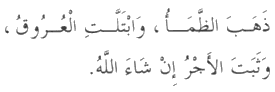
Thahaba th-thama o wabtallatil-Aaurooq, wathabatal ajru in shaal-lah
(The thirst has gone and the veins are quenched, and reward is confirmed, if Allah wills.)
Can women fast Nafil fasts without her husband’s permission?
A woman must fast the compulsory Ramadan fasts even if her husband does not want her to fast as their is no obedience to the created when it involves disobedience to the creator
But a married woman must ask her husband’s permission to fast the Nafil fasts. The reason for that is that the husband has the right to be intimate with her.
Al-Bukhaari (5191) and Muslim (1026) narrated from Abu Hurayrah (may Allah be pleased with him) that the Messenger of Allah (peace and blessings of Allah be upon him) said: “It is not permissible for a woman to fast when her husband is present except with his permission.”
The version narrated by Abu Dawood (4258) and al-Tirmidhi (782) says: “No woman should fast when her husband is present except with his permission, apart from Ramadan.” Classed as saheeh by al-Albaani in Saheeh al-Tirmidhi.
Breaking a nafil fast
Shaykh Ibn `Uthaymin (may Allah have mercy on him) said:
“If a person is observing an optional fast and something happens and he has to break his fast, then he should break his fast. This is what was narrated from the Prophet (peace and blessings of Allah be upon him), that he came to the Mother of the Believers `Aishah (may Allah be pleased with her) and said: “Do you have anything to eat?’ She said: “We have been given some Hays (a kind of meal). He said: “Show it to me, for I started the day fasting.” Then he (peace and blessings of Allah be upon him) ate some of it. This has to do with optional fasts, not those that are obligatory.” (Majmu` Al-Fatawa, 20)
Umm Hani’ (may Allah be pleased with her) who said: “O Messenger of Allah, I broke my fast and I was fasting.” He said to her: “Were you making up for a day you had missed?” She said: “No.” He said: “Then it does not matter if it was a voluntary fast.” (Narrated by Abu Dawud, 2456; classed as authentic by Al-Albani)
bu Juhayfah (may Allah be pleased with him) said: “… Abu Ad-Darda’ came and he made some food for him – i.e., for Salman. He said: ‘Eat, for I am fasting.’ Salman said: ‘I will not eat until you eat.’ So he ate… and Salman said to him: ‘Your Lord has rights over you, your soul has rights over you, and your family has rights over you, so give each of them their rights.’ Then he came to the Prophet (peace and blessings of Allah be upon him) and told him about that, and the Prophet (peace and blessings of Allah be upon him) said: ‘Salman is right.’” (Narrated by Al-Bukhari, 1968)
Abu Sa`id Al-Khudri (may Allah be pleased with him) said: “I made some food for the Prophet (peace and blessings of Allah be upon him), and when it was served a man said: ‘I am fasting.’ The Messenger of Allah (peace and blessings of Allah be upon him) said: ‘Your brother has invited you (to eat) and has gone to some effort for your sake, so break your fast and fast another day in its stead if you wish.’” (Narrated by Ad-Daraqutni, no. 24; classed as sound by Ibn Hajar in Al-Fat-h, 4/210).
The second view is that optional fasts should be completed, and if a person breaks such a fast he has to make it up. This is the view of the Hanafis who quoted the following evidence that such fasts have to be made up
Aishah (may Allah be pleased with her) said: “Hafsah and I were given a gift of food and we were fasting, so we broke our fast. Then the Messenger of Allah (peace and blessings of Allah be upon him) entered and we said to him: ‘O Messenger of Allah, we were given this gift and we wanted to eat so we broke our fast.’ The Messenger of Allah (peace and blessings of Allah be upon him) said: ‘It doesn’t matter; fast another day in its stead.’” (Narrated by Abu Dawud, 2457; At-Tirmidhi, 735. Its Isnad (chain of narration) includes Zamil, of whom it says in At-Taqreeb: he is Majhul (unknown). It was classed as inauthentic by An-Nawawi in Al-Majmu`, 6/396 and by Ibn Al-Qayyim in Zad Al-Ma`ad, 2/84. It was also classed as inauthentic by Al-Albani.
With regard to the Hadith of `Aishah quoted above from Muslim, some of them add the words: “… ‘I started the day fasting,’ and he ate and said: ‘I will fast another day instead.