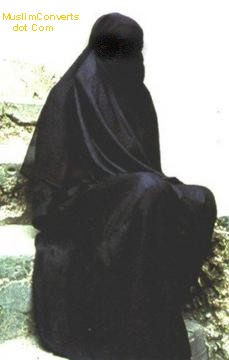
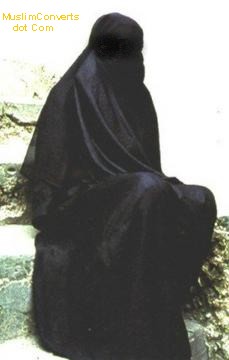
I am a Muslimah who reverted to Islam after I got married
I have been wearing the niqab for 3 years now, I have decided to wear it when I was pregnant, despite my husband’s relatives telling me not to do so as I may stumble or fall. I still did…it is Jihad nifsi. Allah has always been with me. Alhamdullilah.
I too was used to wearing all sorts of fads before I met my husband.
SubhanAllah! Niqab, is good for women as it avoids deceitful eyes, temptation for men which will lead them to sin. The shaitan works in very mysterious ways, that’s his job, to lead us away from Allah.
We all have difficulties to breath, and it gets hot in there too sometimes. But we women who wear niqab believe, the more difficulties you have for Allah’s cause, and bear it, the more rewards we obtain in paradise, Insha’Allah.
I practiced Islam after reading and reading and reading…this triggered me to do so when my husband asked me questions about Christianity. And I can’t just answer him rationally! To think, I was brought up in an all girls school run by nuns, and a mother who is a devoted Catholic.
This is my short story:
Before I got married, I worked in a Muslim country for four years. While I attended mass, I could hear the Adhan calling. It bothered me and thought the sounds they were doing were strange. Being brought up and sent to an all girls school run by nuns and a mother who was devoted to the Roman Catholic religion, I had totally no idea what is Islam!
I got married and lived with my husband in his country and converted to Islam by the end of the year. When I saw my mother-in- law prostrating on the floor, I thought it was also strange. I converted to Islam without knowing anything about it.
After taking loads of tests after two years of not conceiving, I then knew that both my fallopian tubes were blocked, I had a growing pituitary tumor and the ovaries making the eggs were weak. I was sickly when I was young, I even had a thyroidectomy at 16.
In the end of the year 2000, my husband all of a sudden started to pray. I guess, Allah had given him the chance. Both of us were working that time. My husband told me to pray so that Allah would give us a child.
In mid 2001, he taught me how to pray, and I was reading the Sahih Al Bhukhairi by Dr. Mohammed Muhsin Khan at the same time.
Later on, realizing that the God of Islam is the God of Abraham and all the prophets and Jesus was one of them. Allah as what the Muslims call Him is the One True God.
Ramadan before the year 2002 came I was praying the lailatul qadr and would wake up an hour before the fajr to pray. I would even pray with my husband and we would ask Allah to give us a child. I knew I was crying most of the time when asking HIM heartedly and sincerely. Just as a child crying when it wants something from the parent.
In February 2002, I had an In-vitro Fertilization operation for short, test tube baby. After two weeks, it was confirmed pregnant and is blessed by Allah with a beautiful and healthy baby girl. ALHAMDULILLAH!!!!!
It was a miracle, as not too many women conceive right away on the first try with IVF. I knew that God has given me a gift. I knew that if we work hard for something it is always given to you. I left my life in the hands of God. I made Allah my Auliya. I have proven to myself and I want to show the world that there is no might and power except with Allah!
I am a born Muslim, Alhamdu lillah, although I did not practice when I was young I do Masha Allah practice and I also went to a Madrassa for 3.5 years.
I also wear the Niqab but even some of my family members debate on this, but I ignore them and I do this to please Allah. What can I tell them about this, as they think I am extreme and silly. Sometimes I feel very upset about this, please explain to me what I should tell any one who ask me why I am doing this.
Jazzakhallah khairan.
wassalaam
Zareena
Assaalamu `Alaykum Wa Rahmatullahi Wa Babarakaatuhu Sister Zareena
All praise is to Allah, we praise Him, seek His aid, and ask His forgiveness. We seek refuge in Allah from the evils of ourselves, and from the bad consequences of our deeds. Whoever Allah guides there is none who can lead him (or her) astray, and whoever Allah leads astray there is none who can guide him (or her).
I testify that there is none worthy of worship except Allah alone without any partners (i.e. sons, daughters, wives, etc), and I testify that Muhammad ibn Abdullah (peace be upon him) [the direct descendant of Ibraheem (AS) through his son Isma’eel (AS)] is His last Prophet and Messenger. As for what follows:
Know first of all, dear sister that Allah has blessed you by guiding you back to Islam. We cannot thank Allah enough for giving us this precious gift. Niqab is a well established practice in Islam. It was the practice of the mothers of the believers (prophet peace be upon him’s wives) and it was also the practice of the Sahabiyat. Anyone who is against it is against Islam no matter how much they claim to be Muslim or even if they are an Imam of a Masjid.
Thus you are doing the right thing by wearing Niqab and ignoring what they are saying. You are our sister in Islam and I am very proud of you and it makes me very happy when I hear that a sister has decided to wear Niqab or when we see sisters wearing Niqab. So there are many brothers and sisters who are proud of you. Some of them may not even be practicing Islam themselves. The importance of Niqab cannot be cannot be over emphasised. Especially for sisters living in western countries, were men have no restrictions on fulfilling their lusts. The importance and need of Niqab has already been dealt in another article in great detail in the following link:.
I fully understand how upsetting it must be when you family say hurtful words. It is upsetting when a person is doing the right thing and others say no you are doing something wrong. It is even worse when such comments come form ones family. And it is even more upsetting when your family is Muslim and they say such things. We can understand that if the family is not Muslim but a Muslim family should be encouraging their daughter to wear Niqab rather than discouraging her.
It just shows how far away from Islam some Muslims have gone. In fact when a person says that Niqab is silly and extreme then they can go out of the fold of Islam.
Tell your family that the prophets wives and the sahabahs wives, daughters, sisters wore Niqab. Are you saying they were silly and extreme?
Tell them then this could even take them outside of Islam.
Tell them prophets wives and female sahabah are the best women and they are our examples of how women should dress, behave and contribute to society.
Tell them I want to be a slave of Allah not a slave of the people. Say I want Islam to dictate how to live and not the kaffirs nor the Munafics.
Tell them you say you are Muslims then you should also submit to the will of Allah and not to the will of society.
Tell them you love them and you do not want them to be in the hell fire with the disbelievers and the Munafics.
Many parents want to compete with society. Even if that competition is degrading for their children. Just because it is the societies norm they will say my daughter can also do the same and better.
Some so called Muslim mothers from mostly rich families want their children to imitate the ways of the disbelievers in the west and even beat their daughters for not revealing their aura and not dancing with non- Mehrem males. They loose guidance. and become just like the kaffirs. loosing all sense of shame.
Other parents do not realise that their little girl is no longer a little girl but is now a women whose her face and body are appealing to men. It is hard for a Mehrem to realise that men could want to sleep with his daughter, niece, sister because he does not get the desires that other men get for her.
Therefore some parents have to be educated about the realities of this world.
Therefore you should tell your family do you want men looking at my body and face and having perverted thoughts. Especially in this day and age when looking at a women’s lips can causes so much sexual thoughts in the minds of men.
If they say oh some men imagine what she is like under her abaya and Niqab. Say I am wearing this to please Allah and secondly I am not going to aide them in their perversion by revealing my beauty. Also say if that was the case why do you wear cloths at all in the summer heat.
The goal of Shaytan is to strip human beings of their clothing and thus reveal their aura. Shaytan could not accept that our father Adam was better than him so he plotted and planned to strip our father Adam and our mother Hawwa (even of their dignity and respect).
Shaytan will use all his tools to do the same with you and me and the rest of the Muslims. The devil will even use our own families to strip us naked and reveal what we are not supposed to reveal to non-Mehrems.
This is a trial for you sister. It will make you Insha’Allah a better Muslim and a stronger Muslim. Thus a better mother for your children and a better wife for your husband.
Have patience and thank Allah for opening your eyes and giving you the taufiq to practice Islam.
Bismillahir Rahmanhir Raheem-in the name of Allah, the Most Beneficent, the Merciful.
Lately, there has been much controversy about “the veil” in the media. Certain people (e.g. politicians such as Jack Straw) have been making statements that, should he have directed them towards any other group in society, they would most probably elicit much derision and uproar.
Yet, when such ignorant, hateful and insightful remarks are directed towards members of the Muslim community, there seem to be many who are “jumping on the band wagon”.
Why is this?
There seem to be quite a few reasons why some are opposed to women wearing the niqab (the piece of fabric which covers the face).
Some are saying that a woman who wears a niqab cannot be fully integrated into society & that it is a hindrance to communication.
Others are saying that it is “scary” & “frightening” & may hinder her being able to be identified; or that they want to “liberate” those “poor oppressed” women who are “forced” to wear it.
Well, whatever the so-called reasons that are causing people to call for the removal of the niqab from the faces of some Muslim women, it is without a doubt as a result of 9/11 in New York & the bombings in London.
What is not happening is these people respecting the rights of women who want to wear the niqab.
So perhaps the question needs to be asked: not of why women shouldn’t cover their faces but why they choose to do so and why this choice (and their right to do so) should be respected.
I wear the niqab for a several reasons
. One reason I wear it it is because I am a Muslim woman. If I weren’t a Muslim, I highly doubt I would ever choose to cover my face. I say this also because I personally have not seen any non-Muslims wear it (though I have heard accounts of some Christian & Buddhist women covering their faces).
Primarily, I wear it because I seek to please Allah, but not everyone who seeks to please Allah wears a niqab.
I wear it to be more modest, but not everyone who wishes to be more modest chooses to wear a niqab.
I wear it to help my Muslim brothers (& other men) to lower their gaze, but not everyone who wants to stop men looking at them does this.
I wear it out of respect (but not by his request) for my husband, but not everyone who respects their husband (or whose husband requests it) wears a niqab.
So, I wear it because for me, it is easier to put a piece of material on my face to achieve all these things as I don’t know any other way to do so as completely & easily.
I also wear it because, in the past, when I have worn just the headscarf & abaya (long cloak) I found myself becoming increasingly shy & loathe to show my face around men.
I discovered to my surprise (after reviewing my feelings & behavior) that in the presence of strange men (men who are not very closely related to me or ‘mahrams’) I would either lower or turn my head, turn my whole body, use my hands to hide my face by pretending to touch my upper nose area or hide completely and I found that I was reluctant to leave the house even when I needed to.
So, as you can see, this is was a problem.
In fact, by NOT wearing niqab I was turning into a recluse; I was NOT a functioning member of society.
In essence by NOT wearing my niqab, I was becoming as they say “segregated” & was not “integrating” into society.
So in a nutshell, niqab allows me to feel comfortable enough to go outside my house for my needs, it allows me the feeling of liberty to be in the presence of non-mahrams without dread & embarrassment on my part. It is for me, a freedom.
I know this may seem difficult for non-Muslims to understand and to be honest it probably would have seemed so to me prior to my entering Islam.
My journey towards wearing niqab “full-time” has been many things. It has been frustrating yet encouraging, confusing yet enlightening, difficult yet easy, heartbreaking yet uplifting; basically full of ambivalence. What is has always been is wonderful because this journey has drawn me much closer to Allah. I first started by wearing niqab “part-time” using a half-niqab (which covers only the nose & mouth). It is put on underneath the headscarf & the elastic back would allow me to pull it up or down in a fraction of a second. I would wear it for a few minutes at home & then for short trips out depending on where I was going. For instance, if I were to go to the masjid (the more correct term of ‘mosque’) or my husband’s shop I would wear it. If I were going to the grocery store I would leave it off. At first (when I drove on my own) I wouldn’t wear it while driving. When I was more confident wearing it while walking around I would then wear it while driving. I laugh now to think of the picture I must have made plus what the other drivers must have thought when they saw me-niqab plus sunglasses in a little hatchback! I currently wear the “headband-style” of niqab, the under layers exposing the eyes with a top, sheerer layer to cover the eyes which can be flipped back for better visibility. It is worn over the headscarf and sits just on (covering) my eyebrows, like a headband and is secured at the back of the head with either ties or with a velcro fastening. This allows me to conceal or reveal my eyes depending on where I am, what I am doing or to whom I am talking with. I do not drive now on my own out of personal choice (much to the frustration of my husband, I think) previously I drove just twice a week, to & from my Qur’an lesson- and I drove with the eye screen up and I find it did not in any way hinder my ability to maneuver my car.
To be quite honest a major impetus for me to even consider wearing something to cover my face came from visiting my husband while at his shop. I would see the interest many of his customers would have in me. Being a very pale-skinned person with western features & colouring, my husband would often receive enquiries about me. After a while, he started to get quite annoyed, as did I, with the questions about where I was from, why didn’t he marry “his own kind”, why did he marry me (i.e. why did he marry an Australian, a revert?-for some Muslims here these seem to be dirty words when used in the same sentence as ‘marriage’), why did I enter Islam, did I have a sister (for the purposes of marriage)? I used to think, “what do they care, can’t I be just a MUSLIM?” I (& my husband especially) was becoming increasingly upset with men (many of whom are Muslim & should know better not to do this), to put it plainly, ogling me for whatever reasons. We also were afflicted, we believe by “al-‘ayn” or the jealousy eye-which is very real-and suffered a short period of intense marital hardship which we had never experienced before. Alhamdulillah, after becoming educated about how to gain the protection of Allah & the cure, this trial lifted. But it left me with a valuable lesson-that it would be better to cover my face for a variety of reasons. I think the final straw (no pun intended) was when one day after dropping my husband off at his work, I had a minor car accident. The first person who came to the scene was a non-Muslim, an acquaintance of my husband. He asked if I were OK & in the meantime my husband came running back after hearing the noise of the crash. He was later asked by this non-Muslim acquaintance who had spoken not more than ten words to me (covered in my long headscarf & loose abaya, both black) if I “had a sister”. This made me realize that even to the non-Muslims the headscarf & abaya of the Muslim woman were not enough to deter interest. I said to myself at the time, “right, that’s it! I’ve had enough! I’m wearing my niqab everywhere from now on!” And I have, Alhamdulillah and I have never once looked back.
I truly believed that it was enough to wear what I was wearing (headscarf and abaya) to deter men’s interest; I thought to myself, “what else is there to cover when everything sexual or desirable IS covered?” Well, the answer is, the things left to cover are the face and hands. And when you think about it, a woman’s face & hands are the focal point of beauty ESPECIALLY when she has covered every other part of her body with loose clothing. I mean, what else is there to look at? When you say a woman is beautiful you are not talking about her feet or her knees; you are talking about her face. What areas of a woman’s body have more money spent on them than the face and hands (besides hair)? Multi-billion dollar industries are devoted to selling products for the face and hands. Hours and hours are spent in the further beautification of these areas. Beauty spas/salons and manicure centres are plentiful all over the world. And there is nothing really wrong with this except that is causes men to further desire women (and also perhaps can be seen as a major waste of time.) Which for the Muslim woman is a problem, unless the man happens to be her husband! So anyone who says that the face and hands are not important or desirable-even sans cosmetics-is underestimating the beauty of women and the ability of men to find beauty in the women around him.
So I spent many hours pouring over the evidences, days, in fact looking at ahadith and of course, ayat in the Qur’an.
I did this because in my “part-time” wearing of niqab I had discovered that my father-in-law was somewhat opposed to niqab (for reasons I did not [and still don’t fully] understand).
Also, I had encountered a sister who said to me, “you know, you don’t HAVE to wear it!?”
So, I wanted to be fully equipped to handle any questions and oppositions; basically I wanted to be able to justify to Muslims why I wear niqab.
As I delved into the evidences, I discovered that there are two views: mustahabb (highly recommended) and fard/wajib (obligatory,compulsory).
To the common-garden variety Muslimah like me I was a little frustrated. Why with something that seemed (to me) so crucial, was there such a difference of opinion?
I had decided to wear niqab anyway & to make it easier on myself I really wanted the covering of the face to be obligatory and was searching for such (clear) supporting evidence from scholarly interpretation; main reason being was my belief that my father-in-law was going to oppose me on this issue & forbid me from wearing it.
I finally came to a personal decision (from looking at the evidence from the Qur’an & Sunnah & taking the more correct of scholarly opinion) about this issue; that covering the face is fard/wajib.
After realizing that if the scholars can’t agree on the status of covering the face then the common Muslim isn’t going to agree either, I really had to look at WHY I wanted to wear niqab so much, basically so I could justify my decision to my father-in-law.
I had also made the salatal-istikhara (prayer of guidance) so that whichever path I did choose it would be with guidance from Allah.
I thought again about all the things that had happened to me in the time since I became a Muslim and I also looked at my level of faith. So why did I feel this compulsion to cover my face in the presence of strange men?
I discovered I really wanted to wear niqab because I fear Allah.
Wallahi I fear the Day of Resurrection (Yaumul-Qiyaamah) and what I may have to answer to Allah for.
If covering the face is obligatory, I fear He may ask me why I didn’t do it.
If covering the face is “only” highly recommended & something for which extra rewards are given, I fear he will ask me why I didn’t do something that I knew to be a highly recommended Sunnah (Sunnah is that which the Prophet Muhammad, peace be upon him, did, which he enjoined, and which was not forbidden by him when done in his presence) knowing what fitnah (trial) I was perhaps causing others.
I know of saheeh ahadith that support this and after seeing them, and after knowing them and understanding them I couldn’t truthfully plead ignorance to Allah on the day when our hands, our eyes, and our limbs and even our Qur’an will speak for us, even if we do not wish to tell the truth.
So after considering all these (many) reasons, I understood that I had more reason to wear it than not to.
And the reasons for not wearing niqab suddenly seemed so insignificant compared to the real reason why I should which is to gain the pleasure of Allah insha’Allah (Allah willing) and to insha’Allah lose the displeasure of Him.
Most of the reasons that I did not wear niqab (which seem so silly now) were because I was worried what people would think of me.
The main person I was worried about was my father-in-law, I just didn’t want him to think that I was going against his wishes and ‘challenging’ him.
Then I was worried what other Muslims will think, for instance, “who does she think she is to wear a niqab, she’s only a ‘convert’ .”
I was also worried what westerners and non-Muslims will think; they will be confused and /or frightened; I will be harassed; I will be discriminated against; I will be put in danger etc etc. Not to mention the (initial) discomfort and inconvenience of wearing niqab.
At that time of confusion, the only opinion I didn’t worry about was Allah’s and what He thought of me. For me, that suddenly put it all into perspective.
All the other reasons, the staring, the insults, the discomfort, the questions, even what I thought was the opinion of my father-in-law (whom I love dearly) didn’t matter anymore.
All that mattered was Allah. For Whom we have no reason to exist but to worship Him.
I knew without a shred of doubt that as I would be covering my face in the hope that I would gain Allah’s pleasure, He would make it easy for me and He would protect me from all harm.
And that any hardship I faced as a result of covering my face would insha’Allah only be an increase in any rewards I would gain.
Alhamdulillah, Allah has made my journey of wearing niqab easy (well, easier than some sister whose stories I have heard).
Yes, sometimes people stare and whisper, sometimes they say some remarks under their breath and once someone called me a ‘ghost’ while standing in line at the checkout counter (to which my bearded and fierce husband gave a menacing reply) and recently I was harassed on my way to my Qur’an lesson (while driving on my own, so now I have arranged a time when my husband can drive me).
However, in general, Muslim and non-Muslim men have afforded me with greater respect than even before. Hijab (with or without covering the face) enables a Muslim woman to no longer cringe with embarrassment when walking past a group of men;
a Muslim woman if properly covered can be fully assured that those said men cannot gaze lustfully at her chest and will not be waiting until she passes to take a better look at her back view.
I have come into contact with many non-Muslim women who go out of their way to smile and to be polite and kind as if they instinctively know the hardship the we Muslim women especially the “niqabis” face due to the ignorance of our fellow Australians.
On a lighter note, I am always amused at the expressions of surprise on people’s faces when they hear my very Australian-with-no-trace-of-an-accent voice.
And then when they (if it is a woman) see an amused set of blue eyes, I think then they suddenly feel embarrassed at their misconceptions and stereotypes.
I hope then they realize that underneath I’m just a normal woman with a family with hopes and dreams who just happens to cover her face & body. And that this woman does not represent “The Enemy”.
It is also my hope that other Muslim women (even the ones who wear niqab) do not create difficulties for their Muslim sisters who wish to cover their face.
I have found that some munaqabahs (niqab-wearing Muslim women) have harassed “part-time” niqaabis for not covering all the time. It is my hope they understand that this step requires patience, understanding, support and lots of eman. And Allah knows best.
As with any other religious action whether you deem it fard or “just sunnah” (ooh, that’s a term that just gets on my nerves) we should be encouraging and definitely not discouraging other Muslims to perform them.
Thank you for taking the time to read my story. I wrote this fisabeelAllah (for the sake of Allah) to help non-Muslims understand why some women cover their faces despite such opposition (even from other Muslims) and to encourage those sisters who are wanting to.
Anything good and correct I have said is from Allah and anything incorrect is from me or the shaytan (the devil). Subhanaka Allahumma wa bihamdika, ‘ash-hadu ‘an laa illaaha illaa ‘Anta, ‘asaghfiruka wa ‘atoobu ‘ilayka.
Sister Aliyah bint Les Yaqub from Australia
Sister Aliyah became Muslim around 2004
She met her husband first briefly when they were unmarried while attending an Australian high-school together and tutoring him in English and then again.
She met him again 15 years later when she happened to walk into his butcher shop (as a Muslim) to buy halal meat. She had been a Muslimah for 6 months when she met him this time. Her previous Husband was a very wealthy non-Muslim man. She had lived in a luxury home with sports car with her previous husband but says She is much happier married to her husband that has a job that does not pay much.
I had accepted Islam during the beginning of my 11th grade school year. Before taking Shahadah I had adopted wearing a jilbab and hijab (scarf).
One of my Muslim friends enlightened me on the evidence of niqab. She had said that their were two scholarly views based on its daleel, however the practice of niqab was the safer choice, so I decided that the day after school out that year, I will Insha Allah start to wear niqab.
Then I started asking myself, why I was waiting until the summer vacation, was I that scared to face my peers at school with the niqab?
I had already shocked everybody with jilbab and hijab, I just didn’t want to deal with their stares and hushed comments. I became scared that I was committing shirk by putting the opinions of my schoolmates before that of Allah.
Also I was very scared of taking the subway in my niqab, I already received murderous stares from various pairs of eyes.
The next Jumu’ah prayer that I attended, Alhamdulillah, the Imam was talking about the amount of time we have in this life and suddenly I became restless.
I seriously started to think about the waiting period that I had set up for my self to start the niqab, and was it the right thing to do. I can’t be sure if I will live until school ends. (This thought was triggered by the unfortunate event that had occurred earlier that year, my childhood friend had died in a car accident and I was a bit sensitive about death during the Jumu’ah.)
I made up my mind that from that Saturday, I will be wearing my khimar a little bit differently, with only my eyes showing. I am still wearing the niqab and I have not regretted my decision.
For those of you who live in New York City and know the state of their public transportation system, I hope it gives you strength to start your own niqab by knowing that I take the subway (train) and sometimes the bus at least 5 times a week in my niqab.
Whenever I take the subway, I remind myself of the hadith that says that if the whole world wanted to harm you, they wouldn’t be able to, unless Allah willed it.
May Allah raise your Iman and reward in the Hereafter.
Assalamu’alaikum wa rahmatullah. Sister Tara Blackthorn(17 years old)
A detailed look on whether Niqab is Fard and the Importance of Niqab.
What Is Niqab, Bhurka and Hijab?
Niqab is a garment of clothing that covers the face. It is worn by Muslim women.
Some niqabs are just one layer and thus expose the eyes, Others have three layers were the eyes be either exposed or they can cover even their eyes with an extra thin transparent layer makes it harder for onlookers to see the eyes and a secound layer which completely hides the eyes but the Muslim woman wearing the veil (niqab) is able to still see through both layers
.
The Bhurka worn in Afghanistan comes in one piece which covers the Muslim woman from head to ground. It has hole like grill for women to see through and thus is very easy to slip on quickly
Hijab literally means a “Veil”, a “Curtain”, a Partition” or a “Separation”. In Shariah terms Hijab does not just refer to the head covering. It is about covering everything of a woman thus leading to a separation of her beauty from men who are not her Mahrem. This will also include her clothing, the way she smells, the way she talks and the way she walks.
Due to ignorance Hijab has been mistaken for the head covering. The head covering is actually called the Khimaar.
There are a great deal of misunderstandings about the Niqab and there are also numerous attacks on Niqab from misguided Muslims, from traitors and from some non-Muslims.
They propagate lies about Niqab just like they propagate lies about other issues of Islam.
In sha Allah in this comprehensive article I will try to clear the misunderstandings about the ruling on Niqab and refute the arguments against Niqab.
In brief, Islamic scholars have talked about the issue of Niqab in detail.
Some of them believe Niqab is Fard ( compulsory) and others believe it is not Fard but regard it as a highly recommended Sunnah.
By compulsory they mean if a sister doesn’t wear Niqab she is sinning and the other team of scholars say she does not sin if she doesn’t wear it but she should wear it when there are non Mahrem men present and also when there are dangers of fitna.
For instance Sheikh ‘Abdul-‘Azeez ‘Abdullah bin Baaz and Shaikh Muhammad ibn Saalih Al-‘Uthaimeen said that the Niqab is indeed wajib (compulsory upon the believing women ) and their argument is strong and convincing. Others such as the Muhaddith of our time Sheikh Muhammad Naasiru-Deen Al-Albaani said that the Niqab is not wajib (compulsory) but rather Mustahab (highly recommended).
Even those who believe that Niqab is not Fard say that when the Muslimah is very close to the men, she MUST cover her face. Or if she knows that such men will look at her with desire or a wrong way then she MUST also cover her face. Many of the great Scholars of the past have also said that Niqab is Fard (compulsory). Therefore the safer option would be to wear the Niqab.
If you wear it and it was not Fard (compulsory)then you will In sha’ Allah at least get the reward for practicing something that the Prophet peace be upon him approved of and which his wives and the Sahabiyat did. They are the roles models for the women of this Ummah with regards to how a women should dress and behave. So you do not loose out if you wear the Niqab.
For those who say Niqab is not compulsory they quote the following hadith
Narrated by Abu Dawood (4104) from al-Waleed from Sa’eed ibn Basheer from Qataadah from Khaalid ibn Durayk from ‘Aa’ishah (may Allaah be pleased with her), that Asma’ bint Abi Bakr entered upon the Messenger of Allaah (peace and blessings of Allaah be upon him) wearing a thin dress. The Messenger of Allaah (peace and blessings of Allaah be upon him) turned away from her and said, “O Asma’, when a woman reaches the age of puberty, nothing should be seen of her except this and this” – and he pointed to his face and hands.
However Abu Dawood himself said: This is mursal; Khaalid ibn Durayk did not meet Aishah (may Allah be pleased with her).
Many great scholars have said this is not an authentic narration
Even if we assume that this hadith is authentic. Some scholars have said that this incident occurred before Hijab was enjoined. I think it is very unlikely that Asma would have being wearing a thin dress after the enjoining of Hijab
Ibn Qudaamah said: “With regard to the hadeeth of Asma, it is to be understood as having occurred before the verse of Hijab was revealed.
Prior to Islam the non Muslim Arabs used to have male and female slaves. They used to earn money from the females slaves by getting them to sleep with men for money so they would have them revealing their bodies etc. However, the free women covered up most of their bodies.
Ibn Jazi al-Kalbi al-Maliki (may Allah have mercy on him) said:
“The Arab women used to uncover their faces as slave women do, which was an invitation to men to look at them. So Allah commanded them to cover themselves with their jilbabs and cover their faces with them.” (Al-Tas-hil li ‘Uloom al-Tanzil, 3/144)
So lets look at the evidences for Niqab
How did Niqab Begin
Niqab is indeed a practice of the Sahabiyaat and the mothers of the believers
The story of Niqab begins from the following Hadith in Sahih Bukhari
Narrated Umar: I said, “O Allah’s Apostle! Good and bad persons enter upon you, so I suggest that you order the mothers of the Believers (i.e. your wives) to observe veils.” Then Allah revealed the Verses of Al-Hijab.
Bukhari Volume: 6, Book Number: 60, Hadith Number: 313
It was narrated from ‘Aa’ishah that the wives of the Prophet (peace and blessings of Allah be upon him) used to go out at night to al-Manaasi’ (well known places in the direction of al-Baqee’) to relieve themselves and ‘Umar used to say to the Prophet (peace and blessings of Allah be upon him), “Let your wives be veiled.” But the Messenger of Allah (peace and blessings of Allah be upon him) did not do that. Then one night Sawdah bint Zam’ah, the wife of the Prophet (peace and blessings of Allah be upon him), went out at ‘Isha’ time and she was a tall woman. ‘Umar called out to her: “We have recognized you, O Sawdah!” hoping that hijab would be revealed, then Allah revealed the verse of hijab.
Narrated by al-Bukhaari, 146; Muslim, 2170.
We learn from this hadith the wives of the Prophet peace be upon held a very high position in Islam and thus any malicious talk about them would be a direct attack on the Prophet. So Umar did not want anyone to recognise them when they went out of their homes.
How is a woman recognised? Is it by her hair or her face?
Whenever an identity check is required, seeing a women’s face is both essential and sufficient. Whenever a lady wants to do something that requires an Identity check. Her face is checked to see if it is actually her. It is her face that is checked not her hair. Even if her hair does not match it is said the person in real life and the one in the passport photo is the same. Then security clearance is given. A guard will not say “Hey, I need to see your hair, but you can keep your face covered because I can identify you from your hair.”
In 99.99 percent of cases we can all tell the difference between peoples faces. But to recognise and differentiate people by looking at their hair would be highly inaccurate and most likely impossible.
After Umar’s requests for the Prophet’s wives to be veiled. Allah revealed the following verse.
“O Prophet! Tell your wives and your daughters and the women of the believers to draw their cloaks (veils) all over their bodies (i.e. screen themselves completely except the eyes or one eye to see the way). That will be better, that they should be known (as free respectable women) so as not to be annoyed. And Allah is Ever Oft-Forgiving, Most Merciful”
[al-Ahzaab 33:59]
It was narrated from Ibn Shihaab that Anas said: I am the most knowledgeable of people about hijab. Ubayy ibn Ka’b used to ask me about it. When the Messenger of Allah (peace and blessings of Allah be upon him) married Zaynab bint Jahsh, whom he married in Madeenah, he invited the people to a meal after the sun had risen. The Messenger of Allah (peace and blessings of Allah be upon him) sat down and some men sat around him after the people had left, until the Messenger of Allah (peace and blessings of Allah be upon him) stood up and walked a while, and I walked with him, until he reached the door of Aishah’s apartment. Then he thought that they had left so he went back and I went back with him, and they were still sitting there. He went back again, and I went with him, until he reached the door of Aishah’s apartment, then he came back and I came back with him, and they had left. Then he drew a curtain between me and him, and the verse of hijab was revealed.
Al-Bukhaari, 5149; Muslim, 1428.
Then the women began to observe Hijab in front of men.
It was narrated that Aisha (may Allah be pleased with her) said: May Allah have mercy on the women of the Muhaajireen. When Allah revealed the words (interpretation of the meaning)
“and to draw their Khumur (veils) all over Juyoobihinna (i.e. their bodies, faces, necks and bosoms)”
[al-Noor 24:31], they tore their aprons and covered their faces with them.
(Narrated by al-Bukhaari, 4480)
Allah says in Surah An Noor
And tell the believing women to lower their gaze, and protect their private parts (from illegal sexual acts, etc.) and not to show off their Zeenah (adornment) except only that which is apparent (like palms of hands or one eye or both eyes for necessity to see the way, or outer dress like (Khumur) veil, gloves, head-cover, apron, etc.), and to draw their veils all over Juyubihinna (i.e. their bodies, faces, necks and bosoms, etc.) and not to reveal their adornment except to their husbands, their fathers, their husband’s fathers, their sons, their husband’s sons, their brothers or their brother’s sons, or their sister’s sons, or their (Muslim) women (i.e. their sisters in Islam), or the (female) slaves whom their right hands possess, or old male servants who lack vigour, or small children who have no sense of the shame of sex. And let them not stamp their feet so as to reveal what they hide of their adornment. And all of you beg Allah to forgive you all, O believers, that you may be successful. (24:31)
It was narrated from Aisha ” that Safwaan ibn al-Muattal al-Sulami al-Dhakwaani was lagging behind the army. He came to where I had stopped and saw the black shape of a person sleeping. He recognized me when he saw me, because he had seen me before Hijab was enjoined. I woke up when I heard him saying “Inna Lillaahi wa inna ilayhi raajioon (verily to Allah we belong and unto Him is our return),” when he saw me, and I covered my face with my Jilbab.”
(Narrated by al-Bukhaari, 3910; Muslim, 2770)
Look at how our mother Aisha, who is regarded as one of the best scholars of all time, understood the commandment of Hijab.
She speaks of Safwaan ibn al-Muattal al-Sulami al-Dhakwaani recognising her because he had seen her face before the commandment of Hijab and further again she says she covered her face. She says he recognised me when he saw me because he had seen me before Hijab was enjoined. Now note the word recognised and seen. A man or a women will recognise a women from her face even if her hair is covered. Thus this hadith shows that the purpose of Hijab was so that she could not be recognised.
If the purpose of Hijab was just to cover the hair and not the face then she wouldn’t have said he had seen me before the command of Hijab. It is clear that the Hijab stopped men from seeing the faces of women and thus being unable to recognise any non Mehrem women whom they had not seen before the command of Hijab.
Furthermore she covered her face. Had Niqab not been Fard them then she would not have had any need to cover her face in front of him especially since he has already seen her prior to the command of Hijab.
It was narrated from ‘Urwah that Aishah said: The Messenger of Allah (peace and blessings of Allah be upon him) used to pray Fajr and the believing women would attend (the prayer) with him, wrapped in their aprons, then they would go back to their houses and no one would recognize them.
Narrated by al-Bukhaari, 365; Muslim, 645.
The Mufassireen, such as Al-Qurtubi, cite in their Tafseer of the Ayah on Jilbaab (Al-Ahzab 33:59) that the Jilbaab is: “a cloth which covers the entire body… Ibnn ‘Abbaas and ‘Ubaidah As-Salmaani said that it is to be fully wrapped around the women’s body, so that nothing appears but one eye with which she can see.” [Tafseer Al-Qurtubi].
The most beautiful part of a woman to most men is her face. Let us look at what the Prophet peace be upon him said about the face and the veil of the women of paradise.
Narrated Anas: Um Haritha came to Allah’s Apostle after Haritha had been martyred on the Day (of the battle) of Badr by an arrow thrown by an unknown person. She said, “O Allah’s Apostle! You know the position of Haritha in my heart (i.e. how dear to me he was), so if he is in Paradise, I will not weep for him, or otherwise, you will see what I will do.” The Prophet said, “Are you mad? Is there only one Paradise? There are many Paradises, and he is in the highest Paradise of Firdaus.” The Prophet added, “A forenoon journey or an after noon journey in Allah’s Cause is better than the whole world and whatever is in it; and a place equal to an arrow bow of anyone of you, or a place equal to a foot in Paradise is better than the whole world and whatever is in it; and if one of the women of Paradise looked at the earth, she would fill the whole space between them (the earth and the heaven) with light, and would fill whatever is in between them, with perfume, and the veil of her face is better than the whole world and whatever is in it.” (Bukhari Volume 8, Book 76, Number 572:)
Look at the importance of the face of the women of paradise. It is so beautiful and her veil is so precious. Likewise the faces of the women of this world are also beautiful and their veils precious.
You will find men on websites such as facebook saying to Sisters with very attractive faces, comments such as ” you are so hot, sexy, you have a nice smile lets be friends, you have a pretty face, “you are stunning, gorgeous”, “Your lips are so nice”, “I want to kiss them” “email me or contact me and so on”
Such comments are rare with regards to Niqabis and if some comments are made they are usually because the Niqabis Sisters is not wearing Niqab properly because usually the Sisters are just posing in a Niqab for the camera and not lowering their gaze whilst taking the picture.
Several sisters, especially those who from 16-30 age group have said that when they wore just Jilbab and Hijab, they were approached by males trying to flirt with them or ask them for their numbers.
One sister for instance said that even when she was with her mother making a purchase in a store a the non Muslims male was trying to flirt with her.
After such type of experiences they realise they should wear Niqab. When they wore Niqab they found this problem of males approaching them for dating was solved and they didn’t not get such propositions.
A sister who was not practising yet and had men annoying her due to her looks said the jilbab and khymar would not be enough for because she knows men are attracted to her face.
In an authentic Hadeeth
The Prophet (peace be upon him ) commanded: “A woman (pilgrim) does not cover her face with a Niqab (i.e. does not tie or affix) nor should she wear gloves.” [Al-Bukhari; Muslim; Saheeh Abi Dawood #1600; authenticated by Al-Albaani].
Thus, from this authentic Hadeeth, we can clearly see that the Sahabiyaat were accustomed to covering their faces with Niqab otherwise, there would not have been any need for the Prophet (peace be upon him) to specifically forbid it during the state of Ihram.
It was narrated that Asma bint Abi Bakr said: We used to cover our faces in front of men.
Narrated by Ibn Khuzaymah, 4/203; al-Haakim, 1/624. He classed it as saheeh and al-Dhahabi agreed with him. It was also classed as saheeh by al-Albaani in Jilbaab al-Mar’ah al-Muslimah
It was narrated that Aasim al-Ahwaal said: We used to enter upon Hafsah bint Sireen who had put her jilbab thus and covered her face with it, and we would say to her: May Allaah have mercy on you. Allaah says (interpretation of the meaning): “And as for women past childbearing who do not expect wedlock, it is no sin on them if they discard their (outer) clothing in such a way as not to show their adornment” [al-Noor 24:60]. And she would say to us: What comes after that? We would say: “But to refrain (i.e. not to discard their outer clothing) is better for them”. And she would say: That is confirming the idea of hijab.
Narrated by al-Bayhaqi, 7/93.
It was narrated that Aisha said: “The riders used to pass by us when we were with the Messenger of Allah (peace and blessings of Allah be upon him) in ihraam. When they came near, each of us would lower her jilbaab from her head over her face, and when they passed by we would uncover (our faces).”
(Narrated by Abu Dawood, 1833; Ahmad, 24067 Shaykh al-Albaani said in Jilbaab al-Mar ah al-Muslimah (107): its isnaad is hasan because of the existence of corroborating reports.)
This hadith indicates that a Muslimah does not wear a fixed Niqab when in ihram but when men come near she can cover the face by lowering the jilbaab from her head over her face and uncover the face when the men pass by during Ihram.
Also Jaabir ibn Abd-Allah said: “The Messenger of Allah (peace and blessings of Allah be upon him) said: “When any one of you wants to propose marriage to a woman, if he can look at that which will motivate him to go ahead and marry her, then let him do so.” I proposed marriage to a girl and I used to hide myself until I saw that which motivated me to go ahead and marry her, then I married her.” (Classed as hasan by al-Albaani in Saheeh Abi Dawood, no. 1832. In the report narrated by Ibn Maajah it says that he hid in her garden to see her).
This hadeeth indicates that the women of the Sahabah used to cover their faces, because if it had been the custom for women to uncover their faces, there would have been no need to hide, because he would have been able to see her in any place if she had been uncovering her face.
Furthur more
Some of the enemies of Islam amongst the kaffirs and the Munafics want to stop Sisters form wearing Niqab by falsely claiming Niqab is Arab culture.
If it was just Arab culture and not from Islam then they would be illogically claiming that the wives of the Prophet and the Muslim women did not observe Arab culture before the revelation of verses of Hijab but observed Arab culture after the revelation of Hijab.
Well the above hadiths and Ayats have shown that Niqab is part of Islam.
This is how ridiculous their attacks on Niqab are. A child could even see how stupid they are.
However, some Muslims believe such nonsense due to lack of ability to reflect. What can we say about such poor brothers and sisters who can be lead astray so easily?
Shaytan enmity with mankind
My dear brothers and sisters. The issue of both men and women covering their aura is not a light issue. It has always been the goal of Shaytan (Satan) to cause mankind to become naked and his shame be exposed from the time of the first human being, Adam, the father of the whole of humanity,.
Allah promised our father Adam (father of all humans), that in Jannah (heaven) he would never be naked and he will never go hungry. Allah honoured Adam and the whole of mankind by creating for us clothing. Such an honour was not bestowed upon the animals, Satan and the jinn’s. They do not have cloth.
The Story of satan’s enmity towards the father of mankind , Adam and thus the whole of Humanity is repeated in almost every juz of the Quran. Every Muslim should know this story and understand its implications.
When Allah had completed the creation of Adam, He commanded the angels to prostrate to him, so they prostrated, except for Iblees, who was present but he refused and was too arrogant to prostrate to Adam:
“(Remember) when your Lord said to the angels: “Truly, I am going to create man from clay. So when I have fashioned him and breathed into him (his) soul created by Me, then you fall down prostrate to him.” So the angels prostrated themselves, all of them, Except Iblees (Satan), he was proud and was one of the disbelievers” [Saad 38:71-74 interpretation of the meaning]
Then Allah told the angels that He was going to place Adam on earth and make generations after generations of his offspring, as He said (interpretation of the meaning):
“And (remember) when your Lord said to the angels: “Verily, I am going to place (mankind) generations after generations on earth” [al-Baqarah 2:30]
When Iblees refused to prostrate to Adam, Allah expelled him and cursed him:
“(Allah) said: “Then get out from here; for verily, you are outcast. And verily, My Curse is on you till the Day of Recompense.” [Saad 38:77-78 interpretation of the meaning]
When Iblees knew of his fate, he asked Allah to give him respite until the Day of Resurrection:
‘[Iblees (Satan)] said: “My Lord! Give me then respite till the Day the (dead) are resurrected.” (Allah) said: “Verily, you are of those allowed respite Till the Day of the time appointed” Saad 38:79-81 interpretation of the meaning]
When Allah granted him that, he declared war on Adam and his descendents, made disobedience attractive to them and tempted them to commit immoral actions:
“[Iblees (Satan)] said: “By Your Might, then I will surely, mislead them all, Except Your chosen slaves amongst them (i.e. faithful, obedient, true believers of Islamic Monotheism).” [Saad 38:82-83 interpretation of the meaning]
Shaytan started his war with mankind by trying to pretend he was a well wisher of Adam and Hawwa (eve)
Allah caused Adam and his wife to dwell in Paradise and as a test for them, Allah commanded them to eat of the fruits of Paradise but He forbade them to eat from one tree:
“And We said: “O Adam! Dwell you and your wife in the Paradise and eat both of you freely with pleasure and delight, of things therein as wherever you will, but come not near this tree or you both will be of the Zaalimoon (wrong-doers).” [al-Baqarah 2:35 interpretation of the meaning]
Allah warned Adam and his wife against the Shaytaan, as He said (interpretation of the meaning):
“O Adam! Verily, this is an enemy to you and to your wife. So let him not get you both out of Paradise, so that you will be distressed” [Ta-Ha 20:117]
Then Shaytaan (Satan) whispered suggestions to them both in order to uncover that which was hidden from them of their private parts (before); he said: “Your Lord did not forbid you this tree save you should become angels or become of the immortals.” ).(Quran 7:20)
. And he [Shaytaan (Satan)] swore by Allah to them both (saying):
“Verily, I am one of the sincere well wishers for you both.” ).(Quran 7:21)
So he misled them with deception. Then when they tasted of the tree, that which was hidden from them of their shame (private parts) became manifest to them and they began to stick together the leaves of Paradise over themselves (in order to cover their shame). And their Lord called out to them (saying):
“Did I not forbid you that tree and tell you: Verily, Shaytaan (Satan) is an open enemy unto you?” ) (Quran 7:22)
Thus for their disobedience to Allah. The honour of being clothed was immediately taken away. This is what Satan wanted all along. He was jealous of the great honour that Allah had given to Adam and Hawwa. And he wanted to mislead them and have them stripped of the honour they had been given.
We can see how mankind as a whole is deceived by satan into disobeying Allah. Which leads to mankind loosing their sense of honour and causing their Aura to be naked,
Satan tricks men and women to uncover what Allah has told them is shameful to uncover amongst certain people,
Satan tricked Adam and Eve by falsely promising them that if they ate form the tree they will become angels and become immortals and it would not be a sin to eat form that fruit.
Thus this battle of the Hijab is not a new battle. It started in heaven and will continue till the last day. We often wonder why do the Islam hating kaffirs and the Munafics have such hostility to Hijab. They fine Sisters who wear Niqab in European countries and threaten them with imprisonment if they don’t pay the fine. In the land of Democracy such as France they banned Muslim girls wearing covering their heads from an School. Even in Muslim countries ruled by Munafics, Sisters wearing sisters just covering heads were not allowed to enter universities. Any who wanted a degree had to uncover her head. This happened in Turkey for many decades. Even now they do not allow Niqab in Turkey. A Turkish sister was saying she had to leave her degree because it was a choice between taking of her Niqab and being allowed to continue her education or keeping her Niqab and being expelled.
Yet at the same time they Bomb Afghanistan and say the Taliban doesn’t allow females to go to school. The Taliban said that they had Female medicals students but for the Girls they wanted time to develop a curriculum which was Islamic and did not teach Kaffir values or Kaffir ways of thinking.
Yet the French and even some British 6 form schools deprive sisters of an education by telling them to leave Niqab or covering the head or leave the school. Even though they have are actually getting a free chance to brainwash these Muslim girls with kaffir secular values.
So both satan and his allies amongst the humans want to expose the Muslimahs Aura
One of the ultimate goal of shaytan is for you to expose what you are not allowed to expose. In the history of humanity, shaytan tried to get men and women to uncover the parts that Allah ordered them to cover.
“O Children of Adam! We have bestowed raiment upon you to cover yourselves (screen your private parts, etc.) and as an adornment, and the raiment of righteousness, that is better. Such are among the Ayat (proofs, evidences, verses, lessons, signs, revelations, etc.) of Allah, that they may remember (i.e. leave falsehood and follow truth ).”(Quran 7:26)
“O Children of Adam! Let not Shaitan (Satan) deceive you, as he got your parents [Adam and Hawwa (Eve)] out of Paradise, stripping them of their raiments, to show them their private parts. Verily, he and Qabiluhu (his soldiers from the jinns or his tribe) see you from where you cannot see them. Verily, We made the Shayatin (devils) Auliyâ’ (protectors and helpers) for those who believe not.” (Quran 7:27)
Through history shaytan has deceived people. The first fitna for the children of Israel was through the women. When shaytan persuaded women to go outside their homes without covering the way Allah had commanded them to cover.
The Prophet (peace and blessings of Allah be upon him) warned against: “Beware of women, for the first fitna among the Children of Israel was because of women.” Narrated by Muslim (2742). And he said: “I have not left behind me any fitnah more harmful to men than women.” Narrated by al-Bukhaari (5096)and Muslim (2742)
.
Narrated AbuSa’id al-Khudri:
Allah’s Apostle (peace be upon him) said: There was a woman from Banu Isra’il who was short-statured and she walked in the company of two tall women, with wooden sandals in her feet and a ring of gold made of plates with musk filled in them and then looked up, and musk is the best of scents; then she walked between two women and they (the people) did not recognize her, and she made a gesture with her hand like this, and Shu’bah shook his hand in order to give an indication how she shook her hand. Muslim 20: Book Number: 26, Hadith Number: 5598
Thus shaytan persuaded this women to go out in a way that would attract men. High heels today are very common. We can how they make a women move her body more seductively. He buttocks move vigorously mesmerising the men, her chest is made to lean forward and the hearts of men lean to her breasts, her legs to appear more slender and seductive. Her heals made such a noise as to awaken the men’s desires. Telling them i am here. They go tik tak and the mans hearts starts to do bhangra (dil vagda – heart starts dancing) and voices in his head are saying Kuri Kuri (Girl Girl). Then there’s perfume. Women wearing perfume is also common place and we know how it makes a man want to get close to her, smell her body and then to taste her flesh.
We should realise that fashion was not first invented in Paris but rather this sort of fashion was invented in the shaytans factory To strip humans from the honour that Allah has bestowed upon them. Shaytan want humans to dwell in hellfire with him. Shaytan knows he will go to hell for his arrogance and he wants to take as many humans with him as possible because he blames humans for his own destruction.
After the Jews it was the Christians who were tricked by shaytan. Their head covering and possibly veil became exclusive for certain people. The nuns. Then it went shorter and shorter. Sometimes from the top and sometimes from the bottom. And you can see some of the nuns now they show their neck and parts of their legs.
Today shaytan tricks some Muslims by making similar promises to the Muslim women and the their families as he made to Adam and Hawwa. He promises Muslim women that they will get nice husbands if they remove the Niqab. Then shaytan promises the Muslims that the Kuffaar will be happy with them, will stop attacking us, we will not look extremists to the kuffaar and they will flock to Islam if our women folk remove their Niqab or even the head covering.
But those who do not fall for the tricks of shaytan will say disobeying Allah cannot give us good. It will result in destruction and loss of honour. We will be stripped of our dignity. Just like our parents Adam and Hawwa forgot and disobeyed Allah. They listened to the whisperings of shaytan and their shame was exposed and they were expelled from paradise.
A Muslimah should ask Allah for a good husband not have shaytan helping her. Shaytan only wishes harm for you.
We call people to Islam in the hope to make the world of Allah above all else and thus gain the pleasure of Allah.
Allah and His messenger have shown us how to do dawah. How can some one call to Islam and say it is prefect yet imply that his/her way is better than that which Allah and his Messenger have shown us. His or her way could be inspired by shaytan
Allah says:
“By Allah, We indeed sent (Messengers) to the nations before you (O Muhammad ), but Shaitan (Satan) made their deeds fair-seeming to them. So he (Satan) is their Wali (helper) today (i.e. in this world), and theirs will be a painful torment. 16:63.
We are told that we will follow the Jews and Christians in every way. So much so that if a Jew or Christians was to have sex with his own mother some one among the Muslims will copy his way.
It was proven that the Prophet (peace and blessings of Allah be upon him) said: “Whoever imitates a people is one of them.” Narrated by Imam Ahmad and Abu Dawood. In Saheeh Muslim (2077)
It is narrated from Abd-Allaah ibn Amr that the Prophet (peace and blessings of Allah be upon him) saw him wearing two garments dyed with safflower, and he said, “These are from the clothing of the kuffaar ” do not wear them
As mentioned earlier the Jewish women went astray a particular way and Christian women went also astray a particular way. In every rakah of every.
Salah we ask Allah to make different from the Jews and Christians. Unfortunately some Muslim men and women have become like them. As mentioned earlier the Christians were tricked by shaytan into thinking the Hijab is just for a certain pious elite amongst them called the Nuns. Who dedicated themselves to the Church etc.
Some Niqabi sisters have said that their husbands and other sisters say that Niqab is just for the wives of the Prophet peace be upon him. Some Munafics (hypocrites pretending to be Muslim) have gone so far as to say that the whole Muslim dress code is just for the Wives of the Prophet peace be upon him. And they try to fool us by using quoting some verses and not quoting all the verses to do with the issue of women’s dress code.
For instance the quote the following two verses
Allah says:
“O you who believe! Enter not the Prophet’s houses, except when leave is given to you for a meal, (and then) not (so early as) to wait for its preparation. But when you are invited, enter, and when you have taken your meal, disperse, without sitting for a talk. Verily, such (behaviour) annoys the Prophet, and he is shy of (asking) you (to go), but Allah is not shy of (telling you) the truth. And when you ask (his wives) for anything you want, ask them from behind a screen, that is purer for your hearts and for their hearts. And it is not (right) for you that you should annoy Allah’s Messenger, nor that you should ever marry his wives after him (his death). Verily! With Allah that shall be an enormity”(Quran 33:53)
And in another verse Allah says:
“It is no sin on them (the Prophet’s wives, if they appear unveiled) before their fathers, or their sons, or their brothers, or their brother’s sons, or the sons of their sisters, or their own (believing) women, or their (female) slaves, and keep your duty to Allah. Verily, Allah is Ever All Witness over everything.” (Quran 33:55)
Obviously the two verses talk only about the Prophet’s (peace be upon him) wives. Some very stupid people use these verses in a poor attempt to get sisters away form Niqab. In fact in the 1990’s such people tried to use these verses to get Muslim women to falsely believe that even covering the hair was not compulsory for the ordinary Muslim women. Some enemies of Islam are still doing this in the hope that the Muslim women who are ignorant of their religion will believe them and stop covering.
The reason why the cannot use these verses to falsely suggest that Hijab just for the Prophet’s wives is that, only 4 verses latter in the same Surah Allah say:
“O Prophet! Tell your wives and your daughters and the women of the believers to draw their cloaks (veils) all over their bodies (i.e.screen themselves completely except the eyes or one eye to see the way). That will be better, that they should be known (as free respectable women) so as not to be annoyed. And Allah is Ever Of Forgiving, Most Merciful.” (Quran 33:53)
This verse clearly shows that the Hijab is for all Muslim women. Since this verse is so close to the other two verses, anyone who says Hijab is just compulsory for the wives of the Prophet (peace be upon him), and claims to be a Muslim and is a speaker or a writer or runs a Dawah organisation (man or women) must be either he is a Munafic (worst form of a non-Muslim as he/she is a hypocrite pretending to be Muslim and clear enemy of Islam) or he or she is extremely dumb.
They enemies of Islam mainly the kaffirs used to concentrate their attack on the Authenticity of the Quran. Because if you can prove that the Holy book of a religion is incorrect then you destroy that religion completely. However for so many centuries they could not find a single mistake in the Quran and they finally gave up. But instead of saying this book is from our creator. Their jealousy, hate and arrogance makes them try to find other ways of getting Muslims away from Islam and try to prevent non-Muslims from coming to Islam. So now they try to attack the secound source of Islam which is the Hadiths of the Prophet peace be upon him.
Similarly the Munafics (hypocrites) have tried many ways to get Muslims away from Hijab. One of them was to work with the kaffirs.
The kaffirs acted as the bad guys by attacking Muslim women and girls physically and along came the Munafics pretending to be the well wishers of the true Muslims and saying you are in danger of being attacked. So save your self and stop wearing covering your head.
MashaAllah even the Muslim children less than 16 years of age in Britain told them “We will not stop wearing Hijab. Allah has promised to protect us and he will protect us”
After their plot against the head covering was foiled they went for an easier attack. That was to attack the Niqab as they know that there is division between the Muslim scholars over weather Niqab is Fard or something that is very highly recommended.
Interestingly you will find the Munafics and the Kaffirs will use the writings of great scholars such as sheik Albaani and twist things.
They will say Sheik Albaani said Niqab is not Fard but they wont mention that Sheik Albaani and other scholars who believe that Niqab is not Fard say it is a highly recommended Sunnah. They also say when a Muslimah is very close to the men she MUST cover her face. Or that she knows that such men will look at her with desire or a wrong way then she must cover her face. Yet they leave these statements of sheik Albaani and others out of their writings in the hope that Sisters will stop wearing Niqab.
One dumb woman was saying hey listen to Why I wear Hijab and not Niqab. Then she went to quote sheik Albaani opinions on Niqab. But the true reality is that sheik did not say do not wear Niqab. But rather he himself believed Niqab was highly recommended.
Yet this poor women is trying to suggest that wearing Niqab is something not good and makes a women inferior. So what are such women saying that the Sahabiyaat and the Prophet’s wives were doing something less good by wearing Niqab in a society were fitna was less than that of today and the heart of the Sahabah were far more purer than our hearts?
Such men and women are dumb because I don’t believe everyone of them is Munafics but rather just lacking in logical thinking.
The face of a women is something highly desirable to a man. Any man who is normal, no matter how pious he may be. If he saw a women with a beautiful face he will want to look at her again even if she has a head covering on. If he is very pious he may try very hard not to go for a secound look and he may even succeed. Even those brothers who, along with their wives are against Niqab, you often see them staring at the faces of sisters with just head coverings.
One sister said she decided to have a Niqab picture only on her profile on a website because she was getting sexual remarks men such as You are so hot and so on, even though she had her head covered.
In certain websites like facebook were sisters have their pictures in their profiles. You will see men going absolutely crazy over sisters with certain type of faces. They will make comments such as ” you are so hot, your are sexy, you have a nice smile lets be friends, you have a pretty face, you are stunning, gorgeous, Your lips are so nice that I want to kiss them, my email is this contact me and so on”
However when the Niqab is worn such comments are rare and only occur when the sister does not wear Niqab properly she may get unwanted comments. For instance she may not be covering all her face and parts of her face is shown, the Niqab she wears is colourful or shows too much of her eyes especially when she has rather attractive eyes. In many cases such sisters do not actually wear Niqab in real life and thus do not know how to wear Niqab nor do not care.
Another argument that I heard was that a women’s eyes are beautiful. Yes they are but if she wears Niqab and lowers her gaze when men are in visible distance then her eyes and face will not been seen. But if she does not wear Niqab then even if she lowers her gaze her beautiful face will be seen.
There are even so many songs about the woman with the Beautiful face.
The Famous Bollywood songs talk about this. One song says:
“Tere Chehreh se Nazar nahee hat tee.
Nazareh ham kia deykeh”
[ I can’t remove my gaze away from your face. What else could I look at anything else (meaning nothing on earth is so beautiful as your face. I couldn’t possibly look at anything else.)? ]
Part of another song say
Tera ang sacha sona , muskaan sache moti
tere hont hai madhushaala, tu roop ki hai jyoti
(Your body is like true gold and your smile is like true pearls
Your lips are like a tavern. you are the vision of beauty)
When a convert sister started wearing a head scarf she explained to her family that it keeps you special for that special loved one. The brother said he couldn’t understand why a head scarf would keep you special.
Had she worn niqab the brother will realise she doesn’t want anyone to look at her beauty except her family and her husband.
Ofcourse we know a women’s hair has a degree of beauty in it but it is far less than a woman’s face.
It is also well know that men are attracted to women’s lips. Many women spend vast amounts of money on lip stick and makeup some even on surgery to beautify their lips and face to make them even more appealing for men.
Several magazine articles, polls, blogs have been dedicated to the lips of the actress Angelina Jolie.
Describing her Lips as being big and sexy. What does sexy mean. We can see how close this word is with sex. It seems to be a very good description of something that is seductive, having sexual appeal and having the ability to lure the men to commit fornication and adultery.
Men clearly state what their fascination is about women’s lips. They think her lips in particular will be good for kissing and even more intimate things. These are the thoughts that go through their mind , which they even write on blogs and forums.
Therefore when the Shariah hating British politician Jack Straw (whose Mother is Jewish) says he wants to see women’s lips when he is talking to them. We know exactly why he wants to see women’s lips. When the wives of these kind of men learn about their husbands cheating with on their wife with their secretary or other women they cannot understand why it happened.
The beauty of the face and the value of the Niqab is even mentioned in hadith.
Narrated Anas: Um (the mother of) Haritha came to Allah’s Apostle after Haritha had been martyred on the Day (of the battle) of Badr by an arrow thrown by an unknown person. She said, “O Allah’s Apostle! You know the position of Haritha in my heart (i.e. how dear to me he was), so if he is in Paradise, I will not weep for him, or otherwise, you will see what I will do.” The Prophet said, “Are you mad? Is there only one Paradise? There are many Paradises, and he is in the highest Paradise of Firdaus.” The Prophet added, “A forenoon journey or an after noon journey in Allah’s Cause is better than the whole world and whatever is in it; and a place equal to an arrow bow of anyone of you, or a place equal to a foot in Paradise is better than the whole world and whatever is in it; and if one of the women of Paradise looked at the earth, she would fill the whole space between them (the earth and the heaven) with light, and would fill whatever is in between them, with perfume, and the veil of her face is better than the whole world and whatever is in it.(Bukhari Volume 8, Book 76, Number 572 )
There are some groups who want a modern Islam (i.e. they want to change Islam). They are generally against Niqab and sometimes even harass those sisters who wear Niqab. Some also try to promote free mixing of the sex’s but even amongst them you find them checking out other women without niqab even when they are married,
Some from such groups even admit that the faces of certain sisters (with head covering but no niqab) are big temptation for them.
Some will say no they are not and may suggest the problems is just for the unmarried ones and their wives may even mock and abuse sisters in Niqab. Yet you will find the same husbands cannot control their eyes whenever a pretty sister without niqab (but head covering and jilbab) passes by. Their eyes following them.
Even the most pious Muslims (which are very few) cannot compare their levels of piety with the piety of the Sahabah and Sahabiyaat,
Let us imagine how that environment must have been. A city full of best Muslims ever to live on this earth. Yet even in such an amazing conditions the Muslimahs felt it necessary to wear Niqab.
Now let us look at our state of affairs. There is no one who fears Allah like the Sahabah. Even in the Muslim community the majority do not adhere strictly to Islam. Some are on drugs, others drinking and going disco and committing zina. You cannot expect such people to leave any women alone as they do not fear Allah like the Sahabah feared Allah. Then in non Muslim countries they aren�t going to fear Allah at all as they do not believe in Islam. So do you think they are going to lower their gaze?
Some Muslims are tricked by shaytan in to thinking Niqab should be worn just in Muslim countries. This defies logic as one of the purposes of the Islamic dress for a Muslimah is her protection against unwanted advances. The most pious men you have in a society the less likely something bad will happen. If the society is full of almost 99 percent Muslims and they are all very pious. Then the risk of fornication and adultery and rape is going to be far less.
Yet if the Sahabiyaat wore Niqab is such pious societies. Then in today’s Muslim societies which are full of Muslims who jump at the chance for fornication and adultery then it only seems right that if the Sahabiyaat felt it necessary to wear Niqab in their pious society then Muslim women need to wear it for sure in our impious Muslim societies and even more in Non-Muslim countries were the majority do not even believe in Islam and their morals are very little if any when it comes to sex.
With regards to non Muslim males in west their society does not forbid them of having sex before marriage. But it even encourages them to have sex with at least a handful of women before marriage. The one who is the best puller (seducer) is admired and congratulated. And for many, it is even a goal to sleep with as many women as possible and brag that he has slept with so many women.
The more a women covers the lesser the chance of men trying to seduce her.
If a woman with a very pretty face wore only a Jilbaab and a khymar she will still get approached by men wanting to date her and sleep with her. If the same woman went outside wearing say a miniskirt and a tight top then she will be even more likely to be approached by men. But will be approached.
however if she wore Niqab, gloves, jilbaab, khymar and lowered her gaze when men approached then no she will be very unlikely to be approached by men wanting to date her and sleep with her.
So far we have established that Niqab may be Fard and if it is not Fard it is a highly recommended Sunnah as it was approved by the Prophet (peace upon him ) and his wives who are the role models for the Muslim women wore it and so did the other Sahabiyaat who best generation of Muslim women. And in addition exposed some of the plots of the Munafics.
Now let us deal with some of the problems Niqabi sisters face directly from other Muslims or Munafics. And why these problems occur.
If a person thinks that Niqab is Fard then she should not remove it because there is no obedience to the created when it involves disobedient to the creator. As I mentioned earlier the covering mentioned in the Quran was for all women. It did not say that only the Prophet’s wives should cover their face. Nor is there any hadith which says that the Prophets wives should cover their face
And from the two Hadiths quoted earlier we know that the Prophet wives and the other Sahabiyaat covered their face and that’s how they understood the commandments of Allah regarding Hijab
The hadith of Asma which is used to prove that face and hands can be uncovered is disputed by the two camps.
Other Hadiths used to prove that women can uncover face are to do with when women are in ihram and about to prayer. These latter two are special circumstances.
However in any case one thinks why did Ayesha cover her face and why did she praise the Muslim women for covering their face and why did she say that the other Sahabah recognised her because he had seen her before the command for Hijab. And as we know it was just an accidental look can give a person an idea of what some one looks like,
Also we should note that the silence of the prophet peace be upon him in matters is considered as approval.
In case of Niqab if the Prophet’s wives and the Muslim women did not normally cover their faces then Prophet would not have had a need to tell them that it cannot be worn during prayer and ihram.
Whatever the case may be regarding whether Niqab is Fard or highly recommended, mocking something which is Fard, or Sunnah is a extremely serious crime in Islam.
The Prophet’s wives wore Niqab. We got the order for Niqab from the Quran and Hadith. If a Muslim calls any Niqabi a Ninja or approves of Kaffirs laughing at the Niqab. Then we can see what he thinks of the Prophets wives. Also since the Prophet approved of them wearing it. We can see that he has a very low opinion of Messenger of Allah’s decisions.
Or if he says you are being extreme. He is implying that the Prophets wives were extreme and that the Prophet allowed extremism.
Since Allah choose the Prophet Muhammad peace be upon him as his last and final Prophet and Messenger to mankind and an ideal example for mankind. Then he does not have a good opinion of Allah decision Question :
What is the ruling concerning one who ridicules those who wear the proper Hijab and cover their faces and hands?
Answer :
Praise be to Allah.
Whoever ridicules a Muslim woman or man for sticking to and applying the teachings of Islam is a disbeliever. This is regardless of whether it is concerning woman’s Hijab or any other matter of the Shariah. This is based on the following narration from ibn Umar: At a gathering during the Battle of Tabuk, one man said, “I have not seen anyone like our Quranic readers who is more desirous of food, more lying in speech and more cowardly when meeting the enemy.” A man said, “You have lied and you are a liar. I shall definitely tell the Messenger of Allah (peace be upon him) about that.” That news was conveyed to the Messenger of Allah and the Quran was revealed. Abdullah ibn Umar added, “I saw the man holding on to the bag of the camel of the Messenger of Allah and the dust was striking him while he was saying, ‘O Messenger of Allah, we were just joking and playing. The Messenger of Allah (peace be upon him) was simply saying the verse of the Quran],
“Was it Allah, and His Signs and His Messenger you were mocking? Make no excuse, you have disbelieved after you had believed. If We pardon some of you, We will punish others among you because they were sinners” (al-Tauba 65-66).
So ridiculing believers has been equated with ridiculing Allah, His Signs and His Messenger.
The Standing Committee (www.islam-qa.com) You see how serious Allah took that issue which I was far less serious than some one mocking a Niqabi sister for wearing a Niqab by calling her ninja, laughing at her when others make fun of her Niqab or call her backward or extreme. Or worse. The historical incidence was mocking the Quran readers and not even mocking the rules of Allah or implying that those who wear Niqab are extreme and so on.
If a man or women implies that a Sister who wears Niqab is being extreme then they are implying that the Prophet peace be upon him , his wives, his female companions were also extreme.
It seems every decade some one comes out with a new term to justify their un-Islamic ideas. The terms do have Islamic origins but they are always misused. For instance some will say Islam is the Middle path. That is true. Islam is the middle of the two kuffars. For instance One kuffur says the way to live is have free sex and the other way is to the Catholic way which says do not have sex at all. Islam says have sex as much as you like but within marriage and with one’s wives or husband. Thus you can see the if you stick strictly to Islam you will find that Islam is in the middle.
However what deviant Muslims and the Munafics a decade or so ago wanted to misuse this term the Middle path to dilute Islam by a half. A diluted version will not be Islam it will be towards one of the other two ways. And this group of people started to allow forbidden things. This will also take a person out of Islam as no one can make what Allah has forbidden as lawful.
In recent years the word extremism is being used in the same manner to try and dilute Islam and smash the roof and top floor of the house of Islam. It should be the aim of every Muslim to do their utmost to stop the Munafics and those Muslims who are tricked by the Munafics and by shaytan and the other enemies of Islam.
Many of the Niqabi convert sisters have said that the most opposition they get towards their Niqab is from other Muslims.
For instance Sister Khadija says “I think you will find that non Muslims offer the least resistance to Niqabi women, it is the Muslim women who do not wear Niqab that can be (not always, Alhamdulillah) but can be the most hostile to us. every Niqabi I know has experienced more kindness and openness from the Jews and Christians than from their sisters. Sisters need to know, even if they choose not to wear Niqab, that this is a part of our deen”
Prophet (peace and blessings of Allah be upon him) told us when he said: “There will come a time of patience when the one who adheres steadfastly to his religion will be like one who holds a burning coal.”
Narrated by al-Tirmidhi, 2260; classed as saheeh by al-Albaani in al-Silsilah al-Saheehah, 957.
Al-Qaari said: The apparent meaning of this hadeeth is that just as it is impossible to hold on to a burning coal except with intense patience and great difficulty, at that time no one will be able to adhere to his religion and the light of faith except with great patience
There are many reasons to why some Muslims especially some Muslim women may give Niqabi women a hard time
1. They fear that their men folk may tell them to wear Niqab.
2. Some women want to be special and have praises of others without actually doing the right thing. If someone is a better Muslim than her, rather than putting the effort in to be a better Muslim, she tries to pull her done. If she wear scarf but wants the same respect that the niqabi receives she will will say niqab is not fard or other lies. If she does not even cover her her and body she Try to pull done both the Niqabis and the ones in scarf by claiming they do bad things or covering is not required. We know the first Murder happened when the two sons of Adam due to this kind of jealousy.
They wear the headscarf and enjoy the feeling of being special or the praises of people. However if some one else wears Niqab she will get more respect than them and thus her status may go done. Or she is simply jealous that other Muslims will think that the Niqabi sister is more pious than her.
3. They wear a head scarf and wear western cloths to keep both non-Muslim and Muslims happy. Saying to the Muslims hey I am like you. See I wear a headscarf. And at the same time say to the Kaffir friends hey I wear your cloths. So she wants to please Allah and shaytan at the same time. This does not work as you have to choose which side you are on. Are you in the party of Allah or the party of shaytan.
4. If she does not wear even the headscarf then you remind her of her obligations to wear Islamic dress and it makes her feel guilty.
In some cases she may feel jealous that you have a higher reputation than her.
So she wants to pressurise you to leave of Niqab and possibly whole of your dress code so that she can be at an equal footing with you in terms of competition for status in society.
Some sisters and brothers think the deserve the praises of people more than a pious sister or a pious brother due to their big bank balance, big house, degree, their job, their political contacts.
They feel the only way for them to be praised is to remove the competition.
So they will try to mock you. Point out any slight fault you may have to the people and even to you.
This is why even when they are totally shameless themselves.
They will say oh we saw a Hijabi (or in case of men a bearded guy) the other day doing so and so and they will laugh. This is pure shaytanic.
Shaytan could not accept that Adam was better than him. Saying Adam is made of clay and he is made of fire. Even this claim that he was better because he was made of fire was his faulty thinking. As we know whenever there is a fire. It is easily put out by throwing soil on it. So he did not even have daleel for his claim.
Likewise the praises of people do not make a person good.
But it is the criterion laid down in the Quran and Sunnah which determines who is better.
According to the Quran the best person is the one with best Taqwa.
Bank balance, knowing influential people, or what your degree or what your race is or how many people praise you , does not enter the equation.
5. Also some men may not like a Niqabi sister because they are also jealous that their wife, mother or daughter does not wear Niqab and people will think that the Niqabis sister is better that their females.
6. Some Muslims want to be so accepted by the disbelievers that they think what will the kaffirs think if they see a women like that (i.e. in Niqab).
That they will think bad of them too. Just like a non-Muslim thinks that her daughter causes her embarrassment to her non-Muslim family, friends and neighbours . they too think that a Niqabi causes them embarrassment amongst their non-Muslim friends or even enemies.
7. Some foolish Muslims think that Niqab is not good for dawah.
This is also a ridiculous shaytan inspired thought.
Having established that the Niqab is indeed an authentic part of Islam, we must then conclude that to hide it would be counterproductive to Dawah.
When the Sahabah spread Islam throughout Arabia and beyond they did not conceal the practices they learned from the Messenger of Allah,
‘Umar ibn Al-Khattab (RA) declared: “LET THE SUNNAH GO FORTH AND DO NOT STOP IT WITH OPINIONS.”
8. The best person at dawah was the Prophet peace be upon him and he taught his companions how to give dawah to non-Muslims. The true fact is that these people who make such foolish claims they lack true dawah skills.
They cannot explain the beauty of Niqab so due to their inadequacies they want to reject it.
Just like the Christians could not explain some of the verses of the bible so they just rewrote the bible and deleted the bits they did not want.
On another issue of Islam some one person said the non Muslims think Islam is too hard. Well if this is true. What you want us to do?
It seems they want to dilute it by getting rid of the hard bits. That would not be Islam they can not call it Islam. So it would need another name.
Islam means submission to the will of Allah. That new religions meaning would be submitting to the will of the kaffirs. So it would need an appropriate name and a Muslim is one who submits to the will of Allah. So they would need a new name for the people of their religion.
In reality NIQAB IS VERY GOOD FOR DAWAH.
This is another reason why some of the elite of the non Muslims are so against Niqab.
They may not admit it but they know that Niqab is a visible sign of Islam.
People see a Niqabi they will want to know why she is wearing that. Does her religion oppress her.
Lets see what is written in their Quran.
One of the Convert sisters complained about people staring at her.
I explained it could be good for dawah. As a result of her wearing Niqab some one may want to find out why is she wearing that and pick up a book on Islam or search on the net.
As we know many people have become Muslim by simply picking up a surfing the net or reading the Quran or a book on Islam. And incidentally the same sister was being observed by another unpractising Muslimah. Who finally came up to her and said I like your dress and I observed you and other peoples reaction to you.
In some Muslim families the relatives are afraid that if the daughter wears a Hijab or a Niqab she will be maybe attacked or her children may be attacked or the family be attacked.
The scare mongering that shaytaan and the friends of shaytaan whispers are to get sisters to uncover the face and eventually their whole head and then body.
Some deviant scholars even do this. They have been either tricked by shaytaan or they have been promised by the enemies of Islam things like money, high position in society or university or simple friendship.
One deviant scholar used to lie year after year. He would reject certain clear law of Islam and make things that were haram as halal.
After 9/11 it seemed that many Munafics came out openly and showed their true colours. One such liar was being propped up by the British government to be Mufti for British Muslims so that he could give wrong Islamic information, advice and fatwas to the Muslims in Britain.
They tried to make him famous through the media. There were incidents were Muslims were being attacked by kaffirs and naturally there was some degree of fear in the Muslim community.
He tried to use this fear to persuade Muslim women to commit haram. He came on television stating that the Muslim females should not wear Hijab as they may be attacked.
After this several Muslim school girls wearing hijab were asked if they would be taking their hijabs of. They bravely replied no . One brave young Muslim school girl said that they will continue to wear the Hijab as Allah has promised to protect them. But who will protect him against Allah?
Eventually many scholars declared that sisters should not listen to him and keep wearing hijab.
In fact within a year or so Allah killed him and British government with all their doctors and sophisticated technology could not save him or bring him back to life.
On the authority of Abdullah bin Abbas, who said : One day I was behind the prophet and he said to me: “Young man, I shall teach you some words [of advice] : Be mindful of Allah, and Allah will protect you. Be mindful of Allah, and you will find Him in front of you. If you ask, ask of Allah; if you seek help, seek help of Allah. Know that if the Nation were to gather together to benefit you with anything, it would benefit you only with something that Allah had already prescribed for you, and that if they gather together to harm you with anything, they would harm you only with something Allah had already prescribed for you. The pens have been lifted and the pages have dried.”
narrated by Tirmidhi, who said it is true and fine hadith
In a version other than that of Tirmidhi it reads:
“..Be mindful of Allah, you will find Him before you. Get to know Allah in prosperity and He will know you in adversity. Know that what has passed you by was not going to befall you; and that what has befallen you was not going to pass you by. And know that victory comes with patience, relief with affliction, and ease with hardship.”
The Muslims will be tested and Allah, the Exalted, says: “And certainly, We shall test you with something of fear, hunger, loss of wealth, lives and fruits, but give glad tidings to As-Sabirun (the patient)”. (2:155)
“And surely, We shall try you till We test those who strive hard (for the Cause of Allah) and As-Sabirun (the patient)” (47:31)
“O you who believe! Endure and be more patient..”. (3:200)
“Seek help in patience and As-Salat (the prayer). Truly, Allah is with As-Sabirun (the patient).” (2:153)
“Only those who are patient shall receive their reward in full, without reckoning.” (39:10)
“As for those who strive hard in Us (Our Cause), We will surely guide them to Our Paths (i.e., Allah’s Religion Islamic Monotheism). And verily, Allah is with the Muhsinoon (good doers).” [al Ankaboot 29:69]
Allah says : “The only saying of the faithful believers, when they are called to Allah (His Words, the Qur’an) and His Messenger, to judge between them, is that they say: “We hear and we obey.” And such are the successful (who will live forever in Paradise).
And whosoever obeys Allah and His Messenger , fears Allah, and keeps his duty (to Him), such are the successful” [al-Noor 24:51-52]
Alama Ehsan elahi Zaheer (rahimullah) said “Cowardice never saved a nation”
If some one thinks that the kuffaar will not attack them or their children if they remove their Niqab. Then look at the Muslims of Bosnia. They removed even their cloths, They went out half naked just like the kaffirs. This happened in our life time. The women and children were raped.
Babies roasted on spit and fathers made to eat them. The bikinis and the miniskirts did not save them.
In fact due to the war some of the Bosnian Muslimahs started to wear NIQAB.
A Muslim should not be stung twice. Allah has told us that the kaffirs will not be happy with us until we leave Islam completely and embrace their religion.
Even if the sisters go out butt naked (without even your underwear ) the kaffirs will still not be happy with you unless you leave Islam.
This is an early warning system. The one who knows everything in the past, the present and what will happen in the future has told us about.
We have been told that the non-Muslims will not leave us in peace unless we say we stop being Muslim.
This life is short. The real peace will be in Jannah (heaven) and it will be eternal and it will be for those who are Muslims and the non-Muslims will have endless and unthinkable torture.
In addition to this a white convert sister faced huge amounts of problems from European Kaffirs when she only wore jilbab and covered her head but when she wore Niqab her problems were actually even reduced. Now she gets stares but before Niqab she had old men shouting at her as if they wanted to kill her.
Obviously they can see she is white and European. Indicating she has become Muslim and those who hate Islam will get even more angry when they see someone of their own race becoming Muslim. They will think she is a traitor to their religion or race.
But if she wears Niqab she appears as just another Muslim woman so their anger will not be at such elevated levels.
They may think why does this women wear this?
Oh she is a Muslim. What is this religion? Why does it make her hide her face?
Maybe I could find a book about this religion Or let me search their holy book and see if it tells men to oppress their women.
We know from our MuslimConverts.com website that many people come to Islam because they read they Quran.
There are many reasons why they hate the Niqab and one of them is that they fear it will attract people to Islam.
If a women appears in front of non-Mehrem men without her Hijab.
Then she is showing her aura. and she is naked.
Just as if she showed her breasts or her private parts. If she shows her hair to non-Mehrem men then she is naked. When a sister understands the importance of Hijab she will feel naked without it in the presence of non-Mehrem men.
One 17 year convert sister from Canada said that her mother converted to Islam and she also converted as her mother converted.
She said “My mother kept bugging me about Hijab since I was 14 years old” She disliked her mother bugging her but finally she started to wear it. It started with fashionable Hijab (which is not correct Hijab) then she eventually progressed to jilbaab and Hijab that was dark in colour so not attractive.
Finally one day after listening to her stepfather and Mother she decided to wear Niqab.
She had noticed that with her face showing boys had tried to talk to her even in the presence of her mother at stores counter.
Eventually after wearing Niqab for some time she said that she feels naked without her Niqab and she does not like going out without her family,
Also when men understand the true values of Hijab they would prefer to die than have their women go out without Hijab. As we know from the story of the third Khalif of Islam.
As I said before it appears the whenever Satan or kaffirs and Munafics attack they try to attack the foundations of whatever part of Islam they are attacking.
When their attack against the foundations or the roots is not successful they focus their attack on the branches and when that is not successful they move on the leaves. However even then they try to attack the branches and roots when ever they can. In this case the foundation is the term Hijab and the branch is the Niqab and then other things like the Jilbaab ,
There were many cases were the Sahabah put their Islam before their family and even their very lives. The following is a beautiful hadith of how those who truly believe in their lord will stay firm on their Deen at all costs.
Suhaib (May Allah be pleased with him) reported that the Messenger of Allah (peace be upon him) said, “There lived a king before you and he had a court magician. As he (the magician) grew old, he said to the king: `I have grown old, so send me a young boy in order to teach him magic.’ The king sent him a young boy to serve the purpose. And on his way (to the magician) the young boy met a monk to whom he listened to and liked it. It became his habit that on his way to the magician, he would meet the monk and sit there and would come to the magician (late). The magician used to beat him because of this delay. He complained about this to the monk who said to him: ‘When you feel afraid of the magician, say: Members of my family detained me. And when you fear your family, say: The magician detained me.’
It so happened that there came a huge beast and it blocked the way of the people, and the young boy said: ‘I will know today whether the magician or the monk is better.’ He picked up a stone and said: `O Allah, if the way of the monk is dearer to You than the way of the magician, bring about death to the animal so that the people be able to move about freely.’
He threw that stone at it and killed it and the people began to move about freely. He then came to the monk and told him the story. The monk said: `Son, today you are superior to me. You have come to a stage where I feel that you would be soon put to a trial, and in case you are put to a trial, do not reveal me.’
That young boy began to heal those born blind and the lepers and he, in fact, began to cure people from all kinds of illnesses. When a courtier of the king who had gone blind heard about him, he came to him with numerous gifts and said, `If you cure me, all these things will be yours.’ He said, `I myself do not cure anyone. It is Allah, the Exalted, Alone Who cures; and if you affirm faith in Allah, I shall also supplicate to Allah to cure you.’
This courtier affirmed his faith in Allah and Allah cured him. He came to the king and sat by his side as he used to sit before. The king said to him, `Who restored your eyesight?’ He said, `My Rabb.’ Thereupon he said, ‘Do you have another lord besides me?’ He said, `My Rabb and your Rabb is Allah.’ So the king kept torturing him until he revealed the young boy.
The young boy was thus summoned and the king said to him, ‘O boy, it has been conveyed to me that you have become so much proficient in your magic that you cure the blind and the lepers and you do such and such.’ Thereupon he said, `I do not cure anyone; it is Allah Alone Who cures,’ and the king took hold of him and began to torture him until he revealed of the monk
. The monk was summoned and it was said to him: `You should turn back from your religion.’ But he refused. The king sent for a saw, placed it in the middle of his head and cut him into two parts that fell down.
Then the courtier of the king was brought forward and it was said to him: `Turn back from your religion.’ He, too, refused, and the saw was placed in the midst of his head and he was torn into two parts.
Then the boy was sent for and it was said to him: `Turn back from your religion.’ He refused. The king then handed him over to a group of his courtiers, and said to them: `Take him to such and such mountain; make him climb up that mountain and when you reach its peak ask him to renounce his Faith. If he refuses to do so, push him to his death.’
So they took him and made him climb up the mountain and he said: `O Allah, save me from them in any way you like,’ and the mountain began to shake and they all fell down (dead) and that young boy came walking to the king. The king said to him, `What happened to your companions?’ He said, `Allah has saved me from them.’
He again handed him to some of his courtiers and said: `Take him and carry him in a boat and when you reach the middle of the sea, ask him to renounce his religion. If he does not renounce his religion throw him (into the water).’ So they took him and he said: `O Allah, save me from them.’ The boat turned upside down and they all drowned except the young boy who came walking to the king. The king said to him, `What happened to your companions?’ He said, `Allah has saved me from them,’ and he said to the king: `You cannot kill me until you do what I command you to do.’
The king asked, `What is that?’ He said, `Gather all people in one place and tie me up to the trunk of a tree, then take an arrow from my quiver and say: With the Name of Allah, the Rabb of the boy; then shoot me. If you do that you will be able to kill me.’ `
The king called the people in an open field and tied the young boy to the trunk of a tree. He took out an arrow from his quiver, fixed in the bow and said, `With the Name of Allah, the Rabb of the young boy,’ he then shot the arrow and it hit the boy’s temple. The young boy placed his hand upon the temple where the arrow had hit him and died.
The people then said: `We believe in the Rabb of this young boy.’ The king was told: `Do you see what you were afraid of, by Allah it has taken place; all people have believed.’ The king then commanded that trenches be dug and fire lit in them, and said: `He who would not turn back from his (the young boy’s) religion, throw him in the fire’ or `he would be ordered to jump into it.’ They did so till a woman came with her child. She felt hesitant in jumping into the fire. The child said to her: `O mother! Endure (this ordeal) for you are on the Right Path”. [Muslim]
. Also the European concept of when in Rome do as the Romans. In Islam a Muslim is commanded to obey Allah no matter were he or she is living.
Everything in this world belongs to Allah including people. So were ever we are on Allah’s earth or universe we must obey Allah at all times. It does not matter whose house you are in. You should dress according to Islam whether the host likes it or not.
Not long ago, it was the culture of Rome to treat black people worse than animals. To rape their women, beat and torture the men whenever they felt like it. How would they feel if they tide was turned against them?
If the native Indians took back power in the North America and treated all the white people in a way similar to how the white people treated them or the black people.
Then the demanded we the Muslims torture and gang rape the white inhabitants like them by saying do in in Rome as the Romans.. Would the really like us to follow this European rule of do as the Romans do in Rome?
Ofcourse we as Muslims could not participate in such injustice just because the host nation demanded us to do as they did.
Similarly a Muslimah who does not uncover her aura or free mixes with men just because she is in a certain country (or house) and the host demands that she do as the natives do.
The Prophet (peace and blessings of Allah be upon him) said: “There is no obedience if it involves sin, rather obedience is with regard to that which is good and proper.” Narrated by al-Bukhaari, 7257; Muslim, 1840
Allah says (interpretation of the meaning):
“O you who believe! Ward off yourselves and your families against a Fire (Hell) whose fuel is men and stones, over which are (appointed) angels stern (and) severe, who disobey not, (from executing) the Commands they receive from Allah, but do that which they are commanded”
[al-Tahreem 66:6]
A sisters Mahrems should make sure she is covered
Prophet (peace and blessings of Allah be upon him) said: “Each of you is a shepherd and each of you is responsible for his flock. The ruler is a shepherd and is responsible for his flock; the man is the shepherd of his family members and is responsible for them…”
Narrated by al-Bukhaari, 853; Muslim, 1829.
The Prophet (peace and blessings of Allaah be upon him) referred to the former when he said: “The likeness of me and you is that of a man who lit a fire and grasshoppers and moths started falling into it, and he tried to push them away. I am seizing your waistbands and trying to pull you away from the Fire but you are trying to get away from me.”
(Muslim, 2285, from the hadeeth of Jaabir; a similar hadeeth was narrated by al-Bukhaari, 3427 from the hadeeth of Abu Hurayrah).
To summarize Niqab is a well established practice in Islam.
It may even be compulsory for Muslimahs to wear Niqab.
Thus it is best to be on the safe side and wear it.
Any Muslim who mocks the Niqab or any other concepts of Islam is a disbeliever.
It is one of the ultimate goals of shaytaan to get Humans to strip themselves of their dignity by exposing their aura.
The battle of Hijab began from the time of creation of the first human beings and will continue till the day of judgment.
Today is a time to revive Niqab and all aspects of Islam that we not doing
Below is another example of a sister suffering problems from so called Muslims for wearing Niqab
Assalaamu alaikum wa ramatullahi wa barakatu!
I wear Niqab (for the last four months full-time; 12 months before that “part-time”) Alhamdulillah. But could I please have some advice from Brother Abu Ubaida about how to deal with my in-laws, esp. my father-in-law (who is Arab & quite religious in most other aspects) who opposes my wearing it?
My father-in-law has said I shouldn’t wear the Niqab at his house…this is a big problem as my & my husband’s presence is required every Saturday night at the ‘family meeting’. All my husband’s brothers (four of them) attend this meeting with their wives & kids. Although I don’t mix (the others sit in a big group to listen to the Qur’anic lesson) with the men, I still have to walk past the brothers-in-law as there is no other way to the private room.
I have discussed this twice before with my father-in-law to no avail & do want to obey him in all that is halal. So far I either make excuses not to go to family meetings (say I have headache, which this does cause me headache!) or arrive so early & leave so late, but unfortunately this is not always possible for various reasons.
So, should I refuse to go to his house or just wear it there anyway? Please note, he loves me dearly but is old & firm in his ways….two of my other sisters-in-law have tried to wear it too, in the past & he has yelled at them to “Take it off!!” or told them if they are going to wear it to “get out!!”. I obviously wish to avoid such a scene for my & his dignity. His reasons are that firstly it’s not required (he cites the daif (weak) hadith of Asma, allowed by the Prophet sallahu alayhi wasallam to show her hands & face; and when doing tawaf/ihram women must show their face & hands.) And secondly, in this kaffir country (Australia) women are at risk of physical harm if they wear it (I don’t think that is true, either). If the last reason were true anyway, he wouldn’t have a problem with me wearing niqab, inside his home (where the non-believers can’t see me, can they?).
It’s obvious (to me) that he will not be convinced that covering the face is wajib (compulsary) for women (it seems only Allah can help him to see) so my problem is how to deal with the situation now-how not to cause a (further) rift?
Your sister-in-Islam, Aliyah
Sister Aisha who is also a convert said:
“I love my Niqab and feel more free than ever. I live in a society that have low amount of Muslims, so it is for the kaffirs here very disturbing to them that I wear it. But I don’t care any more, before I was afraid of what people would say bout it, but now I don’t care. oh ya and a another thing is…the Muslimahs that are born Muslims…they can give me the most bad stare or just look very bad at me coz me wearing my Niqab…why is that? From converts/reverts the approve of it and are very pleased and happy bout it.
She further added that her husband disapproves of her wearing Niqab. He claims that Niqab is only for the wives of the Prophet peace be upon him. I have already as I have proven above that the Sahabiyat also wore Niqab. She further adds that he calls mocks at her calling her ninja, laughs at her when kaffirs talk bad about her Niqab and says to her she is putting the kids in danger,
Alhamdulillah after my advice to her her Father in law changed his ways and claimed that he actually believed Niqab was fard.
Islam helps prevent the diseases in society from happening.
Those who wanted to dilute Islam would on this occasion quote sheik Albani and for most other issues they would either not mention Sheik Albanis point of view or even hate the sheik for having that point of view.
Today you find some brothers from such groups now doing a complete turn after seeing the damage that their wrong opinions did to their youth.
So rather than listening to us and preventing the problem from happening they now try to give the message we gave to prevent the problems happening in the first place.
As I mentioned before the most ridiculous things they would say was oh we live in a non Muslim society.
You can see how they do not have the Aqal to realise that in the non Muslim society you cannot make non Muslim men to lower their gaze.
So the dangers are even more.
And we see these problems in the new generations were the sisters are wearing jilbab and scarf and they are in college and the non Muslims guys are saying wow she has a beautiful, her face is just gorgeous and then they start hitting on her little by little.
Those of us who are men, we can see the hunger in the eyes and face of these kaffir man for her.
Most men know how difficult it is to lower ones gaze and to resist the temptation of not looking at the face of woman. The more beautiful her face the harder it resist her. A Muslim man may say it is haram for me to look at her and i must lower my gaze and then he lowers his gaze.
But for a kaffir man there is no reason for him to resist and then pursue that woman. He may hide his real intention and start chatting to about various different topics such as common hobbies and later reveal his intention. Which might be after seduction or by force even.
So if you want to keep your self safe from fitna then wear Niqab or you may find the importance of Niqab the hard way.
Muslimconverts.com Admin
Verse No. 53 of Surat al-Ahzab, or the Confederates (Interpretation of the meaning); “…for anything ye want, ask them from before a screen: that makes for greater purity for your hearts and for theirs…”
In explaining this Verse, Ibn Kathir (May Allaah have mercy on him) said: “Meaning, as I forbade you to enter their rooms, I forbid you to look at them at all. If one wants to take something from a woman, one should do so without looking at her. If one wants to ask a woman for something, the same has to be done from behind a screen.”
The Prophet (May peace and blessings be upon him) enforced separation of men and women even at Allah’s most revered and preferred place, the mosque. This was accomplished via the separation of the women’s rows from the men’s; men were asked to stay in the mosque after completion of the obligatory prayer so that women will have enough time to leave the mosque; and, a special door was assigned to women. Evidence of the foregoing are:
Umm Salamah (May Allah be pleased with her) said that after Allah’s Messenger (May peace and blessings be upon him) said “as-Salamu ‘Alaykum wa Rahmatullah’ twice announcing the end of prayer, women would stand up and leave. He would stay for a while before leaving. Ibn Shihab said that he thought that the staying of the Prophet (May peace and blessings be upon him) was in order for the women to be able to leave before the men who wanted to depart.” Narrated by al-Bukhari under No. 793.
Abu Dawood under No. 876 narrates the same hadith in Kitab al-Salaat under the title “Insiraaf an-Nisaa’ Qabl al-Rijaal min al-Salaah” (Departure of Women before Men after the Prayer). Ibn ‘Umar said that Allah’s Messenger (May peace and blessings be upon him) said: “We should leave this door (of the mosque) for women.” Naafi’ said: “Ibn ‘Umar never again entered through that door until he died.” Narrated by Abu Dawood under No. 484 in “Kitab as-Salah” under the Chapter entitled: “at-Tashdid fi Thalik”.
Abu Hurayrah said that the Prophet (May peace and blessings be upon him) said: “”The best of the men’s rows is the first and the worst is the last, and the best of the women’s rows is the last and the worst in the first.” Narrated by Muslim under No. 664.
The Messenger of Allah (blessings and peace of Allah be upon him) said: “O Ali, do not follow one glance with another, for you may be allowed the first but not the second.”
Narrated by al-Tirmidhi, 2701; classed as hasan by al-Albaani in Saheeh al-Jaami‘, 7953.
narrated by Jareer ibn ‘Abd-Allah who said: I asked the Messenger of Allah (blessings and peace of Allah be upon him) about an accidental glance and he told me to avert my gaze.
Narrated by Muslim, 2159
Allah says :
“Tell the believing men to lower their gaze (from looking at forbidden things)”
[al-Noor 24:30]
The Prophet (peace and blessings of Allah be upon him) said: “Beware of sitting in the street.” They said, “We have no alternative; that is where we sit and talk.” He said, “If you insist on sitting there, then give the street its rights.” They said, “What are the rights of the street?” He said, “Lowering the gaze and refraining from causing offence…” (Narrated by al-Bukhaari, 2333; Muslim, 2121).
Prophet (peace and blessings of Allah be upon him) said: “… If a woman of the people of Paradise were to look out over the people of this earth, it would light up everything in between and fill it with fragrance, and the veil of her head is better than this world and everything in it.” (Narrated by al-Bukhaari, 2643).
Along with the face covering there are various other aspects of a Muslims dress code and cosmetics which I have explained in the following page
What is the Islamic dress code, and what is the true meaning of hijab? For centuries, modesty (haya) has stood as a core pillar of Islamic practice, serving as a beautiful form of worship, personal identity, and spiritual devotion. This educational guide explores the authentic scriptural rules governing the Muslim woman’s dress code.
By examining foundational texts, clarifying classical definitions, and addressing modern frequently asked questions, this comprehensive framework serves as a trusted resource for new converts, students of knowledge, and anyone seeking to understand the deep wisdom behind Islamic modesty.
Hijab literally means a “Veil”, a “Curtain”, a Partition” or a “Separation”.
In Shariah terms Hijab does not just refer to the head covering. It is about covering everything of a woman thus leading to a partitioning of her beauty from men who are not her Mahram.
This also include her clothing, they way she smells, the way she talks and the way she walks.
Q: Who are a woman’s “Mahrams” (the relatives in front of whom she does not need to wear Hijab)?
A: A Muslim woman is not required to observe the full public dress code in front of her Mahrams—relatives with whom marriage is permanently forbidden due to close blood, marriage, or nursing relationships (being breast fed). These include:
Her husband
Her father, grandfathers, and great-grandfathers
Her sons, grandsons, and great-grandsons
Her brothers (both full and half-brothers)
Her nephews (sons of her brothers or sisters)
Her paternal and maternal uncles
Her father-in-law
The 6 Core Requirements of Islamic Dress for Women
Extent of Covering: What must be covered in public and in front of non-mehrem men(the entire body).
Looseness: The clothing must be loose and not define the shape of the body.
Thickness: The material must be opaque and not see-through.
Not an Adornment (Zeenah): The clothing itself should not be excessively flashy or designed to attract vanity.
No Resemblance to the Opposite Sex: The garments should be distinctly feminine.
No Resemblance to Non-Muslim Religious Garbs: It should uniquely represent Islamic identity.
For some strange reason Hijab has been mistaken for the head covering. The head covering is actually called the Khimaar.
The story of Hijab
Many of the rulings of Islam were revealed at different stages of the Prophet’s (peace upon him) life. Things such as the banning of alcohol, the order to do Jihad and the order for Hijab were given in the Madina period.
Madina Period started when Muslims arrived in the city of Madina from Makkah and established a small Islamic state in Madina. Before that the Muslim women did not cover completely but at the same time they did not dress provocatively. Only those women who were enslaved by the non Muslim Arabs dressed provocatively.
In fact scholars such as Al Qurtubee have told us that women in the past (i.e before the order of Hijab) used to cover their heads with a khimaar, throwing its ends behind their backs. Thus leaving the neck and upper part of the chest bare, in the manner of the Christians.
Unfortunately we find today women who dress in this way claim that they are observing Hijab. When in reality this was how many free women in Makkah and Madina dressed before the command for Hijab.
The story of Hijab begins due to Umar’s great respect and desire to protect the honour of the Mothers of the Believers (the Prophet’s wives). He was very far sighted and the Prophet liked his qualities so much that the Prophet believed the islamic cause would be strengthen by Umar becoming a Muslim. So asked Allah to guide him to Islam. Allah Guided Umar to Islam.
Narrated `Umar:
I said, “O Allah’s Apostle! Good and bad persons enter upon you, so I suggest that you order the mothers of the Believers (i.e. your wives) to observe veils.” Then Allah revealed the Verses of Al- Hijab.
Reference : Sahih al-Bukhari 402
In-book reference : Book 8, Hadith 53
Bukhari reported:
‘The wives of the Prophet used to go to Al-Manasi, a vast open place (near Baqia at Medina) to answer the call of nature at night. ‘Umar used to say to the Prophet “Let your wives be veiled,” but Allah’s Apostle did not do so. One night Sauda bint Zam’a the wife of the Prophet went out at ‘Isha’ time and she was a tall lady. ‘Umar addressed her and said, “I have recognized you, O Sauda.” He said so, as he desired eagerly that the verses of Al-Hijab (the observing of veils by the Muslim women) may be revealed. So Allah revealed the verses of “Al-Hijab” (A complete body cover excluding the eyes).’ (Bukhari)
We learn from this hadith that the wives of the Prophet held a very high position in Islam and thus any malicious talk about them would be a direct attack on the Prophet and on Islam.
After Umar’s requests for the Prophets wives to be veiled. Allah revealed the following verse.
“O Prophet! Tell your wives and your daughters and the women of the believers to draw their jalaabeeb ( outer garments, cloaks) all over their bodies. That will be better, that they should be known (as free respectable women) so as not to be annoyed. And Allah is Ever Oft-Forgiving, Most Merciful”
[al-Ahzaab 33:59]
Then the women began to observe Hijab in front of men.
It was narrated that Aisha (may Allah be pleased with her) said: “May Allah have mercy on the women of the Muhaajireen. When Allah revealed the words
“and to draw their Khumur all over Juyoobihinna “
[al-Noor 24:31], they tore their aprons and covered their faces with them.”
(Narrated by al-Bukhaari, 4480)
Allah says in Surah An Noor
“And tell the believing women to lower their gaze, and protect their private parts (from illegal sexual acts, etc.) and not to show off their Zeenah except only that which is apparent , and to draw their Khumur all over Juyubihinna and not to reveal their adornment except to their husbands, their fathers, their husband’s fathers, their sons, their husband’s sons, their brothers or their brother’s sons, or their sister’s sons, or their (Muslim) women (i.e. their sisters in Islam), or the (female) slaves whom their right hands possess, or old male servants who lack vigour, or small children who have no sense of the shame of sex. And let them not stamp their feet so as to reveal what they hide of their adornment. And all of you beg Allah to forgive you all, O believers, that you may be successful.” (24:31)
Umar was only asking the Prophet peace be upon him to make his wives cover because of their special position in Islam. However, Allah not only honoured the wives of the Prophet but He also honoured all the Muslim females by ordering them to cover too.
Khumur is plural for Khimaar which is headcovering.
Juyubihinna meaning entire bodies.
Zeenah literally could be translated as adornment so would cover her natural beauty and things with which she adorns her self like jewellery, make up, eye shadow, mascara, henna, attractive clothing etc.
Some of the salaf, such as Ibn Mas’ood, al-Hasan, Ibn Sireen and others interpreted the phrase “except only that which is apparent” as meaning the outer garment and clothes, and what shows from beneath the outer garment (i.e., the hem of one’s dress etc.).
It was narrated from Aisha” that Safwaan ibn al-Muattal al-Sulami al-Dhakwaani was lagging behind the army. He came to where I had stopped and saw the black shape of a person sleeping. He recognized me when he saw me, because he had seen me before Hijab was enjoined. I woke up when I heard him saying “Inna Lillaahi wa inna ilayhi raajioon (verily to Allah we belong and unto Him is our return),” when he saw me, and I covered my face with my Jilbab.”
(Narrated by al-Bukhaari, 3910; Muslim, 2770)
Thus the Hijab therefore means cover every part of a woman’s body.
Narrated Anas: Um (the mother of) Haritha came to Allah’s Apostle after Haritha had been martyred on the Day (of the battle) of Badr by an arrow thrown by an unknown person. She said, “O Allah’s Apostle! You know the position of Haritha in my heart (i.e. how dear to me he was), so if he is in Paradise, I will not weep for him, or otherwise, you will see what I will do.” The Prophet said, “Are you mad? Is there only one Paradise? There are many Paradises, and he is in the highest Paradise of Firdaus.” The Prophet added, “A forenoon journey or an after noon journey in Allah’s Cause is better than the whole world and whatever is in it; and a place equal to an arrow bow of anyone of you, or a place equal to a foot in Paradise is better than the whole world and whatever is in it; and if one of the women of Paradise looked at the earth, she would fill the whole space between them (the earth and the heaven) with light, and would fill whatever is in between them, with perfume, and the veil of her face is better than the whole world and whatever is in it.(Bukhari Volume 8, Book 76, Number 572 )
From the above hadiths we learn that a Muslimah (Muslim female) should wear a head covering (khymaar) which goes over her head , neck, face and Breasts and that she covers the rest of her body with an outer cloak ( a Jilbab ).
How is a woman recognised? Is it by her hair or her face?
Whenever an identity check is required, seeing a women’s face is both essential and sufficient. Whenever a lady wants to do something that requires an Identity check. Her face is checked to see if it is actually her. It is her face that is checked not her hair. Even if her hair does not match, it is said the person in real life and the one in the passport photo is the same. Then security clearance is given. A guard will not say “Hey you can keep your face covered but I need to see your hair, because I can identify you from your hair and not from your face.”
We can all tell the difference between people’s faces and to whom the face belongs too in 99.99 percent of the time. But to recognise and differentiate people by looking at their hair would be highly inaccurate and impossible.
There is a dispute amongst scholars as to whether the face Must be covered or if it is recommended.
I explained what the differences are and what is the ruling on covering the face in great detail on following link
Hijab Style and Purpose of the Hijab (full body covering)
Allah has blessed men and women in different ways.
Men for instance on a whole have been blessed with more strength than women. Some men may desires to show off their power on other men or on women or on children.
However, Allah forbids men to misuse that strength. The extra strength given to men should be used for positive things. Such as physical work, fighting for Allah’s cause and defending ones family and the weak.
Similarly women have been blessed with a body, hair, face, speech and bodily movement, which can be used in a very positive way. That being to excite her husband and then relieve him from both sexual tension and the stress of daily life. By doing so she will have a happier marital life and have her own desires will be fulfilled. However, she is forbidden to misuse this power of sexual appeal to excite other men. This would be harmful to both her self and to the society
In societies were women are uncovering their aura and free mixing of the sex’s is common place there is a huge number of women who are approached for dates.
In USA with its large police force and fairly stable aw and order system along with easy availability of sex, there is still one rape every minute.
The reason is we live in this world not heaven. In heaven there are no criminals but earth is swamped with criminals who will take whatever they desire at the expense of others.
A jewel thief will take a jewel because he has desires for it due to its beauty or what the Jewel can provide.
Similarly a rapist will take a women against her wishes because of his desires for women.
Some years ago The police in Britain made poster campaigns such as “Remove it or Loose it” or “hide it or loose it ” (meaning don’t leave your Tom Tom’s attached to your car window or your handbags, mobile phones inside your cars were thieves can see from your car windows.
If these things are visible they will just break the car window and get them from your car.
You could be even walking with your gold necklace and they could easily put a gun to your head or a knife and say hand over your possessions.
Similarly in those hearts which have a disease and do not fear Allah they will take a woman who is sexually appealing to them against her wishes.
Even for those who are not rapists, they may be so affected by her beauty that they will pursue her and harass her with seductive techniques.
The purpose of the Hijab (full body covering not just the head) is for you to be recognised as a Muslimah and not available for dating. Also to minimise sexual appeal to the opposite sex.
Length of the khymaar and Jibab/Abaya
The Hijab hides all of a woman’s body because all of her body is appealing to men. Which includes the feet and the ankles and the feet.
So her Outer garment (Jilbab) should be thick and very loose so that there is no way the shape of her body can be seen and her head covering (khymaar) should go from her head down below her breasts.
Prophet (peace and blessings of Allah be upon him): “There are two types of the people of Hell whom I have not yet seen: people with whips like the tails of cattle with which they strike the people, and women who are clothed yet naked, astray and leading others astray, with their heads like the humps of camels, leaning to one side. They will not enter Paradise nor even smell its fragrance, although it fragrance may be detected from such and such a distance.” Narrated by Muslim, 2128.
It should be a cubit length long so that her feet are not shown.
What is a Cubit and Covering the Feet
It was narrated that Ibn ‘Umar said: The Messenger of Allah (peace and blessings of Allah be upon him) said: “Whoever allows his garment to drag out of pride, Allah will not look at him on the Day of Resurrection.” Umm Salamah said: “What should women do with their hems?” He said: “Lower it a handspan.” She said: “Then their feet will show.” He said: “Let them lower it a cubit, but no more than that.” (Narrated by al-Tirmidhi, 1731; al-Nasaa’i, 5336; classed as saheeh by al-Albaani in Saheeh al-Tirmidhi. )
To find out what a Cubit is, you should take a measurement from your elbow to your longest finger and that will be 1 cubit. Then suppose this measurement was 14 inches. You would measure 14 inches from your shin down to the floor and that will give you the length of your Jilbab or Abya. Thus it will be dragging the floor.
So a Muslimahs dress should be a few inches below her feet but cannot exceed more than a cubit because more than that is haram for Muslim women (note men they cannot have their garment passing below their ankles)
It was narrated that the umm walad said: I used to drag my ‘tail’ (i.e., let my garment drag along the ground) and I would pass through filthy places and clean places. Umm Salamah entered upon me and I asked her about that, and she said: I heard the Messenger of Allah (peace and blessings of Allah be upon him) say: “What comes after it purifies it.” (Narrated by Imam Ahmad, 25949; al-Tirmidhi, 143; Ibn Maajah, 531. Classed as saheeh by al-Albaani. See Saheeh Abi Dawood, 369).
These hadiths prove that a woman should cover her ankles and her feet. It is not surprising because as we know many women try to beautify their feet with polish and heena. They even check which shoe makes their feet look more attractive and you will find women trying to match shoes with their dress and so much money is spent on shoes. Some women will have whole cupboards full of different kind of shoes. Attractive feet may draw a males attention to her.
Furthermore, some men are highly attracted to woman’s ankles and feet. Some have said you can see from her ankle what kind of body she has.
With regards to feet some men have extreme desire for suckling women’s feet.
Several sisters who did not cover their feet said they saw guys checking out their feet and even making comments about skin colour and so on.
In East London (White Chapel) there is a large Muslim community and the sisters there adhere to the wrong belief that they can expose their feet. There was once a discussion on television. A non Muslim woman said that she heard of an old man English man walking along White Chapel, seeing women covered in jilbabs which did not cover their ankles and feet and just the sight of their ankles lead to him having an erection.
The beauty of the Islamic Abaya sweeping the floor is like she has it almost nailed on the ground and is saying there is no way to enter. Go somewhere else.
Sisters new to the Islamic dress code have worries about tripping. However many sisters say that they eventually learn to get used to it.
The dress should also not resemble dress of the non Muslims
That is because the Prophet (peace and blessings of Allah be upon him) said: “Whoever imitates a people is one of them.” Narrated by Abu Dawood, 4031; classed as saheeh by al-Albaani in Saheeh al-Jaami’ al-Sagheer
Also it should not be dress for showing off or for fame. Some people wear designer dress’s not because they may be good quality but they wear them for showing off. Saying hey I am wearing a Gucci and or I am so rich that I have the latest fashion and so on. Showing off is considered as minor shirk.
The cloth must not be be not be attractive and not be appealing. As we know presents are often wrapped in attractive cloth or paper in order to be appealing. They have the effect of drawing the persons eyes and hearts to them. So that would defeat the purpose of Hijab.
Some times shaytaan says to sisters you look more beautiful in Hijab and more men look at you when your wearing Hijab.
Firstly, this is why the face should be covered and the eyes should be lowered. Secoundly if men look at a sister in full Islamic dress with her face covered and her eyes lowered and not very visible. This may be due to curiosity as to why is she dressed like that. That is different than causing him to look at you and think wow she’s pretty I want to date her or I want to have sex with her.
Women have been told to only go out for their necessities. Allah created us and knows what is best for us.
Question: My husband does not like me wearing Hijab.
Answer: Well you were not created to please your husband. You were created to please Allah.
On the day of judgement it will not be your husband who will judge whether you go to hell or heaven. It will be Allah who will decide whether you should go hell or heaven.
Your husband no matter how important he seems to you will himself be frightened as to what is to become of him on the day of judgement.
On that day he will be totally helpless and he will be so frightened as to what will become of him that he will not even glance at you, nor his children nor his parents. All he will think is about himself.
On that day you too will only think about yourself. You will not think about your husband, children nor parents. All you will think about is yourself.
Question: My intention is just to to look Good in front of other women.
Answer: Firstly the rules of Islam are clear that you must wear full Islamic dress outside or even inside if there are non Mahrem men present.
If you are in a house were there are only sisters and only mahrem men, you do not have to wear Hijab but of course you have to still cover some of your parts. Such as your chest and private areas, thighs etc. So if you want to look good you can do so when there are no non-mahrem men present.
But if you want to show off to others that you are fashionable or have expensive designer cloths that would be Riya (showing off) and riya is minor shirk.
If you just want to look beautiful when alone or in front of only Mehrem men an only women, that is allowed.
We should compete in how pious we are not how good our cloths, watches, cars, houses are.
Would you want to go to hell for other women ?
In many cases these women may not even like you. They may back bite about you. They may even get jealous and give you an evil eye.
Q: Are high-heeled or loud shoes permitted in public?
A: The guidelines regarding footwear are derived from the Quranic injunction in Surah An-Nur (24:31), which instructs women not to strike their feet in public to draw attention to their hidden adornments. Footwear that makes a loud, rhythmic clicking sound (such as certain high heels) or causes an unnatural, attention-grabbing posture should be avoided in public settings to maintain the spirit of true modesty.
During the time of the Prophet (peace be upon him) some women used to wear anklets and if they wanted to draw attention they could stamp their feet and thereby making the anklets make a sound. Thus Allah revealed the following verse prohibiting this practise.
“And let them not stamp their feet so as to reveal what they hide of their adornment”
[al-Noor 24:31]
Narrated AbuSa’id al-Khudri:
Allah’s Apostle (peace be upon him) said: There was a woman from Banu Isra’il who was short-statured and she walked in the company of two tall women, with wooden sandals in her feet and a ring of gold made of plates with musk filled in them and then looked up, and musk is the best of scents; then she walked between two women and they (the people) did not recognize her, and she made a gesture with her hand like this, and Shu’bah shook his hand in order to give an indication how she shook her hand. Muslim 20: Book Number: 26, Hadith Number: 5598
During our times women wear high heeled shoes which make a tik tak sound. When the men hear this their hearts start doing bhangra dance. Like kuri kuri behind me (girl, girl behind me or there goes a girl). The high heeled shoes are even more effective at drawing men’s attention than the non healed ones. In fact they could even give an indication as to how strong her legs are. Many years ago a man said that woman is such a (physically) strong woman and would give a good etc etc.
Therefore a Muslimah should wear shoes which do not make sound and are relatively flat.
The high heels have an added sexual effect in that they make a woman’s buttocks sway more and they make her cleavage stick out more. Thus this leaning forward makes the men’s hearts lean forward to her breasts.
We should realise that fashion was not first invented in Paris but rather this sort of fashion was invented in the shaytan’s (satan) factory a long time ago to strip humans from the honour that Allah has bestowed upon them.
Shaytan want humans to dwell in hellfire with him. shaytan knows he will go to hell for his arrogance and he wants to take as many humans as with him possible because he blames humans for his own destruction.
Wearing Pants, Salwar kamiz and Saris
Some Muslims believe that Saris are fine to wear because in their Muslim countries women Saris. Islam is not based on culture but it is based on the Quran and Sunnah.
The Sari hugs the body. It is not Islamically acceptable to wear such a dress when going outside the house or in front of non Mahrem men.
The salwar kamiz is also an unacceptable form of dress to wear in front of Non Mahrems and when outside The material is thin. Her shape can be seen, her breasts size can be clearly seen even in the most modest of Salwar kamizes. Her feet are also visible.
The Pants or jeans, no matter how loose, show to some degree her thighs. Even I have heard men say when they see a women in pants or jeans they want to grab the women’s ankles and split her legs and then the rest you can imagine. This could well be similar case with the Salwar kamiz.
So none of these cloths are acceptable to be worn solely on their own without an abaya on top of them.
Some Asian sisters are confused by their parents saying salwar Kamiz is an Islamic dress and when the sisters compare the Salwar Kamiz with the western Pants and shirts (or the jeans and t shirts ) they find very little difference between these type of dresses. So they think if its ok to go out in salwar kamiz then it should be ok to go out wearing jeans and shirt. In Reality it is not ok to go out or be infront of non mehrems in either.
So if you do wish to wear a salwar kamiz or pants then please wear an abaya over that when you go outdoors or if you are in the presence of non Mahrem men. Lest you fall into the category of being clothed yet naked to some extent.
Clothes of a woman and her behaviour should not be same as man
Ibn ‘Abbaas (may Alah be pleased with him and his father) reported that the Messenger of Allah (peace and blessings of Allah be upon him) said: “Allah has cursed the men who make themselves look like women and the women who make themselves look like men.” (Reported by al-Bukhaari; see al-Fath, 10/332).
Also narrated by Abu Hurayrah (may Allaah be pleased with him): “Allaah has cursed the man who wears women’s clothes and the woman who wear men’s clothes.” (Reported by Abu Dawud, 4/355; see also Saheeh al-Jaami’, 5071).
Ibn ‘Abbaas (may Allah be pleased with him and his father) also reported that the Messenger of Allah (peace and blessings of Allah be upon him) said: “Allah has cursed effeminate men and masculine women.” (Reported by al-Bukhaari, see al-Fath, 3\10/333).Reported by Imam Ahmad, 2/444; see also Saheeh al-Jaami’, 2703).
Etiquettes of walking
A woman should not sway her body when she is walking out side and in presence of non Mehrem men
Prophet (peace and blessings of Allah be upon him): “There are two types of the people of Hell whom I have not yet seen: people with whips like the tails of cattle with which they strike the people, and women who are clothed yet naked, astray and leading others astray, with their heads like the humps of camels, leaning to one side. They will not enter Paradise nor even smell its fragrance, although it fragrance may be detected from such and such a distance.” Narrated by Muslim, 2128.
Etiquettes of Speaking
A woman should not be soft in speech when there are non Mehrem men
Allah says ):
“O wives of the Prophet! You are not like any other women. If you keep your duty (to Allah), then be not soft in speech, lest he in whose heart is a disease (of hypocrisy, or evil desire for adultery) should be moved with desire, but speak in an honourable manner”
[al-Ahzaab 33:32]
What are the Rules on Wearing Perfume in Islam?
Prophet (peace and blessings of Allah be upon him) said: “Any woman who wears perfume then goes out to the mosque, so that the fragrance can be discerned, her prayers will not be accepted until she performs ghusl like the ghusl to be performed when in a state of janaabah.” (Reported by Imaam Ahmad, 2/444; see also Saheeh al-Jaami’, 2703).
Prophet (peace and blessings of Allah be upon him), who said: “Any woman who applies perfume and then goes out among the people so that they could smell her fragrance is a zaaniyah (adulteress).” (Reported by Imaam Ahmad, 4/418; see also Saheeh al-Jaami’, 105).
However a Muslimah may wear perfume inside her house for her husband or even for her self as long as there are no non Mahrem men present but if she needs to go out then she must take a shower or bath in order to remove the smell.
A women can also apply perfume which does not smell (ie it is extremely light in smell) on her private parts were the traces of blood run after ending of her menstrual period. (see women’s ghusl in prayer section )
In front of whom one does not need to wear Hijab
(Allah says (interpretation of the meaning): “It is no sin on them (the Prophet’s wives, if they appear unveiled) before their fathers, or their sons, or their brothers, or their brother’s sons, or the sons of their sisters, or their own (believing) women, or their (female) slaves. And (O ladies), fear (keep your duty to) Allah. Verily, Allah is Ever All‑Witness over everything”
[al-Ahzaab 33:55]
What age can a woman remove her Hijab
Allah says :
“And as for women past childbearing who do not expect wedlock, it is no sin on them if they discard their (outer) clothing in such a way as not to show their adornment. But to refrain (i.e. not to discard their outer clothing) is better for them. And Allah is All‑Hearer, All‑Knower”
[al-Noor 24:60]
So a very old woman is not required to wear Hijab.
Dress with crosses
Aishah (may Allah be pleased with her) said the Prophet (blessings and peace of Allah be upon him) would not leave anything in his house on which there was anything that looked like a cross but he would remove it. (al-Bukhari, 5952,)
Umm `Abd ar-Rahman ibn Udhaynah said: We were circumambulating the Ka`bah with the Mother of the Believers when she saw a woman wearing a cloak which had a pattern that looked like crosses. The Mother of the Believers said: Throw it away, throw it away, for the Messenger of Allah (blessings and peace of Allah be upon him), if he saw something like this, would remove it.(Ahmad, 24567)
Islam, Christianity and Judaism agree on one basic fact that both women and men are created by God, The Creator of the whole universe.
However, disagreement starts soon after the creation of the first humans, Adam, and Eve.
1. Eve’s Fault ?
The Judaeo-Christian conception of the creation of Adam and Eve is narrated in detail in Genesis 2:4-3:24.
God prohibited both of them from eating the fruits of the forbidden tree.
The serpent seduced Eve to eat from it and then Eve seduced Adam to eat with her.
When God rebuked Adam for what he did, he put all the blame on Eve, “The woman you put here with me –she gave me some fruit from the tree and I ate it.” Consequently, God said to Eve:
“I will greatly increase your pains in childbearing; with pain you will give birth to children. Your desire will be for your husband and he will rule over you.”
To Adam He said:”Because you listened to your wife and ate from the tree …. Cursed is the ground because of you; through painful toil you will eat of it all the days of your life…”
The Islamic conception of the first humans is found in several places in the Quran, for example:
“O Adam dwell with your wife in the Garden and enjoy as you wish but approach not this tree or you run into harm and transgression. Then Satan whispered to them in order to reveal to them their shame that was hidden from them and he said: ‘Your Lord only forbade you this tree lest you become angels or such beings as live forever.’ And he swore to them both that he was their sincere adviser. So by deceit he brought them to their fall: when they tasted the tree their shame became manifest to them and they began to sew together the leaves of the Garden over their bodies. And their Lord called unto them: ‘Did I not forbid you that tree and tell you that Satan was your avowed enemy?’ They said: ‘Our Lord we have wronged our own souls and if You forgive us not and bestow not upon us Your Mercy, we shall certainly be lost’ ” (Quran 7:19:23).
The bible blames the female alone but in The Quran both Adam and Eve are blamed for their mistake.
In the Quran it is just a mistake. Eve is not considered temptress, nor a seducer, and nor a deceiver. The pains of childbearing have nothing to do with this mistake. Both Adam and Eve committed a sin and then asked God (Allah) for forgiveness and Allah forgave them both.
2. Eve’s Legacy
The image of Eve as temptress in the Bible has resulted in an extremely negative impact on women throughout the Judaeo-Christian tradition.
All women were believed to have inherited from their mother, the Biblical Eve, both her guilt and her guile.
Consequently, they were all untrustworthy, morally inferior, and wicked. Menstruation, pregnancy, and childbearing were considered the just punishment for the eternal guilt of the cursed female sex.
In order to appreciate how negative the impact of the Biblical Eve was on all her female descendants we have to look at the writings of some of the most important Jews and Christians of all time. Let us start with the Old Testament and look at excerpts from what is called the Wisdom Literature in which it says:
“I find more bitter than death the woman who is a snare, whose heart is a trap and whose hands are chains. The man who pleases God will escape her, but the sinner she will ensnare….while I was still searching but not finding, I found one upright man among a thousand but not one upright woman among them all” (Ecclesiastes 7:26-28).
In another part of the Hebrew literature which is found in the Catholic Bible it says:
“No wickedness comes anywhere near the wickedness of a woman…..Sin began with a woman and thanks to her we all must die” (Ecclesiasticus 25:19,24).
Jewish Rabbis listed nine curses inflicted on women as a result of the Fall:
“To the woman He gave nine curses and death: the burden of the blood of menstruation and the blood of virginity; the burden of pregnancy; the burden of childbirth; the burden of bringing up the children; her head is covered as one in mourning; she pierces her ear like a permanent slave or slave girl who serves her master; she is not to be believed as a witness; and after everything–death.”[2].
To the present day, orthodox Jewish men in their daily morning prayer recite “Blessed be God King of the universe that Thou has not made me a woman.”
The women, on the other hand, thank God every morning for “making me according to Thy will.” [3] Another prayer found in many Jewish prayer books: “Praised be God that he has not created me a gentile. Praised be God that he has not created me a woman. Praised be God that he has not created me an ignoramus.” [4]
The Biblical Eve has played a far bigger role in Christianity than in Judaism. Her sin has been pivotal to the whole Christian faith because the Christian conception of the reason for the mission of Jesus Christ on Earth stems from Eve’s disobedience to God. She had sinned and then seduced Adam to follow her suit.
Consequently, God expelled both of them from Heaven to Earth, which had been cursed because of them.
They bequeathed their sin, which had not been forgiven by God, to all their descendants and, thus, all humans are born in sin. In order to purify human beings from their ‘original sin’,
God had to sacrifice Jesus, who is considered to be the Son of God, on the cross.
Therefore, Eve is responsible for her own mistake, her husband’s sin, the original sin of all humanity, and the death of the Son of God. In other words, one woman acting on her own caused the fall of humanity [5].
What about her daughters? They are sinners like her and have to be treated as such. Listen to the severe tone of St. Paul in the New Testament:
A woman should learn in quietness and full submission. I don’t permit a woman to teach or to have authority over a man; she must be silent. For Adam was formed first, then Eve. And Adam was not the one deceived; it was the woman who was deceived and became a sinner” (I Timothy 2:11-14).
St. Tertullian was even more blunt than St. Paul, while he was talking to his ‘best beloved sisters’ in the faith, he said [6]:
“Do you not know that you are each an Eve? The sentence of God on this sex of yours lives in this age: the guilt must of necessity live too. You are the Devil’s gateway: You are the unsealer of the forbidden tree: You are the first deserter of the divine law: You are she who persuaded him whom the devil was not valiant enough to attack. You destroyed so easily God’s image, man. On account of your desert even the Son of God had to die.”
St. Augustine was faithful to the legacy of his predecessors, he wrote to a friend:
“What is the difference whether it is in a wife or a mother, it is still Eve the temptress that we must beware of in any woman……I fail to see what use woman can be to man, if one excludes the function of bearing children.”
Centuries later, St. Thomas Aquinas still considered women as defective:
“As regards the individual nature, woman is defective and misbegotten, for the active force in the male seed tends to the production of a perfect likeness in the masculine sex; while the production of woman comes from a defect in the active force or from some material indisposition, or even from some external influence.”
Finally, the renowned reformer Martin Luther could not see any benefit from a woman but bringing into the world as many children as possible regardless of any side effects:
“If they become tired or even die, that does not matter. Let them die in childbirth, that’s why they are there”
Again and again all women are denigrated because of the image of Eve the temptress, thanks to the Genesis account. To sum up, the Judaeo-Christian conception of women has been poisoned by the belief in the sinful nature of Eve and her female offspring.
If we now turn our attention to what the Quran has to say about women, we will soon realize that the Islamic conception of women is radically different from the Judaeo-Christian one. Let the Quran speak for itself:
“For Muslim men and women, for believing men and women, for devout men and women, for true men and women, for men and women who are patient, for men and women who humble themselves, for men and women who give in charity, for men and women who fast, for men and women who guard their chastity, and for men and women who engage much in Allah’s praise– For them all has Allah prepared forgiveness and great reward” (33:35). “The believers, men and women, are protectors, one of another: they enjoin what is just, and forbid what is evil, they observe regular prayers, practise regular charity, and obey Allah and His Messenger. On them will Allah pour His Mercy: for Allah is Exalted in power, Wise” (9:71). “And their Lord answered them: Truly I will never cause to be lost the work of any of you, Be you a male or female, you are members one of another” (3:195). “Whoever works evil will not be requited but by the like thereof, and whoever works a righteous deed -whether man or woman- and is a believer- such will enter the Garden of bliss” (40:40). “Whoever works righteousness, man or woman, and has faith, verily to him/her we will give a new life that is good and pure, and we will bestow on such their reward according to the best of their actions” (16:97)
It is clear that the Quranic view of women is no different than that of men. They, both, are God’s creatures whose sublime goal on earth is to worship their Lord, do righteous deeds, and avoid evil and they, both, will be assessed accordingly.
The Quran never mentions that the woman is the devil’s gateway or that she is a deceiver by nature. The Quran, also, never mentions that man is God’s image; all men and all women are his creatures, that is all.
According to the Quran, a woman’s role on earth is not limited only to childbirth. She is required to do as many good deeds as any other man is required to do.
The Quran never says that no upright women have ever existed. To the contrary, the Quran has instructed all the believers, women as well as men, to follow the example of those ideal women such as the Virgin Mary and the Pharaoh’s wife:
“And Allah sets forth, As an example to those who believe, the wife of Pharaoh: Behold she said: ‘O my lord build for me, in nearness to you, a mansion in the Garden, and save me from Pharaoh and his doings and save me from those who do wrong.’ And Mary the daughter of Imran who guarded her chastity and We breathed into her body of Our spirit; and she testified to the truth of the words of her Lord and of His revelations and was one of the devout” (Quran 66:11-13).
3. Shameful Daughters ?
In fact, the difference between the Biblical and the Quranic attitude towards the female sex starts as soon as a female is born.
For example, the Bible states that the period of the mother’s ritual impurity is twice as long if a girl is born than if a boy is (Lev. 12:2-5).
The Catholic Bible states explicitly that:
“The birth of a daughter is a loss” (Ecclesiasticus 22:3).
In contrast to this shocking statement, boys receive special praise:
“A man who educates his son will be the envy of his enemy.” (Ecclesiasticus 30:3)
Jewish Rabbis made it an obligation on Jewish men to produce offspring in order to propagate the race. At the same time, they did not hide their clear preference for male children : “It is well for those whose children are male but ill for those whose are female”, “At the birth of a boy, all are joyful…at the birth of a girl all are sorrowful”, and “When a boy comes into the world, peace comes into the world… When a girl comes, nothing comes.” [7]
A daughter is considered a painful burden, a potential source of shame to her father:
“Your daughter is headstrong? Keep a sharp look-out that she does not make you the laughing stock of your enemies, the talk of the town, the object of common gossip, and put you to public shame” (Ecclesiasticus 42:11). “Keep a headstrong daughter under firm control, or she will abuse any indulgence she receives. Keep a strict watch on her shameless eye, do not be surprised if she disgraces you” (Ecclesiasticus 26:10-11).
It was this very same idea of treating daughters as sources of shame that led the pagan Arabs, before the advent of Islam, to practice female infanticide. The Quran severely condemned this heinous practice:
“When news is brought to one of them of the birth of a female child, his face darkens and he is filled with inward grief. With shame does he hide himself from his people because of the bad news he has had! Shall he retain her on contempt or bury her in the dust? Ah! what an evil they decide on?” (Quran 16:59).
It has to be mentioned that this sinister crime would have never stopped in Arabia were it not for the power of the scathing terms the Quran used to condemn this practice (16:59, 43:17, 81:8-9).
The Quran, moreover, makes no distinction between boys and girls.
In contrast to the Bible, the Quran considers the birth of a female as a gift and a blessing from God, the same as the birth of a male.
The Quran even mentions the gift of the female birth first:
” To Allah belongs the dominion of the heavens and the earth. He creates what He wills. He bestows female children to whomever He wills and bestows male children to whomever He wills” (42:49).
Prophet Muhammad promised those who were blessed with daughters of a great reward if they would bring them up kindly: “He who is involved in bringing up daughters, and accords benevolent treatment towards them, they will be protection for him against Hell-Fire” (Bukhari and Muslim).
“Whoever maintains two girls till they attain maturity, he and I will come on the Resurrection Day like this; and he joined his fingers” (Muslim).
4. Female Education ?
The difference between the Biblical and the Quranic conceptions of women is not limited to the newly born female, it extends far beyond that. Let us compare their attitudes towards a female trying to learn her religion.
The heart of Judaism is the Torah, the law. However, according to the Talmud, “women are exempt from the study of the Torah.” Some Jewish Rabbis firmly declared “Let the words of Torah rather be destroyed by fire than imparted to women”, and “Whoever teaches his daughter Torah is as though he taught her obscenity” [8]
The attitude of St. Paul in the New Testament is not brighter:
“As in all the congregations of the saints, women should remain silent in the churches. They are not allowed to speak, but must be in submission as the law says. If they want to inquire about something, they should ask their own husbands at home; for it is disgraceful for a woman to speak in the church.” (I Corinthians 14:34-35)
Learning Islam is obligatory for both Muslim men and Muslim women. Many Muslim women have memorised the Quran and teach Quran to Children and other women.
5. Unclean Impure Woman ?
Jewish laws and regulations concerning menstruating women are extremely restrictive. The Old Testament considers any menstruating woman as unclean and impure. Moreover, her impurity “infects” others as well. Anyone or anything she touches becomes unclean for a day:
“When a woman has her regular flow of blood, the impurity of her monthly period will last seven days, and anyone who touches her will be unclean till evening. Anything she lies on during her period will be unclean, and anything she sits on will be unclean. Whoever touches her bed must wash his clothes and bathe with water, and he will be unclean till evening. Whoever touches anything she sits on must wash his clothes and bathe with water, and he will be unclean till evening. Whether it is the bed or anything she was sitting on, when anyone touches it, he will be unclean till evening” (Lev. 15:19-23).
Due to her “contaminating” nature, a menstruating woman was sometimes “banished” in order to avoid any possibility of any contact with her. She was sent to a special house called “the house of uncleanness” for the whole period of her impurity [9]. The Talmud considers a menstruating woman “fatal” even without any physical contact:
“Our Rabbis taught:….if a menstruant woman passes between two (men), if it is at the beginning of her menses she will slay one of them, and if it is at the end of her menses she will cause strife between them” (bPes. 111a.)
Furthermore, the husband of a menstruous woman was forbidden to enter the synagogue if he had been made unclean by her even by the dust under her feet. A priest whose wife, daughter, or mother was menstruating could not recite priestly blessing in the synagogue [10]. No wonder many Jewish women still refer to menstruation as “the curse.” [11]
Islam does not consider a menstruating woman to possess any kind of “contagious uncleanness”. She is neither “untouchable” nor “cursed.”
She practises her normal life with only one restriction: A married couple are not allowed to have sexual intercourse during the period of menstruation.
Any other physical contact between them is permissible. A menstruating woman is exempted from some rituals such as daily prayers and fasting during her period.
6. Bearing Witness
Another issue in which the Quran and the Bible disagree is the issue of women bearing witness. It is true that the Quran has instructed the believers dealing in financial transactions to get two male witnesses or one male and two females (2:282)
. However, it is also true that the Quran in other situations accepts the testimony of a woman as equal to that of a man. In fact the woman’s testimony can even invalidate the man’s.
If a man accuses his wife of unchastity, he is required by the Quran to solemnly swear five times as evidence of the wife’s guilt.
If the wife denies and swears similarly five times, she is not considered guilty and in either case the marriage is dissolved (Quran 24:6-11).
On the other hand, women were not allowed to bear witness in early Jewish society [12]. The Rabbis counted women’s not being able to bear witness among the nine curses inflicted upon all women because of the Fall (see the “Eve’s Legacy” section).
Women in today’s Israel are not allowed to give evidence in Rabbinical courts [13]. The Rabbis justify why women cannot bear witness by citing Genesis 18:9-16, where it is stated that Sara, Abraham’s wife had lied. The Rabbis use this incident as evidence that women are unqualified to bear witness. It should be noted here that this story narrated in Genesis 18:9-16 has been mentioned more than once in the Quran without any hint of any lies by Sara (11:69-74, 51:24-30). In the Christian West, both ecclesiastical and civil law debarred women from giving testimony until late last century [14].
If a man accuses his wife of unchastity, her testimony will not be considered at all according to the Bible. The accused wife has to be subjected to a trial by ordeal.
In this trial, the wife faces a complex and humiliating ritual which was supposed to prove her guilt or innocence (Num. 5:11-31).
If she is found guilty after this ordeal, she will be sentenced to death. If she is found not guilty, her husband will be innocent of any wrongdoing.
Besides, if a man takes a woman as a wife and then accuses her of not being a virgin, her own testimony will not count.
Her parents had to bring evidence of her virginity before the elders of the town.
If the parents could not prove the innocence of their daughter, she would be stoned to death on her father’s doorsteps.
If the parents were able to prove her innocence, the husband would only be fined one hundred shekels of silver and he could not divorce his wife as long as he lived:
“If a man takes a wife and, after lying with her, dislikes her and slanders her and gives her a bad name, saying, ‘I married this woman, but when I approached her, I did not find proof of her virginity,’ then the girl’s father and mother shall bring proof that she was a virgin to the town elders at the gate. The girl’s father will say to the elders, ‘I gave my daughter in marriage to this man, but he dislikes her. Now he has slandered her and said I did not find your daughter to be a virgin. But here is the proof of my daughter’s virginity.’ Then her parents shall display the cloth before the elders of the town, and the elders shall take the man and punish him. They shall fine him a hundred shekels of silver and give them to the girl’s father, because this man has given an Israelite virgin a bad name. She shall continue to be his wife; he must not divorce her as long as he lives. If, however, the charge is true and no proof of the girl’s virginity can be found, she shall be brought to the door of her father’s house and there the men of the town shall stone her to death. She has done a disgraceful thing in Israel by being promiscuous while still in her father’s house. You must purge the evil from among you.” (Deuteronomy 22:13-21)
7. Adultery
Adultery and fornication are considered sins in all religions. The Bible decrees the death sentence for both the adulterer and the adulteress (Lev. 20:10).
Islam also equally punishes both the adulterer and the adulteress (24:2).
However, the Quranic definition of adultery is very different from the Biblical definition. Adultery, according to the Quran, is the involvement of a married man or a married woman in an extramarital affair.
The Bible only considers the extramarital affair of a married woman as adultery (Leviticus 20:10, Deuteronomy 22:22, Proverbs 6:20-7:27).
“If a man is found sleeping with another man’s wife, both the man who slept with her and the woman must die. You must purge the evil from Israel” (Deut. 22:22). “If a man commits adultery with another man’s wife both the adulterer and the adulteress must be put to death” (Lev. 20:10).
According to the Biblical definition, if a married man sleeps with an unmarried woman, this is not considered a crime at all. T
he married man who has extramarital affairs with unmarried women is not an adulterer and the unmarried women involved with him are not adulteresses.
The crime of adultery is committed only when a man, whether married or single, sleeps with a married woman.
In this case the man is considered adulterer, even if he is not married, and the woman is considered adulteress. In short, adultery is any illicit sexual intercourse involving a married woman. The extramarital affair of a married man is not per se a crime in the Bible. Why is the dual moral standard?
According to Encyclopedia Judaica, the wife was considered to be the husband’s possession and adultery constituted a violation of the husband’s exclusive right to her; the wife as the husband’s possession had no such right to him [15]. That is, if a man had sexual intercourse with a married woman, he would be violating the property of another man and, thus, he should be punished.
To the present day in Israel, if a married man indulges in an extramarital affair with an unmarried woman, his children by that woman are considered legitimate.
But, if a married woman has an affair with another man, whether married or not married, her children by that man are not only illegitimate but they are considered bastards and are forbidden to marry any other Jews except converts and other bastards.
This ban is handed down to the children’s descendants for 10 generations until the taint of adultery is presumably weakened [16].
The Quran, on the other hand, never considers any woman to be the possession of any man. The Quran eloquently describes the relationship between the spouses by saying:
” And among His signs is that He created for you mates from among yourselves, that you may dwell in tranquillity with them and He has put love and mercy between your hearts: verily in that are signs for those who reflect” (30:21).
This is the Quranic conception of marriage: love, mercy, and tranquillity, not possession and double standards.
8. Vows
According to the Bible, a man must fulfil any vows he might make to God. He must not break his word. On the other hand, a woman’s vow is not necessarily binding on her. It has to be approved by her father, if she is living in his house, or by her husband, if she is married. If a father/husband does not endorse his daughter’s/wife’s vows, all pledges made by her become null and void:
“But if her father forbids her when he hears about it, none of her vows or the pledges by which she obligated herself will stand …Her husband may confirm or nullify any vow she makes or any sworn pledge to deny herself” (Num. 30:2-15)
Why is it that a woman’s word is not binding per se ? The answer is simple: because she is owned by her father, before marriage, or by her husband after marriage. The father’s control over his daughter was absolute to the extent that, should he wish, he could sell her!
It is indicated in the writings of the Rabbis that: “The man may sell his daughter, but the woman may not sell her daughter; the man may betroth his daughter, but the woman may not betroth her daughter.[17]
The Rabbinic literature also indicates that marriage represents the transfer of control from the father to the husband: “betrothal, making a woman the sacrosanct possession–the inviolable property– of the husband…” Obviously, if the woman is considered to be the property of someone else, she cannot make any pledges that her owner does not approve of.
It is of interest to note that this Biblical instruction concerning women’s vows has had negative repercussions on Judaeo-Christian women till early in this century. A married woman in the Western world had no legal status. No act of hers was of any legal value. Her husband could repudiate any contract, bargain, or deal she had made. Women in the West (the largest heir of the Judaeo-Christian legacy) were held unable to make a binding contract because they were practically owned by someone else. Western women had suffered for almost two thousand years because of the Biblical attitude towards women’s position vis-a-vis their fathers and husbands [18].
In Islam, the vow of every Muslim, male or female, is binding on him/her. No one has the power to repudiate the pledges of anyone else. Failure to keep a solemn oath, made by a man or a woman, has to be expiated as indicated in the Quran:
“He [God] will call you to account for your deliberate oaths: for expiation, feed ten indigent persons, on a scale of the average for the food of your families; Or clothe them; or give a slave his freedom. If that is beyond your means, fast for three days. That is the expiation for the oaths you have sworn. But keep your oaths” (5:89).
Companions of the Prophet Muhammad, men and women, used to present their oath of allegiance to him personally. Women, as well as men, would independently come to him and pledge their oaths:
“O Prophet, When believing women come to you to make a covenant with you that they will not associate in worship anything with God, nor steal, nor fornicate, nor kill their own children, nor slander anyone, nor disobey you in any just matter, then make a covenant with them and pray to God for the forgiveness of their sins. Indeed God is Forgiving and most Merciful” (60:12).
A man could not swear the oath on behalf of his daughter or his wife. Nor could a man repudiate the oath made by any of his female relatives.
9. Wife’s Property ?
The three religions share an unshakeable belief in the importance of marriage and family life. They also agree on the leadership of the husband over the family. Nevertheless, blatant differences do exist among the three religions with respect to the limits of this leadership. The Judaeo-Christian tradition, unlike Islam, virtually extends the headship of the husband into ownership of his wife.
The Jewish tradition regarding the husband’s role towards his wife stems from the conception that he owns her as he owns his slave[19]. This conception has been the reason behind the double standard in the laws of adultery and behind the husband’s ability to annul his wife’s vows. This conception has also been responsible for denying the wife any control over her property or her earnings. As soon as a Jewish woman got married, she completely lost any control over her property and earnings to her husband. Jewish Rabbis asserted the husband’s right to his wife’s property as a corollary of his possession of her: “Since one has come into the possession of the woman does it not follow that he should come into the possession of her property too?”, and “Since he has acquired the woman should he not acquire also her property?”[20] Thus, marriage caused the richest woman to become practically penniless. The Talmud describes the financial situation of a wife as follows:
“How can a woman have anything; whatever is hers belongs to her husband? What is his is his and what is hers is also his…… Her earnings and what she may find in the streets are also his. The household articles, even the crumbs of bread on the table, are his. Should she invite a guest to her house and feed him, she would be stealing from her husband…” (San. 71a, Git. 62a)
The fact of the matter is that the property of a Jewish female was meant to attract suitors. A Jewish family would assign their daughter a share of her father’s estate to be used as a dowry in case of marriage. It was this dowry that made Jewish daughters an unwelcome burden to their fathers. The father had to raise his daughter for years and then prepare for her marriage by providing a large dowry. Thus, a girl in a Jewish family was a liability and no asset [21]. This liability explains why the birth of a daughter was not celebrated with joy in the old Jewish society (see the “Shameful Daughters?” section). The dowry was the wedding gift presented to the groom under terms of tenancy. The husband would act as the practical owner of the dowry but he could not sell it. The bride would lose any control over the dowry at the moment of marriage. Moreover, she was expected to work after marriage and all her earnings had to go to her husband in return for her maintenance which was his obligation. She could regain her property only in two cases: divorce or her husband’s death. Should she die first, he would inherit her property. In the case of the husband’s death, the wife could regain her pre-marital property but she was not entitled to inherit any share in her deceased husband’s own property. It has to be added that the groom also had to present a marriage gift to his bride, yet again he was the practical owner of this gift as long as they were married [22].
Christianity, until recently, has followed the same Jewish tradition.
Both religious and civil authorities in the Christian Roman Empire (after Constantine) required a property agreement as a condition for recognizing the marriage.
Families offered their daughters increasing dowries and, as a result, men tended to marry earlier while families postponed their daughters’ marriages until later than had been customary [23].
Under Canon law, a wife was entitled to restitution of her dowry if the marriage was annulled unless she was guilty of adultery. In this case, she forfeited her right to the dowry which remained in her husband’s hands [24].
Under Canon and civil law a married woman in Christian Europe and America had lost her property rights until late nineteenth and early twentieth centuries.
For example, women’s rights under English law were compiled and published in 1632. These ‘rights’ included: “That which the husband hath is his own. That which the wife hath is the husband’s.”[25]
The wife not only lost her property upon marriage, she lost her personality as well.
No act of her was of legal value.
Her husband could repudiate any sale or gift made by her as being of no binding legal value.
The person with whom she had any contract was held as a criminal for participating in a fraud. Moreover, she could not sue or be sued in her own name, nor could she sue her own husband [26].
A married woman was practically treated as an infant in the eyes of the law.
The wife simply belonged to her husband and therefore she lost her property, her legal personality, and her family name [27].
Islam, since the seventh century C.E., has granted married women the independent personality which the Judaeo-Christian West had deprived them until very recently.
In Islam, the bride and her family are under no obligation whatsoever to present a gift to the groom.
The girl in a Muslim family is not a liability.
A woman is so dignified by Islam that she does not need to present gifts in order to attract potential husbands. I
t is the groom who must present the bride with a marriage gift. This gift is considered her property and neither the groom nor the bride’s family have any share in or control over it.
In some Muslim societies today, a marriage gift of a hundred thousand dollars in diamonds is not unusual [28].
The bride retains her marriage gifts even if she is later divorced. The husband is not allowed any share in his wife’s property except what she offers him with her free consent [29].
The Quran has stated its position on this issue quite clearly:
“And give the women (on marriage) their dower as a free gift; but if they, Of their own good pleasure, remit any part of it to you, take it and enjoy it with right good cheer” (4:4)
The wife’s property and earnings are under her full control and for her use alone since her, and the children’s, maintenance is her husband’s responsibility .
No matter how rich the wife might be, she is not obliged to act as a co-provider for the family unless she herself voluntarily chooses to do so. Spouses do inherit from one another. Moreover, a married woman in Islam retains her family name
.
10. Divorce
The three religions have remarkable differences in their attitudes towards divorce.
Christianity abhors divorce altogether. The New Testament unequivocally advocates the indissolubility of marriage. It is attributed to Jesus to have said, “But I tell you that anyone who divorces his wife, except for marital unfaithfulness, causes her to become adulteress, and anyone who marries the divorced woman commits adultery” (Matthew 5:32).
This uncompromising ideal is, without a doubt, unrealistic. It assumes a state of moral perfection that human societies have never achieved. When a couple realizes that their married life is beyond repair, a ban on divorce will not do them any good. Forcing ill-mated couples to remain together against their wills is neither effective nor reasonable. No wonder the whole Christian world has been obliged to sanction divorce.
Judaism, on the other hand, allows divorce even without any cause. The Old Testament gives the husband the right to divorce his wife if he dislikes her:
“If a man marries a woman who becomes displeasing to him because he finds something indecent about her, and he writes her a certificate of divorce, gives it to her and sends her from his house, and if after she leaves his house she becomes the wife of another man, and her second husband dislikes her and writes her a certificate of divorce, gives it to her and sends her from his house, or if he dies, then her first husband, who divorced her, is not allowed to marry her again after she has been defiled” (Deut. 24:1-4).
The above verses have caused some considerable debate among Jewish scholars because of their disagreement over the interpretation of the words “displeasing”, “indecency”, and “dislikes” mentioned in the verses. The Talmud records their different opinions:
“The school of Shammai held that a man should not divorce his wife unless he has found her guilty of some sexual misconduct, while the school of Hillel say he may divorce her even if she has merely spoiled a dish for him. Rabbi Akiba says he may divorce her even if he simply finds another woman more beautiful than she” (Gittin 90a-b).
The New Testament follows the Shammaites opinion while Jewish law has followed the opinion of the Hillelites and R. Akiba [33].
Since the Hillelites view prevailed, it became the unbroken tradition of Jewish law to give the husband freedom to divorce his wife without any cause at all. The Old Testament not only gives the husband the right to divorce his “displeasing” wife, it considers divorcing a “bad wife” an obligation:
“A bad wife brings humiliation, downcast looks, and a wounded heart. Slack of hand and weak of knee is the man whose wife fails to make him happy. Woman is the origin of sin, and it is through her that we all die. Do not leave a leaky cistern to drip or allow a bad wife to say what she likes. If she does not accept your control, divorce her and send her away” (Ecclesiasticus 25:25).
The Talmud has recorded several specific actions by wives which obliged their husbands to divorce them: “If she ate in the street, if she drank greedily in the street, if she suckled in the street, in every case Rabbi Meir says that she must leave her husband” (Git. 89a).
The Talmud has also made it mandatory to divorce a barren wife (who bore no children in a period of ten years): “Our Rabbis taught: If a man took a wife and lived with her for ten years and she bore no child, he shall divorce her” (Yeb. 64a).
Wives, on the other hand, cannot initiate divorce under Jewish law. A Jewish wife, however, could claim the right to a divorce before a Jewish court provided that a strong reason exists. Very few grounds are provided for the wife to make a claim for a divorce. These grounds include: A husband with physical defects or skin disease, a husband not fulfilling his conjugal responsibilities, etc. The Court might support the wife’s claim to a divorce but it cannot dissolve the marriage. Only the husband can dissolve the marriage by giving his wife a bill of divorce. The Court could scourge, fine, imprison, and excommunicate him to force him to deliver the necessary bill of divorce to his wife. However, if the husband is stubborn enough, he can refuse to grant his wife a divorce and keep her tied to him indefinitely. Worse still, he can desert her without granting her a divorce and leave her unmarried and undivorced. He can marry another woman or even live with any single woman out of wedlock and have children from her (these children are considered legitimate under Jewish law). The deserted wife, on the other hand, cannot marry any other man since she is still legally married and she cannot live with any other man because she will be considered an adulteress and her children from this union will be illegitimate for ten generations. A woman in such a position is called an agunah (chained woman)[34]. In the United States today there are approximately 1000 to 1500 Jewish women who are agunot (plural for agunah), while in Israel their number might be as high as 16000. Husbands may extort thousands of dollars from their trapped wives in exchange for a Jewish divorce [35].
Marriage in Islam is a sanctified bond that should not be broken except for compelling reasons. Couples are instructed to pursue all possible remedies whenever their marriages are in danger. Divorce is not to be resorted to except when there is no other way out
. In a nutshell, Islam recognizes divorce, yet it discourages it by all means.
Islam gives the husband the right for Talaq (divorce). Moreover, Islam, unlike Judaism, grants the wife the right to dissolve the marriage through what is known as Khula'[36].
If the husband dissolves the marriage by divorcing his wife, he cannot retrieve any of the marriage gifts he has given her. The Quran explicitly prohibits the divorcing husbands from taking back their marriage gifts no matter how expensive or valuable these gifts might be:
“But if you decide to take one wife in place of another, even if you had given the latter a whole treasure for dower, take not the least bit of it back; Would you take it by slander and a manifest wrong?” (4:20).
In the case of the wife choosing to end the marriage, she returns the marriage gifts to her husband.
“It is not lawful for you (Men) to take back any of your gifts except when both parties fear that they would be unable to keep the limits ordained by Allah. There is no blame on either of them if she give something for her freedom. These are the limits ordained by Allah so do not transgress them” (2:229).
Also, a woman came to the Prophet Muhammad seeking the dissolution of her marriage, she told the Prophet that she did not have any complaints against her husband’s character or manners. Her only problem was that she honestly did not like him to the extent of not being able to live with him any longer.
The Prophet asked her: “Would you give him his garden (the marriage gift he had given her) back?” she said: “Yes”. The Prophet then instructed the man to take back his garden and accept the dissolution of the marriage (Bukhari).
In some cases, A Muslim wife might be willing to keep her marriage but find herself obliged to claim for a divorce because of some compelling reasons such as: Cruelty of the husband, desertion without a reason, a husband not fulfilling his conjugal responsibilities, etc. In these cases the Muslim court dissolves the marriage [37].
A Muslim wife can never become chained by a recalcitrant husband.
It was these rights that enticed Jewish women who lived in the early Islamic societies of the seventh century C.E. to seek to obtain bills of divorce from their Jewish husbands in Muslim courts.
The Rabbis declared these bills null and void. In order to end this practice, the Rabbis gave new rights and privileges to Jewish women in an attempt to weaken the appeal of the Muslim courts. Jewish women living in Christian countries were not offered any similar privileges since the Roman law of divorce practised there was no more attractive than the Jewish law [38].
Let us now focus our attention on how Islam discourages divorce. The Prophet of Islam told the believers that:
“among all the permitted acts, divorce is the most hateful to God” (Abu Dawood).
“Live with them (your wives) on a footing of kindness and equity. If you dislike them it may be that you dislike something in which Allah has placed a great deal of good” (4:19).
Prophet Muhammad gave a similar instruction:
” A believing man must not hate a believing woman. If he dislikes one of her traits he will be pleased with another” (Muslim)
The Prophet has also emphasized that the best Muslims are those who are best to their wives:
“The believers who show the most perfect faith are those who have the best character and the best of you are those who are best to their wives” (Tirmidthi).
The Quran explains that women have rights over their husbands just as their husbands have rights over them. Allah says :
“And they (women) have rights (over their husbands as regards living expenses) similar (to those of their husbands) over them (as regards obedience and respect) to what is reasonable, but men have a degree (of responsibility) over them. And Allah is All-Mighty, All-Wise” [al-Baqarah 2:228]
For the husband whose wife’s ill-conduct is threatening the marriage, the Quran gives four types of advice as detailed in the following verses:
“As to those women on whose part you fear disloyalty and ill-conduct, (1) Admonish them, (2) refuse to share their beds, (3) beat them; but if they return to obedience seek not against them means of annoyance: For Allah is Most High, Great. (4) If you fear a break between them, appoint two arbiters, one from his family and the other from hers; If they wish for peace, Allah will cause their reconciliation” (4:34-35).
The first three are to be tried first. If they fail, then the help of the families concerned should be sought.
Al-Hasan al-Basri said: “This means that it should not cause pain.”
‘Ata said: I said to Ibn `Abbas, what is the kind of hitting that is not harsh? He said, Hitting with a siwak and the like. [A siwak is a small twig used for cleaning the teeth – Translator]
This is more of an action to make her realise this matter is extremely serious. The prophet had several wifes and did not hit any off his wives.
Some Muslim wives complained to the prophet that their husbands had beaten them. Hearing that, the Prophet categorically stated that:
“Those who do so (beat their wives) are not the best among you” (Abu Dawood).
It has to be remembered at this point that the Prophet has also said:
“The best of you is he who is best to his family, and I am the best among you to my family” (Tirmidthi).
The Prophet advised one Muslim woman, whose name was Fatimah bint Qais, not to marry a man because the man was known for beating women:
“I went to the Prophet and said: Abul Jahm and Mu’awiah have proposed to marry me. The Prophet (by way of advice) said: As to Mu’awiah he is very poor and Abul Jahm is accustomed to beating women” (Muslim).
It has to be noted that the Talmud sanctions wife beating as chastisement for the purpose of discipline [39]. The husband is not restricted to the extreme cases such as those of open lewdness. He is allowed to beat his wife even if she just refuses to do her house work. Moreover, he is not limited only to the use of light punishment. He is permitted to break his wife’s stubbornness by the lash or by starving her [40].
For the wife whose husband’s ill-conduct is the cause for the marriage’s near collapse, the Quran offers the following advice:
“If a wife fears cruelty or desertion on her husband’s part, there is no blame on them if they arrange an amicable settlement between themselves; and such settlement is best” (4:128)
Allah says :
“and live with them honourably. If you dislike them, it may be that you dislike a thing and Allah brings through it a great deal of good.” [al-Nisa 4:19]
Allah says :
“And they (women) have rights (over their husbands as regards living expenses) similar (to those of their husbands) over them (as regards obedience and respect) to what is reasonable, but men have a degree (of responsibility) over them. And Allah is All-Mighty, All-Wise” [al-Baqarah 2:228]
The Prophet (peace and blessings of Allah be upon him) enjoined kind treatment and honouring of one’s wife, and he described the best of people as those who are best to their wives. He said: “The best of you are those who are the best to their wives, and I am the best of you to my wives.” (Narrated by al-Tirmidhi, 3895; Ibn Majah, 1977; classed as sahih by al-Albani in Sahih al-Tirmidhi)
The Prophet (peace and blessings of Allah be upon him) spoke a beautiful word concerning kind treatment of one’s wife, stating that when the husband feeds his wife and puts a morsel of food in her mouth, he earns the reward of doing an act of charity. He said, “You never spend anything but you will be rewarded for it, even the morsel of food that you lift to your wife’s mouth.” (Narrated by al-Bukhari, 6352; Muslim, 1628)
The Prophet (peace and blessings of Allah be upon him) said: “Fear Allah with regard to women, for you have taken them as a trust from Allah and intimacy with them has become permissible to you by the words of Allah. Your right over them is that they should not allow anyone to sit on your furniture whom you dislike; if they do that then hit them but not in a harsh manner. And their right over you is that you should provide for them and clothe them on a reasonable basis.” Narrated by Muslim, 1218.
.
11. Mothers
The Old Testament in several places commands kind and considerate treatment of the parents and condemns those who dishonor them.
For example, “If anyone curses his father or mother, he must be put to death” (Lev. 20:9) and “A wise man brings joy to his father but a foolish man despises his mother” (Proverbs 15:20).
Although honouring the father alone is mentioned in some places, e.g. “A wise man heeds his father’s instruction” (Proverbs 13:1), the mother alone is never mentioned
. Moreover, there is no special emphasis on treating the mother kindly as a sign of appreciation of her great suffering in childbearing and suckling. Besides, mothers do not inherit at all from their children while fathers do [42].
It is difficult to speak of the New Testament as a scripture that calls for honouring the mother. To the contrary, one gets the impression that the New Testament considers kind treatment of mothers as an impediment on the way to God. According to the New Testament, one cannot become a good Christian worthy of becoming a disciple of Christ unless he hates his mother. It is attributed to Jesus to have said:
“If anyone comes to me and does not hate his father and mother, his wife and children, his brothers and sisters–yes, even his own life–he can not be my disciple” (Luke 14:26).
In Islam, the honour, respect, and esteem attached to motherhood is unparalleled. The Quran places the importance of kindness to parents as second only to worshipping God Almighty:
“Your Lord has decreed that you worship none but Him, And that you be kind to parents. Whether one or both of them attain old age in your life, Say not to them a word of contempt, nor repel them, But address them in terms of honor. And out of kindness, Lower to them the wing of humility, and say: ‘My Lord! bestow on them Your Mercy as they Cherished me in childhood’ ” (17:23-24).
The Quran in several other places puts special emphasis on the mother’s great role in giving birth and nursing:
“And We have enjoined on man to be good to his parents: In travail upon travail did his mother bear him and in two years was his weaning. Show gratitude to Me and to your parents” (31:14)
The very special place of mothers in Islam has been eloquently described by Prophet Muhammad:
“A man asked the Prophet: ‘Whom should I honor most?’ The Prophet replied: ‘Your mother’. ‘And who comes next?’ asked the man. The Prophet replied: ‘Your mother’. ‘And who comes next?’ asked the man. The Prophet replied: ‘Your mother!’. ‘And who comes next?’ asked the man. The Prophet replied: ‘Your father’” (Bukhari and Muslim).
Among the few precepts of Islam which Muslims still faithfully observe to the present day is the considerate treatment of mothers. The honour that Muslim mothers receive from their sons and daughters is exemplary. The intensely warm relations between Muslim mothers and their children and the deep respect with which Muslim men approach their mothers usually amaze Westerners [43].
12. Female Inheritance ?
One of the most important differences between the Quran and the Bible is their attitude towards female inheritance of the property of a deceased relative. The Biblical attitude has been succinctly described by Rabbi Epstein: “The continuous and unbroken tradition since the Biblical days gives the female members of the household, wife and daughters, no right of succession to the family estate. In the more primitive scheme of succession, the female members of the family were considered part of the estate and as remote from the legal personality of an heir as the slave. Whereas by Mosaic enactment the daughters were admitted to succession in the event of no male issue remained, the wife was not recognized as heir even in such conditions.” [44] Why were the female members of the family considered part of the family estate? Rabbi Epstein has the answer: “They are owned –before marriage, by the father; after marriage, by the husband.” [45]
The Biblical rules of inheritance are outlined in Numbers 27:1-11. A wife is given no share in her husband’s estate, while he is her first heir, even before her sons. A daughter can inherit only if no male heirs exist. A mother is not an heir at all while the father is. Widows and daughters, in case male children remained, were at the mercy of the male heirs for provision. That is why widows and orphan girls were among the most destitute members of the Jewish society.
Christianity has followed suit for long time. Both the ecclesiastical and civil laws of Christendom barred daughters from sharing with their brothers in the father’s patrimony. Besides, wives were deprived of any inheritance rights. These iniquitous laws survived till late in the last century [46].
Among the pagan Arabs before Islam, inheritance rights were confined exclusively to the male relatives.
The Quran abolished all these unjust customs and gave all the female relatives inheritance shares:
“From what is left by parents and those nearest related there is a share for men and a share for women, whether the property be small or large –a determinate share” (4:7).
Muslim mothers, wives, daughters, and sisters had received inheritance rights thirteen hundred years before Europe recognized that these rights even existed. The division of inheritance is a vast subject with an enormous amount of details (4:7,11,12,176)
. Allah says (interpretation of the meaning):
“Allah commands you as regards your children’s (inheritance): to the male, a portion equal to that of two females”
[al-Nisa’ 4:11]
This means that if a man and woman are co-heirs, then the male’s share is equal to that of two females. An exception is made when uterine brothers and sisters (related through the mother) inherit, in the case of kalaalah, which is mentioned in the passage (interpretation of the meaning):
“If the man or woman whose inheritance is in question has left neither ascendants nor descendants, but has left a brother or a sister, each one of the two gets a sixth; but if more than two, they share in a third”
[al-Nisa’ 4:12]
The word kalaalah refers to a case where the deceased leaves behind no ascendants or descendents; if he has brothers and sisters through his mother (uterine siblings), then each male receives a share equal to that of one female. Al-Qurtubi (may Allah have mercy on him) said: “There is consensus on this among the scholars; in the laws of inheritance there is no case where males and females receive equal shares except in the case of uterine siblings”.
Because of the importance of inheritance, Allah explained the ruling on how the estate is to be divided Himself, and He did not leave the matter to human reasoning or interpretation. Hence Allah concluded this aayah with the words (interpretation of the meaning):
“(these fixed shares) are ordained by Allah. And Allah is Ever All‑Knower, All‑Wise”
[al-Nisa’ 4:11]
Allah comments on the rulings of inheritance by saying (interpretation of the meaning):
“These are the limits (set by) Allah (or ordainments as regards laws of inheritance), and whosoever obeys Allah and His Messenger (Muhammad) will be admitted to Gardens under which rivers flow (in Paradise), to abide therein, and that will be the great success.
And whosoever disobeys Allah and His Messenger (Muhammad), and transgresses His limits, He will cast him into the Fire, to abide therein; and he shall have a disgraceful torment”
[al-Nisa’ 4:13-14]
the Muslim husband is charged with the maintenance of his wife and children. If his father dies and he has unmarried sisters or Sisters who are divorced he is also responsible for their maintenance.
The wife, on the other hand, is not obliged to help him in this regard. Her property and earnings are for her use alone except what she may voluntarily offer her husband.
Islam vehemently advocates family life. It strongly encourages youth to get married, discourages divorce, and does not regard celibacy as a virtue.
Therefore, in a truly Islamic society, family life is the norm and single life is the rare exception.
One would appreciate that Muslim men, in general, have greater financial burdens than Muslim women and thus inheritance rules are meant to offset this imbalance so that the society lives free of all gender or class wars.
After a simple comparison between the financial rights and duties of Muslim women, one British Muslim woman has concluded that Islam has treated women not only fairly but generously [47].
13. Plight of Widows
Because of the fact that the Old Testament recognized no inheritance rights to them, widows were among the most vulnerable of the Jewish population.
The male relatives who inherited all of a woman’s deceased husband’s estate were to provide for her from that estate.
However, widows had no way to ensure this provision was carried out, and lived on the mercy of others.
Therefore, widows were among the lowest classes in ancient Israel and widowhood was considered a symbol of great degradation (Isaiah 54:4).
But the plight of a widow in the Biblical tradition extended even beyond her exclusion from her husband’s property. According to Genesis 38, a childless widow must marry her husband’s brother, even if he is already married, so that he can produce offspring for his dead brother, thus ensuring his brother’s name will not die out.
“Then Judah said to Onan, ‘Lie with your brother’s wife and fulfill your duty to her as a brother-in-law to produce offspring for your brother’ ” (Genesis 38:8).
The widow’s consent to this marriage is not required.
The widow is treated as part of her deceased husband’s property whose main function is to ensure her husband’s posterity. This Biblical law is still practised in today’s Israel [48].
A childless widow in Israel is bequeathed to her husband’s brother. If the brother is too young to marry, she has to wait until he comes of age.
Should the deceased husband’s brother refuse to marry her, she is set free and can then marry any man of her choice.
It is not an uncommon phenomenon in Israel that widows are subjected to blackmail by their brothers-in-law in order to gain their freedom.
The pagan Arabs before Islam had similar practices. A widow was considered a part of her husband’s property to be inherited by his male heirs and she was, usually, given in marriage to the deceased man’s eldest son from another wife.
The Quran scathingly attacked and abolished this degrading custom:
“And marry not women whom your fathers married–Except what is past– it was shameful, odious, and abominable custom indeed” (4:22).
Widows and divorced women were so looked down upon in the Biblical tradition that the high priest could not marry a widow, a divorced woman, or a prostitute:
“The woman he (the high priest) marries must be a virgin. He must not marry a widow, a divorced woman, or a woman defiled by prostitution, but only a virgin from his own people, so he will not defile his offspring among his people” (Lev. 21:13-15)
In Israel today, a descendant of the Cohen caste (the high priests of the days of the Temple) cannot marry a divorcee, a widow, or a prostitute [49]. In the Jewish legislation, a woman who has been widowed three times with all the three husbands dying of natural causes is considered ‘fatal’ and forbidden to marry again [50].
The Quran, on the other hand, recognizes neither castes nor fatal persons. Widows and divorcees have the freedom to marry whomever they choose. There is no stigma attached to divorce or widowhood in the Quran:
“When you divorce women and they fulfil their terms [three menstruation periods] either take them back on equitable terms or set them free on equitable terms; But do not take them back to injure them or to take undue advantage, If anyone does that, he wrongs his own soul. Do not treat Allah’s signs as a jest” (2:231).
“If any of you die and leave widows behind, they shall wait four months and ten days. When they have fulfilled their term, there is no blame on you if they dispose of themselves in a just manner” (2:234).
“Those of you who die and leave widows should bequeath for their widows a year’s maintenance and residence. But if they [the widows] leave (the residence) there is no blame on you for what they justly do with themselves” (2:240).
14. Polygamy
Let us now tackle the important question of polygamy
. Polygamy is a very ancient practice found in many human societies. The Bible did not condemn polygamy. To the contrary, the Old Testament and Rabbinic writings frequently attest to the legality of polygamy. King Solomon is said to have had 700 wives and 300 concubines (1 Kings 11:3) Also, king David is said to have had many wives and concubines (2 Samuel 5:13). The Old Testament does have some injunctions on how to distribute the property of a man among his sons from different wives (Deut. 22:7). The only restriction on polygamy is a ban on taking a wife’s sister as a rival wife (Lev. 18:18). The Talmud advises a maximum of four wives [51].
European Jews continued to practise polygamy until the sixteenth century. Oriental Jews regularly practised polygamy until they arrived in Israel where it is forbidden under civil law.
However, under religious law which overrides civil law in such cases, it is permissible [52].
What about the New Testament?
According to Father Eugene Hillman in his in his book, Polygamy reconsidered, “Nowhere in the New Testament is there any explicit commandment that marriage should be monogamous or any explicit commandment forbidding polygamy.” [53]
Moreover, Jesus has not spoken against polygamy though it was practised by the Jews of his society. Father Hillman stresses the fact that the Church in Rome banned polygamy in order to conform to the Greco-Roman culture (which prescribed only one legal wife while tolerating concubinage and prostitution). He cited St. Augustine, “Now indeed in our time, and in keeping with Roman custom, it is no longer allowed to take another wife.”[54]
African churches and African Christians often remind their European brothers that the Church’s ban on polygamy is a cultural tradition and not an authentic Christian injunction.
The Quran, too, allowed polygamy, but not without restrictions:
“If you fear that you shall not be able to deal justly with the orphans, marry women of your choice, two or three or four; but if you fear that you shall not be able to deal justly with them, then only one” (4:3).
The Quran, contrary to the Bible, limited the maximum number of wives to four under the strict condition of treating the wives equally and justly.
Why is polygamy permissible ?
In most human societies, females outnumber males. In the U.S. there are, at least, eight million more women than men. In a country like Guinea there are 122 females for every 100 males. In Tanzania, there are 95.1 males per 100 females [55]. What should a society do towards such unbalanced sex ratios? There are various solutions, some might suggest celibacy, others would prefer female infanticide (which does happen in some societies in the world today !). Others may think the only outlet is that the society should tolerate all manners of sexual permissiveness: prostitution, sex out of wedlock, homosexuality, etc.
For other societies , like most African societies today, the most honorable outlet is to allow polygamous marriage as a culturally accepted and socially respected institution. The point that is often misunderstood in the West is that women in other cultures do not necessarily look at polygamy as a sign of women’s degradation. For example, many young African brides , whether Christians or Muslims or otherwise, would prefer to marry a married man who has already proved himself to be a responsible husband. Many African wives urge their husbands to get a second wife so that they do not feel lonely [56]. A survey of over six thousand women, ranging in age from 15 to 59, conducted in the second largest city in Nigeria showed that 60 percent of these women would be pleased if their husbands took another wife. Only 23 percent expressed anger at the idea of sharing with another wife. Seventy-six percent of the women in a survey conducted in Kenya viewed polygamy positively. In a survey undertaken in rural Kenya, 25 out of 27 women considered polygamy to be better than monogamy. These women felt polygamy can be a happy and beneficial experience if the co-wives cooperate with each other[57].
Polygamy in most African societies is such a respectable institution that some Protestant churches are becoming more tolerant of it. A bishop of the Anglican Church in Kenya declared that, “Although monogamy may be ideal for the expression of love between husband and wife, the church should consider that in certain cultures polygyny is socially acceptable and that the belief that polygyny is contrary to Christianity is no longer tenable.”[58] After a careful study of African polygamy, Reverend David Gitari of the Anglican Church has concluded that polygamy, as ideally practised, is more Christian than divorce and remarriage as far as the abandoned wives and children are concerned [59]. I personally know of some highly educated African wives who, despite having lived in the West for many years, do not have any objections against polygamy. One of them, who lives in the U.S., solemnly exhorts her husband to get a second wife to help her in raising the kids.
The problem of the unbalanced sex ratios becomes truly problematic at times of war. Native American Indian tribes used to suffer highly unbalanced sex ratios after wartime losses. Women in these tribes, who in fact enjoyed a fairly high status, accepted polygamy as the best protection against indulgence in indecent activities. European settlers, without offering any other alternative, condemned this Indian polygamy as ‘uncivilised’ [60]. After the second world war, there were 7,300,000 more women than men in Germany (3.3 million of them were widows). There were 100 men aged 20 to 30 for every 167 women in that age group [61]. Many of these women needed a man not only as a companion but also as a provider for the household in a time of unprecedented misery and hardship. The soldiers of the victorious Allied Armies exploited these women’s vulnerability. Many young girls and widows had liaisons with members of the occupying forces. Many American and British soldiers paid for their pleasures in cigarettes, chocolate, and bread. Children were overjoyed at the gifts these strangers brought. A 10 year old boy on hearing of such gifts from other children wished from all his heart for an ‘Englishman’ for his mother so that she need not go hungry any longer [62]. We have to ask our own conscience at this point: What is more dignifying to a woman? An accepted and respected second wife as in the native Indians’ approach, or a virtual prostitute as in the ‘civilised’ Allies approach? In other words, what is more dignifying to a woman, the Quranic prescription or the theology based on the culture of the Roman Empire?
It is interesting to note that in an international youth conference held in Munich in 1948 the problem of the highly unbalanced sex ratio in Germany was discussed. When it became clear that no solution could be agreed upon, some participants suggested polygamy. The initial reaction of the gathering was a mixture of shock and disgust. However, after a careful study of the proposal, the participants agreed that it was the only possible solution. Consequently, polygamy was included among the conference final recommendations [63].
The world today possesses more weapons of mass destruction than ever before and the European churches might, sooner or later, be obliged to accept polygamy as the only way out. Father Hillman has thoughtfully recognized this fact,
“It is quite conceivable that these genocidal techniques (nuclear, biological, chemical..) could produce so drastic an imbalance among the sexes that plural marriage would become a necessary means of survival….Then contrary to previous custom and law, an overriding natural and moral inclination might arise in favour of polygamy. In such a situation, theologians and church leaders would quickly produce weighty reasons and biblical texts to justify a new conception of marriage.” [64]
To the present day, polygamy continues to be a viable solution to some of the social ills of modern societies. The communal obligations that the Quran mentions in association with the permission of polygamy are more visible at present in some Western societies than in Africa. For example, In the United States today, there is a severe gender crisis in the black community. One out of every twenty young black males may die before reaching the age of 21. For those between 20 and 35 years of age, homicide is the leading cause of death [65]. Besides, many young black males are unemployed, in jail, or on dope [66]. As a result, one in four black women, at age 40, has never married, as compared with one in ten white women [67]. Moreover, many young black females become single mothers before the age of 20 and find themselves in need of providers. The end result of these tragic circumstances is that an increasing number of black women are engaged in what is called ‘man-sharing’ [68]. That is, many of these hapless single black women are involved in affairs with married men. The wives are often unaware of the fact that other women are ‘sharing’ their husbands with them. Some observers of the crisis of man-sharing in the African American community strongly recommend consensual polygamy as a temporary answer to the shortage of black males until more comprehensive reforms in the American society at large are undertaken[69]. By consensual polygamy they mean a polygamy that is sanctioned by the community and to which all the parties involved have agreed, as opposed to the usually secret man-sharing which is detrimental both to the wife and to the community in general. The problem of man-sharing in the African American community was the topic of a panel discussion held at Temple University in Philadelphia on January 27, 1993 [70]. Some of the speakers recommended polygamy as one potential remedy for the crisis. They also suggested that polygamy should not be banned by law, particularly in a society that tolerates prostitution and mistresses. The comment of one woman from the audience that African Americans needed to learn from Africa where polygamy was responsibly practised elicited enthusiastic applause.
Philip Kilbride, an American anthropologist of Roman Catholic heritage, in his provocative book, Plural marriage for our time, proposes polygamy as a solution to some of the ills of the American society at large. He argues that plural marriage may serve as a potential alternative for divorce in many cases in order to obviate the damaging impact of divorce on many children. He maintains that many divorces are caused by the rampant extramarital affairs in the American society. According to Kilbride, ending an extramarital affair in a polygamous marriage, rather than in a divorce, is better for the children, “Children would be better served if family augmentation rather than only separation and dissolution were seen as options.” Moreover, he suggests that other groups will also benefit from plural marriage such as: elderly women who face a chronic shortage of men and the African Americans who are involved in man-sharing[71].
In 1987, a poll conducted by the student newspaper at the university of California at Berkeley asked the students whether they agreed that men should be allowed by law to have more than one wife in response to a perceived shortage of male marriage candidates in California. Almost all of the students polled approved of the idea. One female student even stated that a polyganous marriage would fulfil her emotional and physical needs while giving her greater freedom than a monogamous union [72]. In fact, this same argument is also used by the few remaining fundamentalist Mormon women who still practise polygamy in the U.S. They believe that polygamy is an ideal way for a woman to have both a career and children since the wives help each other care for the children [73].
The Bible, on the other hand, sometimes resorts to forcible polygamy. A childless widow must marry her husband’s brother, even if he is already married (see the “Plight of Widows” section),regardless of her consent (Genesis 38:8-10).
One can, safely, say that the rate of polygamous marriages in the Muslim world is much less than the rate of extramarital affairs in the West. In other words, men in the Muslim world today are far more strictly monogamous than men in the Western world.
Billy Graham, the eminent Christian evangelist has recognized this fact: “Christianity cannot compromise on the question of polygamy. If present-day Christianity cannot do so, it is to its own detriment. Islam has permitted polygamy as a solution to social ills and has allowed a certain degree of latitude to human nature but only within the strictly defined framework of the law. Christian countries make a great show of monogamy, but actually they practise polygamy. No one is unaware of the part mistresses play in Western society. In this respect Islam is a fundamentally honest religion, and permits a Muslim to marry a second wife if he must, but strictly forbids all clandestine amatory associations in order to safeguard the moral probity of the community.” [75]
It is of interest to note that many, non-Muslim as well as some Muslim, countries in the world today have outlawed polygamy. Taking a second wife, even with the free consent of the first wife, is a violation of the law.
On the other hand, cheating on the wife, without her knowledge or consent, is perfectly legitimate as far as the law is concerned! What is the legal wisdom behind such a contradiction? Is the law designed to reward deception and punish honesty? It is one of the unfathomable paradoxes of our modern ‘civilised’ world.
15. The Veil
Finally, let us shed some light on what is considered in the West as the greatest symbol of women’s oppression and servitude, the veil or the head cover.
Is it true that there is no such thing as the veil in the Judaeo-Christian tradition?
Let us set the record straight.
According to Rabbi Dr. Menachem M. Brayer (Professor of Biblical Literature at Yeshiva University) in his book, The Jewish woman in Rabbinic literature, it was the custom of Jewish women to go out in public with a head covering which, sometimes, even covered the whole face leaving one eye free [76]. He quotes some famous ancient Rabbis saying,
” It is not like the daughters of Israel to walk out with heads uncovered” and “Cursed be the man who lets the hair of his wife be seen….a woman who exposes her hair for self-adornment brings poverty.
Rabbinic law forbids the recitation of blessings or prayers in the presence of a bareheaded married woman since uncovering the woman’s hair is considered “nudity” [77].
Dr. Brayer also mentions that “During the Tannaitic period the Jewish woman’s failure to cover her head was considered an affront to her modesty. When her head was uncovered she might be fined four hundred zuzim for this offense.”
Dr. Brayer also explains that veil of the Jewish woman was not always considered a sign of modesty.
Sometimes, the veil symbolized a state of distinction and luxury rather than modesty.
The veil personified the dignity and superiority of noble women.
It also represented a woman’s inaccessibility as a sanctified possession of her husband [78].
The veil signified a woman’s self-respect and social status. Women of lower classes would often wear the veil to give the impression of a higher standing.
The fact that the veil was the sign of nobility was the reason why prostitutes were not permitted to cover their hair in the old Jewish society. However, prostitutes often wore a special headscarf in order to look respectable [79].
Jewish women in Europe continued to wear veils until the nineteenth century when their lives became more intermingled with the surrounding secular culture.
The external pressures of the European life in the nineteenth century forced many of them to go out bare-headed. Some Jewish women found it more convenient to replace their traditional veil with a wig as another form of hair covering.
Today, most pious Jewish women do not cover their hair except in the synagogue [80]. Some of them, such as the Hasidic sects, still use the wig [81].
What about the Christian tradition?
It is well known that Catholic Nuns have been covering their heads for hundreds of years, but that is not all. St. Paul in the New Testament made some very interesting statements about the veil:
“Now I want you to realize that the head of every man is Christ, and the head of the woman is man, and the head of Christ is God. Every man who prays or prophesies with his head covered dishonours his head. And every woman who prays or prophesies with her head uncovered dishonours her head – it is just as though her head were shaved. If a woman does not cover her head, she should have her hair cut off; and if it is a disgrace for a woman to have her hair cut off or shaved off, she should cover her head. A man ought not to cover his head, since he is the image and glory of God; but the woman is the glory of man. For man did not come from woman, but woman from man; neither was man created for woman, but woman for man. For this reason, and because of the angels, the woman ought to have a sign of authority on her head” (I Corinthians 11:3-10).
St. Paul’s rationale for veiling women is that the veil represents a sign of the authority of the man, who is the image and glory of God, over the woman who was created from and for man. St. Tertullian in his famous treatise ‘On The Veiling Of Virgins’ wrote, “Young women, you wear your veils out on the streets, so you should wear them in the church, you wear them when you are among strangers, then wear them among your brothers…” Among the Canon laws of the Catholic church today, there is a law that requires women to cover their heads in church [82]. Some Christian denominations, such as the Amish and the Mennonites for example, keep their women veiled to the present day. The reason for the veil, as offered by their Church leaders, is that “The head covering is a symbol of woman’s subjection to the man and to God”, which is the same logic introduced by St. Paul in the New Testament [83].
The Quran urges the believing men and women to lower their gaze and guard their modesty and then urges the believing women to extend their head covers to cover the neck and the bosom:
“Say to the believing men that they should lower their gaze and guard their modesty……And say to the believing women that they should lower their gaze and guard their modesty; that they should not display their beauty and ornaments except what ordinarily appear thereof; that they should draw their veils over their bosoms….” (24:30,31).
The Quran is still clear: “O Prophet, tell your wives and daughters and the believing women that they should cast their outer garments over their bodies (when abroad) so that they should be known and not molested” (33:59).
The Islamic veil, unlike the veil of the Christian tradition, is not a sign of man’s authority over woman nor is it a sign of woman’s subjection to man.
The Islamic veil, unlike the veil in the Jewish tradition, is not a sign of luxury and distinction of some noble married women.
A Muslim women’s respect, honour, the right to not be harassed is of great importance
“And those who launch a charge against chaste women, and produce not four witnesses (to support their allegations)- Flog them with eighty stripes; and reject their evidence ever after: for such men are wicked transgressors” (24:4)
In Islam the punishment for rape is the death penalty
Compare this strict Quranic attitude with the extremely lax punishment for rape in the Bible:
” If a man happens to meet a virgin who is not pledged to be married and rapes her and they are discovered, he shall pay the girl’s father fifty shekels of silver. He must marry the girl, for he has violated her. He can never divorce her as long as he lives” (Deut. 22:28-30)
One must ask a simple question here, who is really punished? The man who only paid a fine for rape, or the girl who is forced to marry the man who raped her and live with him until he dies?
Another question that also should be asked is this: which is more protective of women, the Quranic strict attitude or the Biblical lax attitude?
Notes
The Globe and Mail, Oct. 4,1994.
Leonard J. Swidler, Women in Judaism: the Status of Women in Formative Judaism (Metuchen, N.J: Scarecrow Press, 1976) p. 115.
Thena Kendath, “Memories of an Orthodox youth” in Susannah Heschel, ed. On being a Jewish Feminist (New York: Schocken Books, 1983), pp. 96-97.
Swidler, op. cit., pp. 80-81.
Rosemary R. Ruether, “Christianity”, in Arvind Sharma, ed., Women in World Religions (Albany: State University of New York Press, 1987) p. 209.
For all the sayings of the prominent Saints, see Karen Armstrong, The Gospel According to Woman (London: Elm Tree Books, 1986) pp. 52-62. See also Nancy van Vuuren, The Subversion of Women as Practiced by Churches, Witch-Hunters, and Other Sexists (Philadelphia: Westminister Press) pp. 28-30.
Swidler, op. cit., p. 140.
Denise L. Carmody, “Judaism”, in Arvind Sharma, ed., op. cit., p. 197.
Swidler, op. cit., p. 137.
Ibid., p. 138.
Sally Priesand, Judaism and the New Woman (New York: Behrman House, Inc., 1975) p. 24.
Swidler, op. cit., p. 115.
Lesley Hazleton, Israeli Women The Reality Behind the Myths (New York: Simon and Schuster, 1977) p. 41.
Matilda J. Gage, Woman, Church, and State (New York: Truth Seeker Company, 1893) p. 142.
Jeffrey H. Togay, “Adultery,” Encyclopaedia Judaica, Vol. II, col. 313. Also, see Judith Plaskow, Standing Again at Sinai: Judaism from a Feminist Perspective (New York: Harper & Row Publishers, 1990) pp. 170-177.
Hazleton, op. cit., pp. 41-42.
Swidler, op. cit., p. 141.
Gage, op. cit. p. 141.
Louis M. Epstein, The Jewish Marriage Contract (New York: Arno Press, 1973) p. 149.
Swidler, op. cit., p. 142.
Epstein, op. cit., pp. 164-165.
Ibid., pp. 112-113. See also Priesand, op. cit., p. 15.
James A. Brundage, Law, Sex, and Christian Society in Medieval Europe ( Chicago: University of Chicago Press, 1987) p. 88.
Ibid., p. 480.
R. Thompson, Women in Stuart England and America (London: Routledge & Kegan Paul, 1974) p. 162.
Mary Murray, The Law of the Father (London: Routledge, 1995) p. 67.
Gage, op. cit., p. 143.
For example, see Jeffrey Lang, Struggling to Surrender, (Beltsville, MD: Amana Publications, 1994) p. 167.
Elsayyed Sabiq, Fiqh al Sunnah (Cairo: Darul Fatah lile’lam Al-Arabi, 11th edition, 1994), vol. 2, pp. 218-229.
=.
=
=.
Epstein, op. cit., p. 196.
Swidler, op. cit., pp. 162-163.
The Toronto Star, Apr. 8, 1995.
=
Ibid., pp. 313-318.
David W. Amram, The Jewish Law of Divorce According to Bible and Talmud ( Philadelphia: Edward Stern & CO., Inc., 1896) pp. 125-126.
Epstein, op. cit., p. 219.
Ibid, pp 156-157.
=.
Epstein, op. cit., p. 122.
Armstrong, op. cit., p. 8.
Epstein, op. cit., p. 175.
Ibid., p. 121.
Gage, op. cit., p. 142.
=.
Hazleton, op. cit., pp. 45-46.
Ibid., p. 47.
Ibid., p. 49.
Swidler, op. cit., pp. 144-148.
Hazleton, op. cit., pp 44-45.
Eugene Hillman, Polygamy Reconsidered: African Plural Marriage and the Christian Churches (New York: Orbis Books, 1975) p. 140.
Ibid., p. 17.
Ibid., pp. 88-93.
Ibid., pp. 92-97.
Philip L. Kilbride, Plural Marriage For Our Times (Westport, Conn.: Bergin & Garvey, 1994) pp. 108-109.
The Weekly Review, Aug. 1, 1987.
Kilbride, op. cit., p. 126.
John D’Emilio and Estelle B. Freedman, Intimate Matters: A history of Sexuality in America (New York: Harper & Row Publishers, 1988) p. 87.
Ute Frevert, Women in German History: from Bourgeois Emancipation to Sexual Liberation (New York: Berg Publishers, 1988) pp. 263-264.
Ibid., pp. 257-258.
=
Hillman, op. cit., p. 12.
Nathan Hare and Julie Hare, ed., Crisis in Black Sexual Politics (San Francisco: Black Think Tank, 1989) p. 25.
Ibid., p. 26.
Kilbride, op. cit., p. 94.
Ibid., p. 95.
Ibid.
Ibid., pp. 95-99.
Ibid., p. 118.
Lang, op. cit., p. 172.
Kilbride, op. cit., pp. 72-73.
=.
=
Menachem M. Brayer, The Jewish Woman in Rabbinic Literature: A Psychosocial Perspective (Hoboken, N.J: Ktav Publishing House, 1986) p. 239.
Ibid., pp. 316-317. Also see Swidler, op. cit., pp. 121-123.
Ibid., p. 139.
Susan W. Schneider, Jewish and Female (New York: Simon & Schuster, 1984) p. 237.
Ibid., pp. 238-239.
Alexandra Wright, “Judaism”, in Holm and Bowker, ed., op. cit., pp. 128-129
Clara M. Henning, “Cannon Law and the Battle of the Sexes” in Rosemary R. Ruether, ed., Religion and Sexism: Images of Woman in the Jewish and Christian Traditions (New York: Simon and Schuster, 1974) p. 272.
Donald B. Kraybill, The riddle of the Amish Culture (Baltimore: Johns Hopkins University Press, 1989) p. 56.
In Islam when girls and boy reaches puberty they becomes an adults. They become accountable for their deeds. Since this article deals with puberty in girls, we will focus on this topic. When a Muslimah reaches puberty she must wear the full Islamic dress and perform all acts of worship which are enjoined on adults.
What is expected of Girls who have NOT reached puberty
All little Muslimahs (Muslimah equals Muslim girl or Muslim woman) should be encouraged to pray by the age of 7 and must be made to pray from the age of 10 if they do not do so by themselves.
However if the little Muslimah has not reached puberty and prayers without a head covering, her prayer will still be valid because the Prophet (peace be upon him) said “Allah does not accept the prayer of a female who has reached the age of puberty except if she is wearing a head covering (khimaar).” (This was recorded by al-Tirmidhi, Ahmad, Abu Dawud and ibn Majah. Sahih aljam’e 2/128) Thus indicated that Allah does accept the prayer of a females who did not use khimaar if she had not reached puberty. However it is better to wear a khimaar.
Signs of Puberty in girls
A girl reaches puberty in Islam when any of the following things happen:-
1. If her pubic hairs grow ( Hairs around her private parts)
2. If she starts to menstruate
3. If she Emits Maniy (this is fluid released from her private parts due to sexual climax)
4. If non of the above happen and she reaches 15 years of age she is regarded as having reached puberty.
If one of these signs of puberty appears in a girl, then she is obliged to do all the obligatory duties and to avoid all haram things. One of the obligatory duties is wearing the hijab.
But the parent or guardian of a girl has her get used to doing the obligatory duties and avoiding haram things before puberty, so that she will grow up with that and it will not be too hard for her to adhere to that after she reaches puberty. This is one of the basic principles of child rearing that are established in the Shariah.
What age do Girls reach puberty and what changes occur
Puberty in Most girls will begin at around 8-14 years of age. With the Average age being 11.
When a girl reaches a certain age her brain releases substances called hormones. These cause changes in her body to prepare her for adult hood. This usually occurs when girls are 8-13 years old.
Some girls start early than others and parents should remind their children that this is nothing to worry about and tell the daughter that she is becoming a young lady now. Whether you start this process at a small age say 8-10 or and older age there is nothing to worry about.
During puberty there is a growth boom. The body is going to grow very fast during puberty and this growth boom will last about 2 to 3 years.
Girls start to grow taller and the body usually gets curvier. They get bigger on their hips and their breasts develop with a little swelling under the nipples.. There will be an increase in body fat and occasionally there may be soreness under the nipples as they enlarge. This is all perfectly normal and nothing to worry about.
Gaining some weight is part of developing into a woman and it is healthy.
There can also be psychological changes which can make a girl to be self conscious, moody and even aggressive.
Usually after 2 to 2.5 years after a girl breasts develop she gets her menstrual period.
A menstrual period usually lasts for 5 to 7 days sometimes a little more.
During a menstrual period a female does not pray nor fasts. She should also not touch the Quran (in Arabic) and she should not enter the Masjid. As soon as her period finishes she must make ghusl and start praying and fasting (i.e the compulsory fasts of Ramadan). Explained in Part two in greater detail.
Some girls will also have dreams of a sexual nature when sleeping which will cause them to release Maniy from their private parts, These dreams are often referred to as wet dreams and a girl or boy who has these dreams should not worry but they should make ghusl before praying, touching the Quran or going to the Masjid.
Girls do not get these dreams as much as boys. Some girls may not even get them at all, which is also normal.
Parents should note that often girls must be told what effects their bodies have on non Mahrem men. A girl may be very developed at a young age and should be taught how to cover her figuire and what effects that has on men and the dangers out there in the world. She must be taught that she has to wear an abyah or jilbab that is very loose that it does not show her figure at all. She must be taught that her head covering (khimaar) must go down below the bottom of her breasts. So that the shape of her breasts are not visible to any non mehrem boys nor men.
Parents should explain to their daughters that non mahrem men and boys may harm them if they can see the size or shape of their breasts, hips, legs, hair etc so they must keep them covered at all times in front of non Mahrem men and when they are outside.
They should tell their daughters that they should lower their gaze (i.e look down) when they see a non mahrem male and that as muslimah we do not do date (i.e no girlfriends or boyfriends).
What is expected of Girls who have reached puberty
If a Muslimah has reached puberty she must do all acts of worship that an adult is required to do. So she must fast in Ramadan and She must also cover her head when she prays and thus must be in full Islamic prayer clothing.. Because the Prophet (peace be upon him) said “Allah does not accept the prayer of a female who has reached the age of puberty except if she is wearing a head covering (khimaar).” (This was recorded by al-Tirmidhi, Ahmad, Abu Dawud and ibn Majah. Sahih aljam’e 2/128)
She must do all her daily prayers unless she is menstruating. She should fast in Ramadan except for the days she is menstrating. If she is menstrating she is exempt from prayers and fasting. She does not have to make up of her missed prayers but she must make up any fasts she had to miss due to menstration.She wear the full Islamic dress when she is outside or in the presence of of NON-MEHREM MALES, She should not shake hands nor hug nor kiss non Mahrem males. She should not mix unnecesserily with non mahrem males.
Mahrems Males are Grandfathers, Father, Brother, fathers brothers and mothers Brothers, your brothers sons or sisters sons and your husband. All other males are non-mehrems.